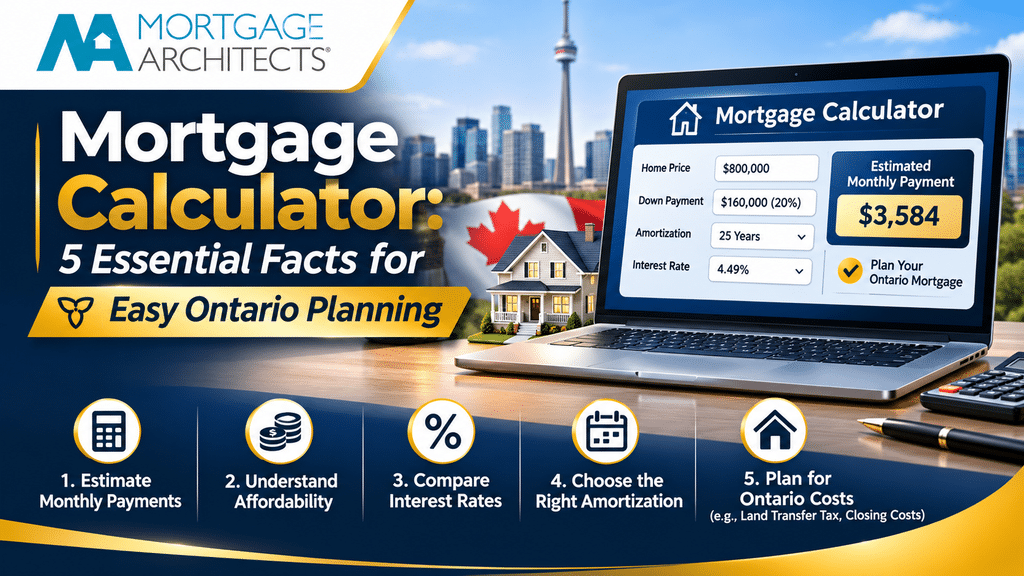
The mortgage calculator is one of the most useful tools for Ontario buyers to estimate what your regular mortgage payment could look like—before you ever apply.
Written by Satish Kumar, Licensed Mortgage Agent with Mortgage Architects (12728). Last updated November 4, 2026.
Quick answer
A mortgage calculator estimates your regular payment by using your mortgage amount, interest rate, amortization period, and payment frequency. It helps you compare options, but it is not a lender approval or a full measure of how much home you can truly afford.
Key takeaways
- A mortgage calculator gives a payment estimate, not a guarantee or pre-approval.
- Use it to compare interest rates, down payments, amortization periods, and payment schedules.
- If your down payment is under 20%, the result usually includes required mortgage loan insurance premiums.
- The result is only principal and interest; plan for property taxes, insurance, and utilities on top.
- For full affordability, combine it with a calculator that covers all debts, income, and living costs.
What is a mortgage calculator and why do Ontario buyers use it?
A mortgage calculator is a planning tool that estimates how much your mortgage payment will be based on your expected rate, loan amount, amortization, and payment schedule.
People use it to run quick “what-if” scenarios and get a sense of the monthly (or biweekly) payment for different homes and down payments. It’s especially helpful before meeting a lender or making an offer.
First-time homebuyers in Durham and the GTA, as well as investors, business owners, and healthcare professionals, often rely on this tool to understand how rates, amortization period, and payment frequency all change their budget. But remember: the calculator only shows an estimate, not the monthly cost a lender will approve or a binding offer.
How does a mortgage calculator work?
A mortgage calculator takes details you enter—like house price, down payment, interest rate, loan period, and payment schedule—and gives you a sample mortgage payment result.
- Mortgage amount: The total you want to borrow (often home price minus down payment, plus any insurance premiums if your down payment is under 20%).
- Interest rate: The rate you might pay, based on your research or advice from a professional.
- Amortization period: The number of years to pay off the entire mortgage (often 25 or 30 years).
- Payment frequency: Monthly, biweekly, or weekly.
Results help you see:
- How different rates affect your payment.
- The impact of a larger or smaller down payment.
- Why a longer amortization lowers the monthly payment—but costs more in total interest paid.
For example, here’s how changing the amortization period or down payment can impact your payment, for a $700,000 home:
| Scenario | Down Payment | Amortization | Sample Monthly Payment* |
|---|---|---|---|
| 1 | 20% ($140,000) | 25 years | $3,012 |
| 2 | 10% ($70,000) | 25 years | $3,330 (includes insurance) |
| 3 | 10% ($70,000) | 30 years | $3,116 (includes insurance) |
| 4 | 20% ($140,000) | 30 years | $2,813 |
*All numbers are examples only. Actual mortgage rates and payments may differ and are not guaranteed.
What should you enter in a mortgage calculator?
Enter your expected down payment, the home price you want, an interest rate reflecting current trends, and your preferred amortization and payment schedule.
For buyers with less than 20% down, verify if the calculator includes mortgage insurance premiums within the loan total. Most calculators (including CMHC’s) add the premium automatically on eligible homes under $1.5 million.
- Try several interest rates to see how a small difference changes your payment.
- Compare monthly and accelerated biweekly payments.
- If you are a first-time buyer or considering a new build, know that insured amortizations may be up to 30 years—check eligibility as rules vary.
What does a mortgage calculator not tell you?
A mortgage calculator does not show your total monthly home cost or guarantee approval from any lender.
- It only includes principal and interest—not property taxes, utilities, home insurance, or condo fees.
- It does not account for your actual household income, debt, or other financial obligations.
- It does not assess your qualification under lender requirements or stress test rules.
Your regular mortgage payment is only one part of homeownership costs. Use a full affordability calculator—like the tools linked in the CMHC guide to planning and managing your mortgage—to get the full picture.
How do mortgage insurance premiums affect the calculator for less than 20% down?
If your down payment is under 20%, mortgage loan insurance is usually required in Canada and will increase your monthly payment.
The calculator will automatically include the premium in your balance if your inputted home price is below $1.5 million and your down payment is lower than 20%. This makes your total mortgage higher than just the price minus the down payment, so your payment is a bit higher than it would be with a larger down payment.
Check that you meet the eligibility rules, especially if considering a longer amortization or a home near $1.5 million. The result is only an estimate—the actual premium and payment could change based on the final purchase price and your specific details.
When should an Ontario buyer use a mortgage calculator—and when is it not enough?
Use a mortgage calculator early in your buying journey to understand potential payments on homes you are interested in.
But do not rely on it as your only budgeting tool, or as a sign a lender will approve your mortgage. When you are serious about a property, also use debt-servicing or affordability tools, and consult with a mortgage professional who can help verify what you qualify for under real lending rules.
The Financial Consumer Agency of Canada also offers resources on what to know about borrowing and mortgages.
What this means for Ontario homebuyers
A mortgage calculator is a great first step to understanding how your payment changes across scenarios, but it is not a true qualification. For an accurate plan:
- Try different rates, down payments, and amortizations in the calculator.
- Include estimated mortgage insurance if your down payment is less than 20%.
- Add property tax, insurance, and other housing costs on top of your payment estimate.
- Check the full cost using an affordability or debt-servicing calculator.
- Before making any offers, confirm all numbers with your mortgage professional.
Frequently asked questions
Does a mortgage calculator tell me if I can get a mortgage?
No, a mortgage calculator only provides payment estimates based on your inputs. It does not consider your income, credit score, or any lender’s qualification rules. Approval depends on factors a calculator does not capture.
Is mortgage loan insurance always included in the calculator result?
If your down payment is less than 20% and the home price is under $1.5 million, most calculators include the estimated CMHC insurance premium in the mortgage amount. Always double-check the details and eligibility rules before relying on the number.
What costs are missing from a mortgage calculator result?
A mortgage calculator only estimates principal and interest. It does not include property taxes, home insurance, utilities, or condominium fees—these must be added when making your budget or calculating your total homeownership cost.
Can I use a mortgage calculator if I am self-employed?
Yes, anyone can use a mortgage calculator, including self-employed buyers, to estimate payments. However, lenders may use additional criteria, so your real qualification could differ from the calculator’s estimate. Consult a mortgage agent for guidance specific to your situation.
Where can I find trustworthy information about mortgages in Ontario?
The FSRA, Ontario’s financial regulator, and the Bank of Canada offer reliable information on mortgage rules, resources, and economic updates. Always use reputable tools and consult professionals when planning your home purchase.
Ready to talk about your specific mortgage needs, payment estimates, or strategies? Book a free discovery call with Satish Kumar here and explore your options at no obligation.
Related Guides From Satish
Official Resources
- Mortgages: what to know (Financial Consumer Agency of Canada)
- Financial Services Regulatory Authority of Ontario (FSRA)
Disclaimer: This information is for general educational purposes and is not mortgage advice, financial advice, or a personalized recommendation. Mortgage rates, insurance premiums, and rules can change and may vary by lender, borrower, and property type. Please consult appropriate professionals for personalized advice.