Author: Satish Kumar, Mortgage Agent Level 2
Last Updated: July 2026
Reading Time: Approximately 20 Minutes
Executive Summary
Buying a home is one of the biggest financial decisions most Canadians will ever make, and your down payment is one of the most important parts of that journey. Many buyers believe they need a 20% down payment before they can purchase a home, while others assume that putting down only 5% is always the smartest choice. The truth lies somewhere in between.
The amount you choose as a down payment affects much more than whether you qualify for a mortgage. It influences your monthly payment, mortgage insurance costs, borrowing power, interest paid over time, financial flexibility, and even the types of properties you may be eligible to purchase.
This comprehensive guide explains how down payments work in Canada, outlines the current minimum requirements, discusses mortgage default insurance, compares different down payment strategies, and highlights programs that can help first-time home buyers. Throughout the guide, you’ll find practical Ontario examples, expert insights, comparison tables, and actionable advice to help you make informed decisions.
Whether you’re buying your first home, moving to a larger property, investing in real estate, or returning to the housing market after several years, understanding your down payment options can help you choose a mortgage strategy that supports both your immediate needs and your long-term financial goals.
Quick Answer
In Canada, the minimum down payment depends on the home’s purchase price. Buyers typically need at least 5% of the first portion of the purchase price, with higher minimum requirements applying as the purchase price increases. A down payment of less than 20% generally requires mortgage default insurance, while a down payment of 20% or more usually avoids this requirement. Individual lender policies and borrower qualifications may also affect mortgage options.
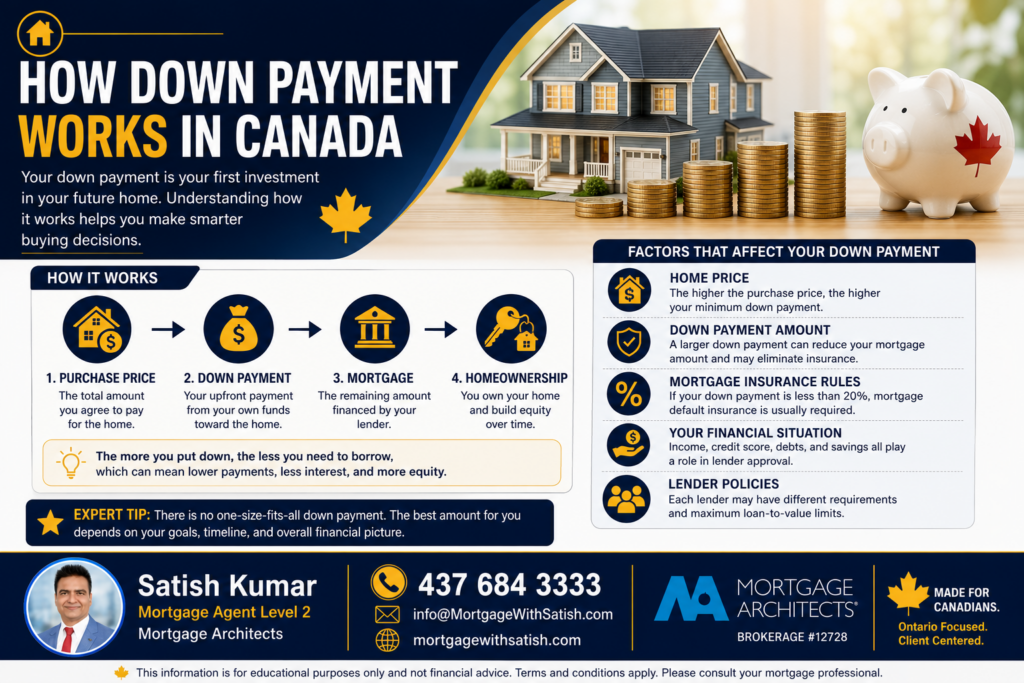
A down payment is the portion of a home’s purchase price that you pay upfront from your own funds. In Canada, the minimum down payment varies based on the home’s purchase price and applicable lending rules. A larger down payment can reduce your mortgage balance, lower borrowing costs, and may eliminate the need for mortgage default insurance.
Key Takeaways
- A down payment is your initial investment when buying a home.
- The required minimum depends on the property’s purchase price and applicable lending rules.
- A larger down payment generally reduces your mortgage amount and monthly payments.
- Buyers with less than a 20% down payment typically require mortgage default insurance.
- Government programs such as the FHSA and Home Buyers’ Plan may help eligible buyers save for a down payment.
- Choosing the right down payment strategy depends on your financial goals, cash flow, and long-term plans.
Table of Contents
Introduction
Buying a home is exciting, but it also comes with many financial decisions. One of the first questions almost every buyer asks is:
“How much down payment do I really need?”
Unfortunately, there is no one-size-fits-all answer.
Some buyers are eager to purchase as soon as they have saved enough for the minimum down payment. Others prefer to wait until they have accumulated a larger amount to reduce their mortgage and avoid mortgage default insurance. Both approaches can be appropriate depending on your income, savings, long-term plans, and comfort with monthly payments.
As an Ontario Mortgage Agent, I’ve worked with buyers in many different situations. Some clients have excellent incomes but limited savings. Others have substantial savings and want to decide whether investing more in a down payment or keeping funds available for renovations, emergencies, or investments makes more financial sense.
The right strategy is not simply about meeting the minimum requirement—it’s about choosing an approach that aligns with your overall financial goals.

What Is a Down Payment?
A down payment is the portion of a home’s purchase price that you pay upfront using your own funds before your mortgage is advanced.
The remaining balance is financed through your mortgage lender.
For example:
| Home Purchase Price | Down Payment | Mortgage Amount |
|---|---|---|
| $600,000 | $60,000 | $540,000 |
| $800,000 | $120,000 | $680,000 |
| $1,000,000 | $200,000 | $800,000 |
Your down payment represents your initial ownership, often referred to as equity, in the property. As you make mortgage payments and, potentially, as your home’s value changes over time, your equity may increase.
A larger down payment generally means:
- Lower mortgage principal.
- Lower monthly mortgage payments.
- Reduced interest costs over the life of the mortgage.
- Greater financial flexibility.
However, using every dollar you have for a down payment isn’t always the best choice. Maintaining an emergency fund and budgeting for closing costs and future expenses are also important considerations.
Satish’s Expert Insight
Over the years, I’ve seen many buyers focus solely on reaching a specific down payment percentage while overlooking their overall financial picture. A strong home-buying strategy balances the down payment with emergency savings, moving costs, and future financial goals. The best mortgage isn’t always the one with the biggest down payment—it’s the one that supports long-term financial stability.
Key Takeaways
- A down payment is your upfront investment in the property.
- It directly affects your mortgage amount and borrowing costs.
- Bigger isn’t always better if it leaves you financially stretched.
- Your overall financial health should guide your decision.
Why Is Your Down Payment So Important?
Your down payment is much more than the amount needed to qualify for a mortgage. It influences nearly every aspect of your home purchase—from the type of mortgage you qualify for to your monthly payment, borrowing costs, and long-term financial flexibility.
A well-planned down payment strategy can help you purchase a home with confidence while protecting your financial future.
Let’s look at the biggest ways your down payment affects your mortgage.
1. It Determines Whether You Need Mortgage Default Insurance
One of the most significant effects of your down payment is whether your mortgage requires mortgage default insurance.
In Canada, borrowers who make a down payment of less than 20% generally need mortgage default insurance. This insurance protects the lender—not the borrower—if the mortgage goes into default.
Although the insurance premium increases the overall cost of borrowing, it also makes homeownership possible for many Canadians who haven’t yet saved a 20% down payment.
Without mortgage default insurance, many first-time buyers would need to wait several more years before purchasing a home.
Example
Imagine two buyers purchasing similar homes.
Buyer A
- Down payment below 20%
- Mortgage default insurance required
- Can purchase sooner
Buyer B
- Down payment of 20% or more
- No mortgage default insurance
- Needs more time to save
Neither approach is automatically better.
The right choice depends on your income, savings, long-term goals, and comfort with monthly payments.
Satish’s Expert Insight
One of the biggest misconceptions I hear is:
“I should wait until I save 20%.”
Sometimes that’s the right decision.
Sometimes it isn’t.
If home prices continue rising while you’re saving, waiting several years could mean paying considerably more for the same property. On the other hand, if buying with the minimum down payment leaves your monthly budget too tight, waiting may be the wiser choice.
Every situation deserves an individual mortgage strategy rather than a one-size-fits-all rule.
Key Takeaways
- Less than 20% down generally requires mortgage default insurance.
- Mortgage insurance helps many Canadians buy sooner.
- Waiting for 20% is not always the best financial decision.
- Your complete financial picture matters more than one percentage.
2. Your Down Payment Directly Affects Your Monthly Mortgage Payment
Every additional dollar you contribute as a down payment reduces the amount you need to borrow.
A smaller mortgage usually means:
- Lower monthly payments
- Less interest over the life of the mortgage
- Improved cash flow
- More flexibility in your monthly budget
Comparison Table: Higher vs. Lower Down Payment
| Feature | Smaller Down Payment | Larger Down Payment |
|---|---|---|
| Mortgage Amount | Higher | Lower |
| Monthly Payment | Higher | Lower |
| Interest Paid Over Time | Higher | Lower |
| Cash Remaining After Closing | More | Less |
| Mortgage Default Insurance | Usually Required | Often Not Required |
| Financial Flexibility | Higher initially | Lower initially |
A larger down payment can save money over the long term, but using all of your savings isn’t always advisable.
Ontario Example
Suppose a couple in Ajax has saved enough to put nearly all of their savings toward a larger down payment.
After discussing their goals, they decide to keep part of their savings for:
- Emergency expenses
- Furniture
- Moving costs
- Minor renovations
- Unexpected home repairs
Although their mortgage is slightly larger, they enter homeownership with greater financial confidence.
Key Takeaways
- Larger down payments reduce your mortgage balance.
- Lower mortgage balances generally reduce monthly payments.
- Keeping some savings after closing can improve financial security.
- The goal is balance—not simply the biggest possible down payment.
3. Your Down Payment Can Affect Your Mortgage Options
Different mortgage products and lender policies may vary depending on:
- Down payment amount
- Property type
- Occupancy
- Credit profile
- Income verification
For example:
- Owner-occupied homes may have different lending options than investment properties.
- Newly built homes can have different requirements than resale properties.
- Individual lenders may apply additional underwriting guidelines.
Because lending policies can differ, working with an experienced mortgage professional helps ensure you’re exploring the most suitable options available for your situation.
Key Takeaways
- Down payment is only one part of mortgage qualification.
- Lender policies may differ.
- Property type also influences available mortgage options.
- Professional advice can help identify the most appropriate solution.
How Much Down Payment Do You Need in Canada?
One of the most common questions home buyers ask is:
“Exactly how much down payment do I need?”
The answer depends primarily on the purchase price of the home and the applicable lending rules.
Rather than one fixed percentage, Canada uses a tiered approach for many residential purchases.
General Down Payment Framework
The minimum required down payment increases as the purchase price increases.
Understanding these thresholds is important because they determine:
- Your minimum cash requirement.
- Whether mortgage default insurance is generally required.
- Your financing strategy.
Always confirm the current requirements with your lender or mortgage professional, as lending rules and insurer guidelines may change over time.
Comparison Table: Typical Down Payment Categories
| Home Purchase Price | Typical Minimum Requirement* | Mortgage Insurance |
|---|---|---|
| Lower-priced homes | Lower minimum percentage | Generally Required if under 20% |
| Mid-priced homes | Tiered calculation | Generally Required if under 20% |
| Higher-priced homes | Higher minimum requirements may apply | Depends on applicable rules |
*Actual requirements depend on current Canadian lending rules and the specific transaction.
Why Are the Rules Structured This Way?
The tiered approach is designed to balance two important objectives:
- Help Canadians become homeowners without needing to save an extremely large down payment.
- Manage lending risk as property values increase.
This structure allows many qualified buyers to enter the housing market sooner while maintaining prudent lending practices.
Ontario Scenario
A first-time buyer in Durham Region is considering two similar homes with different purchase prices.
Although both properties meet the family’s needs, the required down payment and overall financing structure differ because of the purchase price.
Reviewing the numbers before making an offer helps the buyer understand:
- Total cash required.
- Closing costs.
- Monthly affordability.
- Long-term financial impact.
This type of planning often prevents surprises later in the home-buying process.
Satish’s Expert Insight
Many buyers spend weeks searching for homes before confirming how much cash they’ll actually need to complete the purchase.
I recommend reversing that process.
Understand your complete budget—including your down payment, closing costs, and monthly affordability—before you start shopping. It makes the buying experience smoother and gives you greater confidence when it’s time to make an offer.
Key Takeaways
- Down payment requirements vary based on the home’s purchase price.
- Planning your total cash requirements early can reduce stress later.
- Your affordability depends on more than just the minimum down payment.
- A pre-approval can help you understand your purchasing power before you begin your home search.
Understanding Mortgage Default Insurance
One of the most misunderstood aspects of buying a home in Canada is mortgage default insurance.
Many buyers assume it’s another type of home insurance or believe it protects them if they lose their job or experience financial hardship. In reality, that’s not how mortgage default insurance works.
Understanding why it exists and how it affects your mortgage can help you make a more informed home-buying decision.
What Is Mortgage Default Insurance?
Mortgage default insurance is insurance that protects the mortgage lender if a borrower is unable to repay the mortgage.
Although the borrower pays the insurance premium, the coverage protects the lender—not the homeowner.
For many Canadians, mortgage default insurance makes homeownership possible because it allows lenders to offer financing with smaller down payments while managing lending risk.
Without this system, many buyers would likely need much larger down payments before qualifying for a mortgage.
Why Does Mortgage Default Insurance Exist?
Mortgage lending involves risk.
When buyers contribute a smaller down payment, the lender is financing a larger percentage of the home’s value. Mortgage default insurance helps reduce that risk and supports access to homeownership for qualified borrowers who may not yet have saved a large down payment.
This has helped many Canadians purchase homes years earlier than they otherwise might have.
Key Takeaways
- Mortgage default insurance protects the lender.
- The borrower pays the premium.
- It supports homeownership with smaller down payments.
- It is different from home insurance or mortgage life insurance.
Who Usually Needs Mortgage Default Insurance?
In general, mortgage default insurance is required when the down payment is less than 20% of the home’s purchase price, subject to applicable Canadian lending rules and insurer guidelines.
Once a buyer contributes 20% or more, the mortgage is typically considered conventional, meaning mortgage default insurance is generally not required.
However, lender policies and specific transaction details can vary.
Does Paying Mortgage Insurance Mean You’re Making a Bad Financial Decision?
Absolutely not.
This is one of the biggest myths in Canadian real estate.
Many financially successful homeowners purchased their first property with less than a 20% down payment.
Sometimes purchasing sooner can be a smarter long-term financial decision than waiting several years to save a larger down payment—particularly if home prices rise during that period.
The right decision depends on:
- Income stability
- Monthly affordability
- Savings habits
- Long-term financial goals
- Personal comfort with debt
There is no universal answer.
Satish’s Expert Insight
One conversation I have regularly with first-time buyers is whether paying mortgage default insurance is “worth it.”
Instead of focusing only on the insurance premium, I encourage clients to compare the total cost of waiting versus buying now. Waiting may allow for a larger down payment, but it can also mean higher home prices, higher rents, or missed opportunities to build home equity. The best choice depends on the individual’s circumstances, not on a single rule of thumb.
Key Takeaways
- Paying mortgage default insurance is not automatically a disadvantage.
- Buying sooner may be beneficial in some situations.
- Waiting may be appropriate in others.
- A personalized affordability review is essential.
Mortgage Default Insurance vs. Home Insurance
These two types of insurance serve completely different purposes.
Many buyers confuse them.
Comparison Table: Mortgage Default Insurance vs. Home Insurance
| Mortgage Default Insurance | Home Insurance |
|---|---|
| Protects the lender | Protects the homeowner |
| May be required with smaller down payments | Typically required by lenders before closing |
| Premium is generally added to the mortgage | Paid directly to the insurance provider |
| Covers lender risk | Covers damage, theft, liability, and other insured events |
| Governed by mortgage lending requirements | Chosen based on the property’s insurance needs |
Understanding the distinction helps avoid confusion during the mortgage approval process.
Key Takeaways
- These are two separate products.
- One protects the lender.
- The other protects your home and personal property.
- Most homeowners will encounter both during the home-buying process.
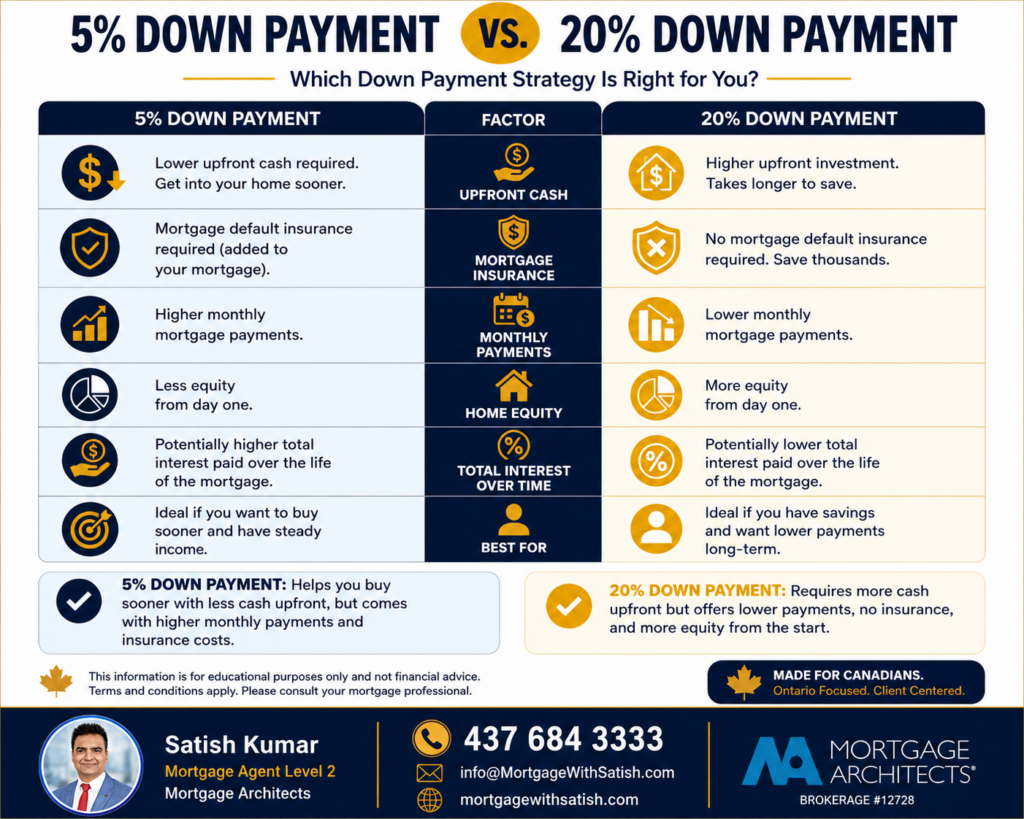
5% Down Payment vs. 20% Down Payment
This is one of the most common questions home buyers ask.
“Should I buy now with a smaller down payment or wait until I have 20%?”
There is no single correct answer.
Let’s compare the advantages and considerations of each approach.
Option 1 — Buying with a Smaller Down Payment
Many Canadians choose this option because it allows them to enter the housing market sooner.
Potential Advantages
- Purchase a home earlier.
- Continue building home equity rather than renting.
- Preserve some savings for emergencies or renovations.
- Take advantage of available home-buying programs if eligible.
Considerations
- Mortgage default insurance is generally required.
- Monthly payments may be higher because the mortgage balance is larger.
- Interest costs over time may also be higher.
Option 2 — Buying with a 20% Down Payment or More
Some buyers prefer waiting until they have accumulated more savings.
Potential Advantages
- Mortgage default insurance is generally not required.
- Lower mortgage balance.
- Lower monthly payments.
- Greater home equity from day one.
Considerations
- Saving the additional funds may take longer.
- Home prices may change while you’re saving.
- Delaying a purchase may affect your long-term plans.
Comparison Table: 5% vs. 20% Down Payment
| Feature | Smaller Down Payment | 20% or More Down |
|---|---|---|
| Time to Buy | Often Sooner | May Take Longer |
| Mortgage Balance | Higher | Lower |
| Monthly Payment | Higher | Lower |
| Mortgage Default Insurance | Generally Required | Generally Not Required |
| Cash Remaining After Purchase | Usually More | Usually Less |
| Initial Home Equity | Lower | Higher |
| Financial Flexibility | May Be Greater | Depends on Remaining Savings |
Ontario Scenario #1
A young professional in Toronto has enough savings for the minimum down payment but would need another three years to save 20%.
After reviewing their income, budget, and long-term plans, they decide purchasing sooner better aligns with their financial goals.
The decision allows them to begin building home equity while maintaining an emergency fund.
Ontario Scenario #2
A family in Whitby plans to move into their long-term home.
Because they have significant savings and prefer lower monthly payments, they decide to contribute a larger down payment.
Their priority is reducing debt rather than preserving cash.
Both families made good decisions because each strategy reflected their own financial circumstances.
Satish’s Expert Insight
I’ve seen buyers regret stretching every dollar into a down payment, only to face unexpected expenses shortly after moving in. I’ve also seen buyers who waited too long, only to discover that higher home prices offset much of the benefit of saving a larger down payment.
The goal isn’t simply to reach a specific percentage. It’s to purchase a home with confidence while maintaining financial flexibility for life’s unexpected events.
Key Takeaways
- Both strategies can be appropriate.
- The best down payment depends on your goals—not someone else’s.
- Consider monthly affordability, emergency savings, and long-term plans together.
- A mortgage strategy should support your overall financial well-being.
Pros and Cons of Making a Larger Down Payment
Before deciding to use all of your savings toward a home purchase, it’s important to consider both the advantages and the trade-offs.
Comparison Table: Pros vs. Cons of a Larger Down Payment
| Advantages | Considerations |
|---|---|
| Lower mortgage balance | Less cash available after closing |
| Lower monthly payments | Smaller emergency fund |
| Lower interest costs over time | Less flexibility for renovations or investments |
| Greater home equity | Longer time required to save |
| May avoid mortgage default insurance | Opportunity cost of using savings |
There is no universally “perfect” down payment.
The right choice balances affordability, financial security, and long-term objectives.
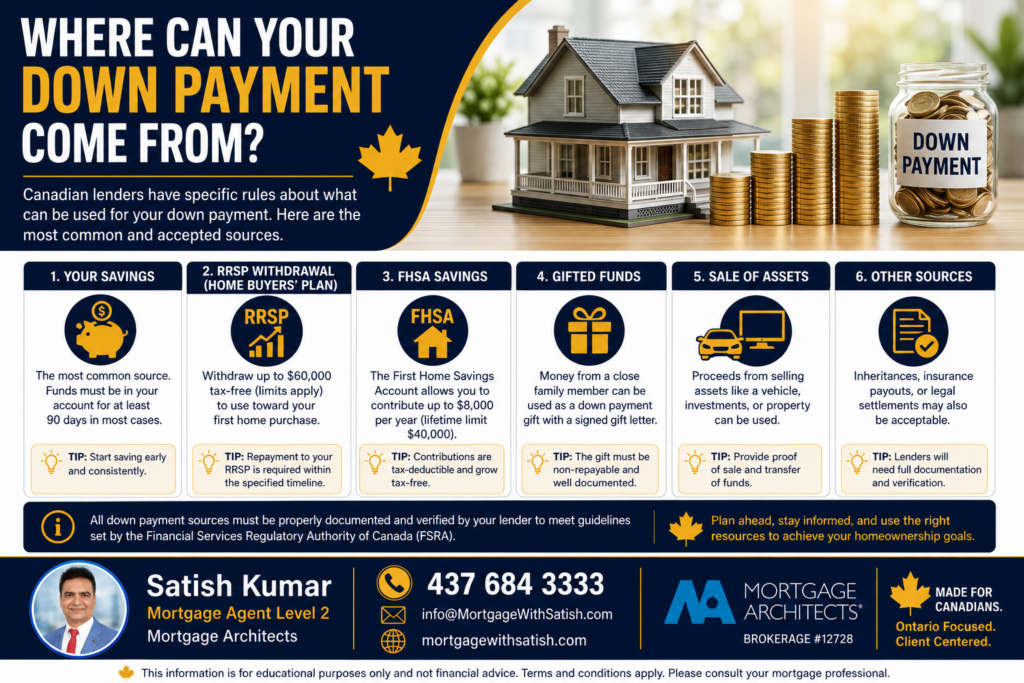
Where Can Your Down Payment Come From?
Saving for a down payment is often the biggest hurdle for home buyers. Fortunately, Canadian lenders recognize that buyers may accumulate their down payment from several legitimate sources.
Before you make an offer on a property, it’s important to understand where your funds can come from and what documentation may be required during the mortgage approval process.
Planning ahead can help avoid delays and make the buying process much smoother.
Common Sources of a Down Payment
Depending on your circumstances, your down payment may come from one or more of the following:
- Personal savings
- Tax-Free First Home Savings Account (FHSA)
- RRSP withdrawals through the Home Buyers’ Plan (HBP)
- Non-registered investments
- Gifted funds from immediate family (subject to lender requirements)
- Proceeds from the sale of another property
- Certain employer or relocation assistance programs
- Other acceptable sources that satisfy lender and regulatory requirements
Lenders generally ask borrowers to demonstrate that the funds are from an acceptable source and are available before closing.
Comparison Table: Common Down Payment Sources
| Source | Typical Benefits | Important Considerations |
|---|---|---|
| Personal Savings | Simple and flexible | Requires consistent saving |
| FHSA | Potential tax advantages for eligible buyers | Subject to government program rules |
| RRSP Home Buyers’ Plan | Access retirement savings under program rules | Funds generally need to be repaid to the RRSP over time |
| Gifted Funds | Helps buyers purchase sooner | Documentation is usually required |
| Sale of Existing Home | May provide substantial equity | Depends on timing of sale |
| Investments | Can supplement savings | Consider market conditions and potential tax implications |
Satish’s Expert Insight
Many buyers use more than one source for their down payment. For example, someone might combine personal savings with FHSA funds and a family gift. Starting these conversations early allows your mortgage professional to identify any documentation requirements well before closing.
Key Takeaways
- Down payments can come from several acceptable sources.
- Combining multiple sources is common.
- Documentation is an important part of the mortgage process.
- Early planning helps prevent delays.
Understanding the First Home Savings Account (FHSA)
The First Home Savings Account (FHSA) is designed to help eligible Canadians save for their first home.
It combines features commonly associated with both savings and investment accounts while providing valuable tax advantages for eligible participants under the program’s rules.
For many first-time buyers, the FHSA has become one of the most effective ways to build a down payment.
Why the FHSA Is So Valuable
The FHSA can help buyers:
- Save for a home in a tax-efficient manner.
- Build their down payment faster.
- Keep investments growing while preparing for homeownership.
- Combine with other eligible home-buying programs where permitted.
Because government programs can change over time, it’s important to review the current eligibility requirements before making contributions or withdrawals.
Ontario Example
Sarah, a first-time home buyer in Oshawa, plans to purchase her first condominium within the next few years.
Instead of keeping all of her savings in a regular account, she contributes to an FHSA while continuing to save monthly. Over time, her disciplined approach helps her build a stronger down payment while taking advantage of the program’s available benefits.
Satish’s Expert Insight
One of the biggest mistakes I see is waiting until you’re actively house hunting before learning about the FHSA. Even if buying a home is still a few years away, understanding this program early can make a meaningful difference to your long-term savings strategy.
Key Takeaways
- The FHSA is designed for eligible first-time home buyers.
- Starting early may help you build your down payment more effectively.
- Review the latest government rules before making financial decisions.
- Consider discussing the FHSA with your financial advisor or tax professional.
Understanding the Home Buyers’ Plan (HBP)
The Home Buyers’ Plan (HBP) allows eligible buyers to withdraw funds from their Registered Retirement Savings Plan (RRSP) to help purchase or build a qualifying home, subject to current program rules.
Unlike a standard RRSP withdrawal, eligible withdrawals under the HBP are generally intended to be repaid to the RRSP over time.
Because the program has specific eligibility and repayment requirements, buyers should understand how it fits into their long-term financial plan.
Advantages of the Home Buyers’ Plan
Potential benefits include:
- Accessing existing retirement savings.
- Increasing the available down payment.
- Potentially reducing the amount that needs to be borrowed.
- Combining with other eligible home-buying programs where permitted.
Things to Consider
Before using the HBP, buyers should consider:
- Future repayment obligations.
- The impact on long-term retirement savings.
- Current government program requirements.
- Their overall financial goals.
Comparison Table: FHSA vs. Home Buyers’ Plan
| Feature | FHSA | Home Buyers’ Plan |
|---|---|---|
| Primary Purpose | Save for a first home | Use existing RRSP savings |
| Funding Source | New contributions | Existing RRSP funds |
| Designed For | Eligible first-time buyers | Eligible home buyers meeting program rules |
| Long-Term Consideration | Ongoing savings strategy | RRSP repayment requirements |
Satish’s Expert Insight
Many buyers ask me whether they should use the FHSA or the Home Buyers’ Plan. The answer isn’t always one or the other. Depending on your circumstances and the applicable program rules, using both strategically may help strengthen your overall home-buying plan.
Key Takeaways
- The HBP provides access to eligible RRSP savings.
- Repayment obligations are an important consideration.
- The FHSA and HBP serve different purposes.
- Professional advice can help determine the most appropriate strategy.
Can Your Down Payment Be a Gift?
Yes.
Many first-time home buyers receive financial assistance from parents or immediate family members.
This can significantly reduce the time required to save for a home.
However, lenders generally require documentation confirming that the funds are a genuine gift rather than a loan.
Requirements may vary between lenders.
Why Documentation Matters
Lenders want to understand:
- Where the funds originated.
- Whether repayment is expected.
- That the gift complies with lender guidelines.
Providing documentation early can help avoid unnecessary delays during underwriting.
Ontario Example
A couple purchasing their first home in Markham receives financial assistance from their parents to supplement their savings. By providing the required gift documentation early in the process, they avoid delays and move through mortgage approval more smoothly.
Key Takeaways
- Gifted funds may help buyers enter the housing market sooner.
- Documentation is generally required.
- Lender policies may differ.
- Discuss gifted funds with your mortgage professional before making an offer.
Don’t Forget About Closing Costs
One of the most common mistakes first-time buyers make is focusing entirely on the down payment while overlooking the other costs involved in completing a home purchase.
Closing costs are separate from your down payment and should be included in your home-buying budget.
Depending on your transaction, these costs may include items such as:
- Legal fees and disbursements
- Land transfer taxes (where applicable)
- Title insurance
- Home inspection fees
- Property appraisal (if required)
- Adjustments for property taxes or utilities
- Moving expenses
- Utility connection charges
Some buyers also choose to budget for immediate repairs, furniture, or renovations after taking possession.
Practical Home Buyer Checklist
Before making an offer, consider whether you’ve planned for:
✅ Down payment
✅ Closing costs
✅ Emergency savings
✅ Moving expenses
✅ Furniture and appliances
✅ Utility setup
✅ Home maintenance
✅ Unexpected repairs
Satish’s Expert Insight
One of the best feelings for a buyer is receiving the keys to their new home. One of the most stressful experiences is realizing there isn’t enough money left to cover unexpected expenses after closing. A complete home-buying budget should include far more than just the down payment.
Key Takeaways
- Budget for both your down payment and your closing costs.
- Keep an emergency fund whenever possible.
- Planning ahead reduces financial stress.
- A complete budget leads to a more confident home-buying experience.
Section Summary
By understanding where your down payment can come from—and by preparing for closing costs—you’ll be in a much stronger position when it’s time to purchase your home. Programs like the FHSA and Home Buyers’ Plan can support eligible buyers, while gifted funds and careful budgeting may make homeownership more achievable. The key is to start planning early and ensure your financing strategy aligns with your long-term financial goals.
Common Down Payment Mistakes to Avoid
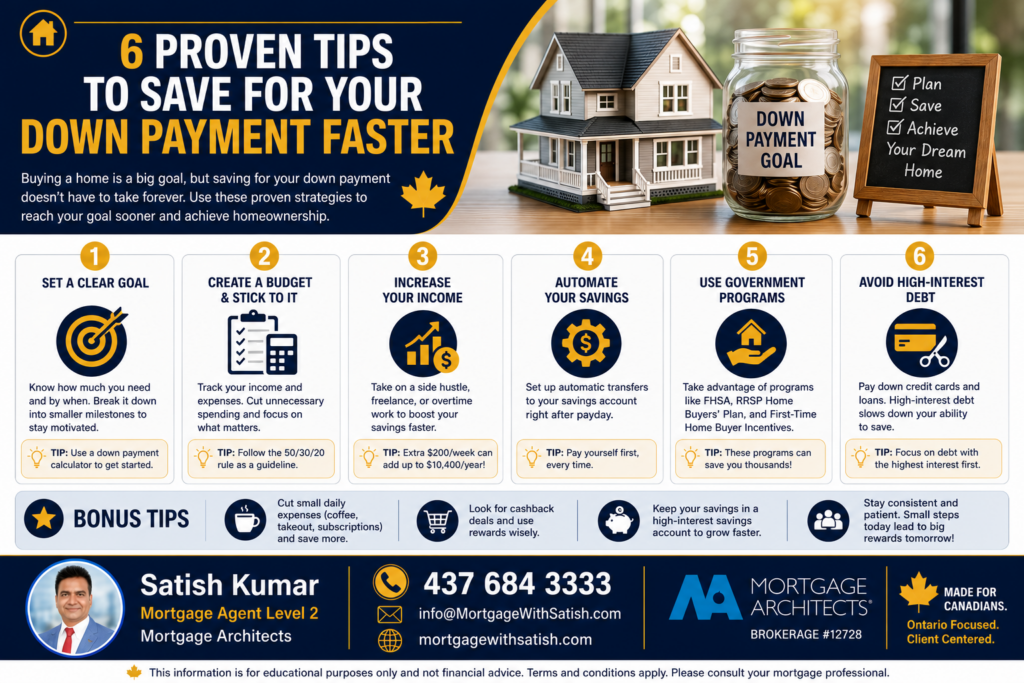
Even well-prepared home buyers can make costly mistakes when planning their down payment. Understanding these common pitfalls can help you avoid unnecessary stress and make more confident financial decisions.
1. Focusing Only on the Minimum Down Payment
Qualifying with the minimum down payment doesn’t necessarily mean it’s the best financial decision.
Ask yourself:
- Will I still have emergency savings?
- Can I comfortably afford my monthly payments?
- Have I budgeted for closing costs?
- Am I financially prepared for homeownership?
Buying a home should strengthen your financial future—not create unnecessary pressure.
2. Forgetting About Closing Costs
Many buyers save enough for the down payment but underestimate the additional costs involved in completing the purchase.
Planning ahead can help prevent last-minute surprises.
3. Emptying Your Savings Account
Using every dollar for your down payment may leave you unprepared for:
- Appliance replacement
- Emergency repairs
- Job interruptions
- Moving expenses
- Unexpected household costs
Maintaining an emergency fund is often just as important as making a larger down payment.
4. Waiting Forever for the “Perfect” Down Payment
Some buyers postpone purchasing because they believe they must reach a specific savings target.
While waiting may make sense for some people, others may discover that rising home prices or changing market conditions outweigh the benefits of delaying their purchase.
5. Taking Financial Advice From Social Media
Mortgage decisions should be based on your own financial circumstances—not on general advice from friends, family, or social media influencers.
Every buyer’s situation is different.
Satish’s Expert Insight
The happiest homeowners I’ve worked with aren’t always the ones who made the largest down payment. They’re the ones who purchased a home they could comfortably afford while maintaining financial flexibility. Homeownership is a long-term journey, and your mortgage strategy should support that journey.
Key Takeaways
- Think beyond the minimum down payment.
- Budget for all home-buying costs.
- Protect your emergency savings.
- Make decisions based on your own financial goals.
Myths vs. Facts
| Myth | Fact |
|---|---|
| You always need a 20% down payment. | Many qualified buyers purchase with less than 20%, depending on applicable lending rules. |
| Mortgage default insurance protects the buyer. | It generally protects the lender. |
| Bigger down payments are always better. | Not if they leave you without emergency savings or financial flexibility. |
| Gifted down payments aren’t allowed. | Many lenders accept gifted funds, subject to their requirements. |
| First-time buyers have only one savings option. | Eligible buyers may have access to more than one government-supported program. |
| You should always wait until you’ve saved more. | The best timing depends on your financial situation and goals. |
What is a down payment?
A down payment is the portion of a home’s purchase price that you pay upfront using your own funds. The remaining amount is typically financed through a mortgage.
How much down payment do I need in Canada?
The required amount depends on the home’s purchase price and current Canadian lending rules. Your mortgage professional can explain how these requirements apply to your situation.
Do I always need a 20% down payment?
No. Many Canadians purchase homes with less than 20% down, although mortgage default insurance is generally required in those cases.
Can I use gifted money?
In many situations, yes. Lenders generally require documentation confirming the funds are a genuine gift and meet their guidelines.
Can I combine different sources of down payment?
Yes. Many buyers combine personal savings with eligible government programs or gifted funds, subject to lender requirements.
What is mortgage default insurance?
It is insurance that generally protects the lender when a borrower has a smaller down payment.
Does mortgage default insurance benefit me?
Indirectly, yes. It helps many qualified buyers purchase a home sooner with a smaller down payment.
Should I use my FHSA?
The FHSA can be an effective savings tool for eligible first-time home buyers. Consider reviewing current program rules before making financial decisions.
Should I use the Home Buyers’ Plan?
The answer depends on your retirement savings, repayment plans, and overall financial goals.
Is a larger down payment always the better choice?
Not necessarily. Maintaining emergency savings and financial flexibility is also important.
What happens if I don’t have enough savings?
A mortgage professional can help you explore strategies, timelines, and eligible programs that may support your home-buying goals.
Can I buy an investment property with a small down payment?
Down payment requirements vary depending on occupancy, property type, and lender policies.
Do closing costs count as part of the down payment?
No. Closing costs are separate expenses that should be budgeted in addition to your down payment.
Should I become pre-approved before saving my full down payment?
A mortgage pre-approval can help you understand your purchasing power and create a realistic savings plan.
When should I speak with a mortgage professional?
Ideally, before you begin seriously shopping for a home. Early planning often leads to better financial decisions and a smoother buying experience.
Conclusion
Your down payment is one of the most important financial decisions you’ll make during the home-buying process, but it should never be considered in isolation.
The right strategy balances your upfront investment with your monthly affordability, emergency savings, long-term financial goals, and overall lifestyle.
Some buyers benefit from purchasing sooner with a smaller down payment. Others prefer to save longer and contribute more upfront. Neither approach is universally right or wrong.
The most successful home-buying decisions are based on careful planning, realistic budgeting, and professional advice tailored to your unique circumstances.
Whether you’re buying your first home, upgrading, downsizing, or investing, understanding your down payment options will help you move forward with greater confidence.
What Should You Do Next?
If You’re a First-Time Home Buyer
- Review your savings strategy.
- Learn about the FHSA and Home Buyers’ Plan.
- Estimate your total home-buying budget.
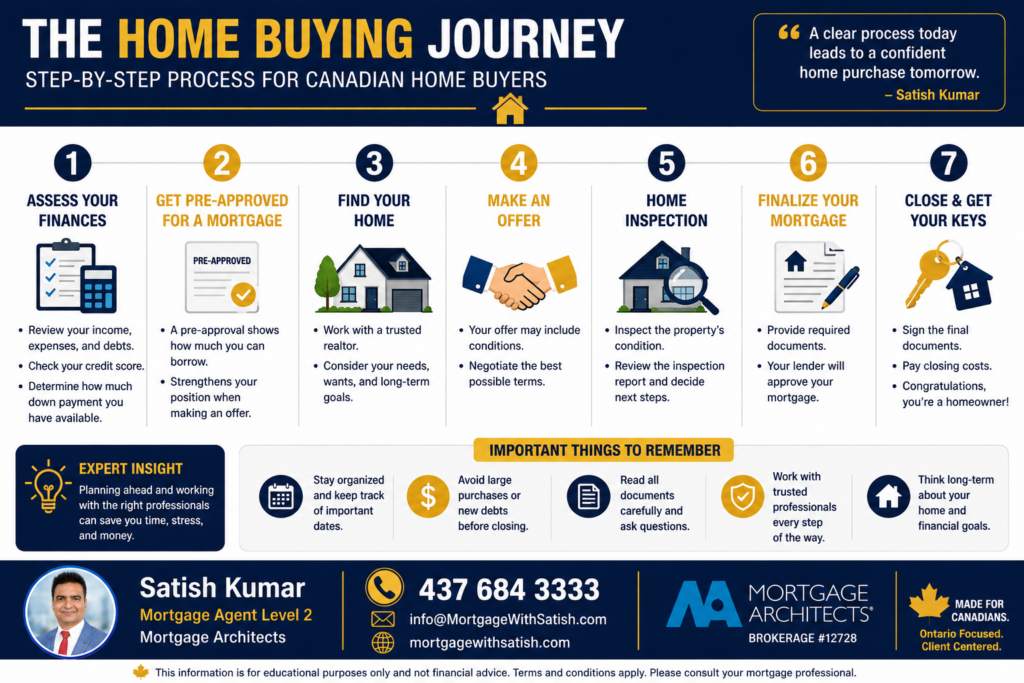
- Get pre-approved before beginning your home search.
If You’re Buying Your Next Home
- Understand how the equity from your current home can contribute to your next purchase.
- Review your monthly affordability.
- Consider the timing of your sale and purchase.
If You’re Self-Employed
- Organize your income documentation early.
- Plan your down payment well in advance.
- Discuss lender options before making an offer.
If You’re Purchasing an Investment Property
- Review financing requirements.
- Understand property-specific lending policies.
- Build a long-term investment strategy.
Satish’s Action Plan
Before purchasing your next home, work through this checklist:
✅ Determine your home-buying budget.
✅ Calculate how much down payment you have available.
✅ Budget for closing costs.
✅ Maintain an emergency fund.
✅ Review available government home-buying programs.
✅ Obtain a mortgage pre-approval.
✅ Compare mortgage options.
✅ Understand your monthly affordability.
✅ Work with an experienced mortgage professional before making an offer.
Call to Action
Buying a home is one of life’s biggest financial decisions, and choosing the right down payment strategy can make a meaningful difference to your long-term financial well-being.
If you’re planning to purchase a home in Ontario and would like guidance tailored to your circumstances, I’d be happy to help you understand your options, explain the mortgage process, and develop a financing strategy that aligns with your goals.
Whether you’re a first-time home buyer, moving to a new home, refinancing, or investing in real estate, informed decisions start with trusted advice.