
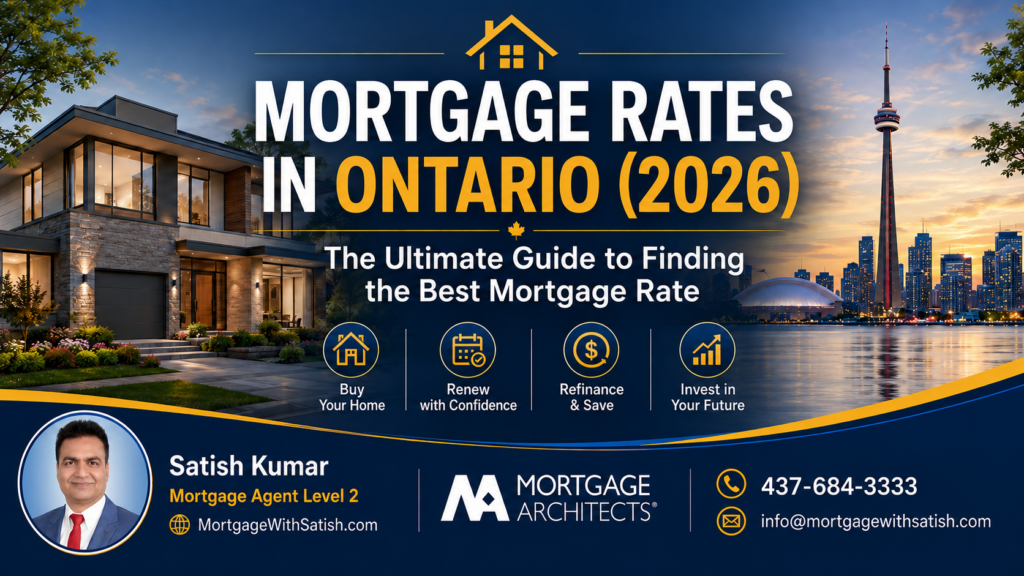
Mortgage Rates in Ontario: The Complete Homeowner’s Guide on Mortgage Rates in Ontario
Whether you’re buying your first home, renewing your mortgage, refinancing to access home equity, or investing in real estate, your mortgage interest rate is one of the most important financial factors affecting the total cost of homeownership.
Understanding Mortgage Rates in Ontario can significantly affect your financial decisions.
Even a small difference in interest rates can affect your monthly payments and the total interest you pay over the life of your mortgage.
In this guide, we will delve into the nuances of Mortgage Rates in Ontario and how they can impact your overall home financing strategy.
This guide explains how mortgage rates work in Canada, what influences them, how lenders determine the rates they offer, and practical steps you can take to improve your mortgage options. By the end, you’ll have a clearer understanding of the factors involved so you can make informed decisions based on your own financial goals.
Who This Guide Is For
This guide is designed for Ontario residents who are:
- Buying their first home
- Renewing a mortgage within the next 12 months
- Considering refinancing
- Purchasing an investment property
- Self-employed
- Comparing fixed and variable mortgage options
- Looking for ways to reduce borrowing costs
- Trying to understand how interest rates affect monthly payments
If any of these situations apply to you, this guide will help you better understand your options.
Quick Answer
Mortgage rates represent the interest charged by a lender on the money you borrow to purchase or refinance a property. The rate you receive depends on several factors, including the type of mortgage, the term, your credit profile, the size of your down payment, the property’s characteristics, and overall economic conditions.
While obtaining a competitive rate is important, the lowest rate is not always the best mortgage. Features such as prepayment privileges, portability, flexibility, penalties, and suitability for your future plans should also be considered.
Key Takeaways
Before we begin, here are the five most important things every homebuyer should know:
✅ Mortgage rates change over time and are influenced by economic conditions.
✅ Your credit profile, income, down payment, and debt levels all affect the options available to you.
✅ The lowest advertised rate may not provide the greatest overall value.
✅ Mortgage Rates in Ontario are influenced by various economic factors that every homeowner should consider.
✅ As you navigate Mortgage Rates in Ontario, be aware that features beyond the rate itself can be crucial.
✅ Mortgage features can be just as important as the interest rate.
✅ Mortgage Rates in Ontario are pivotal in determining your affordability and monthly commitments.
Understanding Mortgage Rates in Ontario
Professional advice can help you compare options based on your personal circumstances rather than focusing on a single number.
Table of Contents
Many homeowners underestimate how Mortgage Rates in Ontario can affect their long-term wealth.
What Are Mortgage Rates?
Mortgage Rates in Ontario: Your Financial Lifeline
Many individuals overlook how understanding Mortgage Rates in Ontario can lead to better financial decision-making.
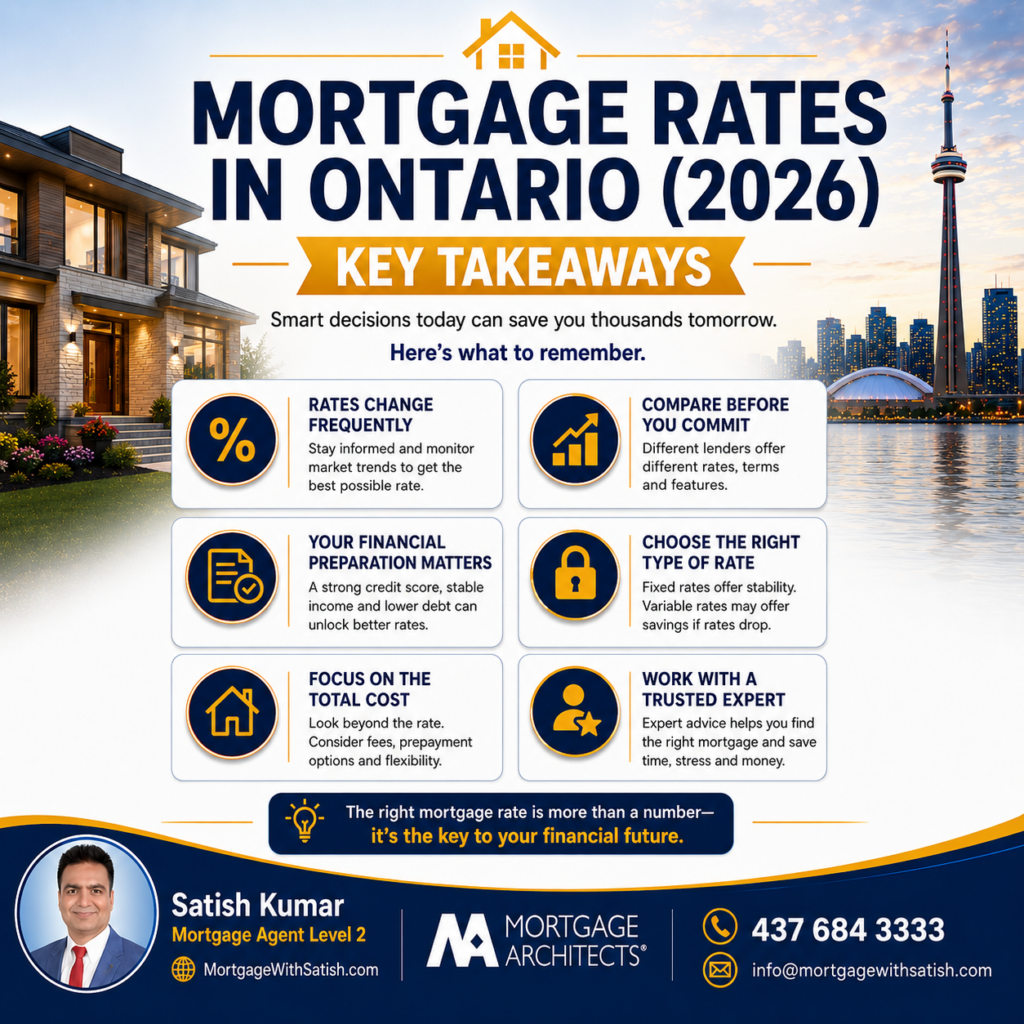
A mortgage rate is the percentage of interest charged on the money borrowed to purchase or refinance a property.
Understanding Mortgage Rates in Ontario
For example, if you borrow $500,000, your lender charges interest based on the agreed mortgage rate. Your monthly mortgage payment generally includes both principal (the amount borrowed) and interest (the cost of borrowing).
The interest rate directly affects:
- Monthly mortgage payments
- Total interest paid over time
- Overall affordability
- Borrowing capacity
Understanding how mortgage rates work is one of the first steps toward making confident home financing decisions.
Why Mortgage Rates Matter
Many people focus only on the monthly payment.
However, mortgage rates influence much more than your payment amount.
They can affect:
- Your long-term financial flexibility
- How quickly you build home equity
- Your ability to make prepayments
- The total cost of owning your home
- Future refinancing or renewal decisions
Choosing the right mortgage involves balancing cost, flexibility, and your financial goals.
How Are Mortgage Rates Determined?
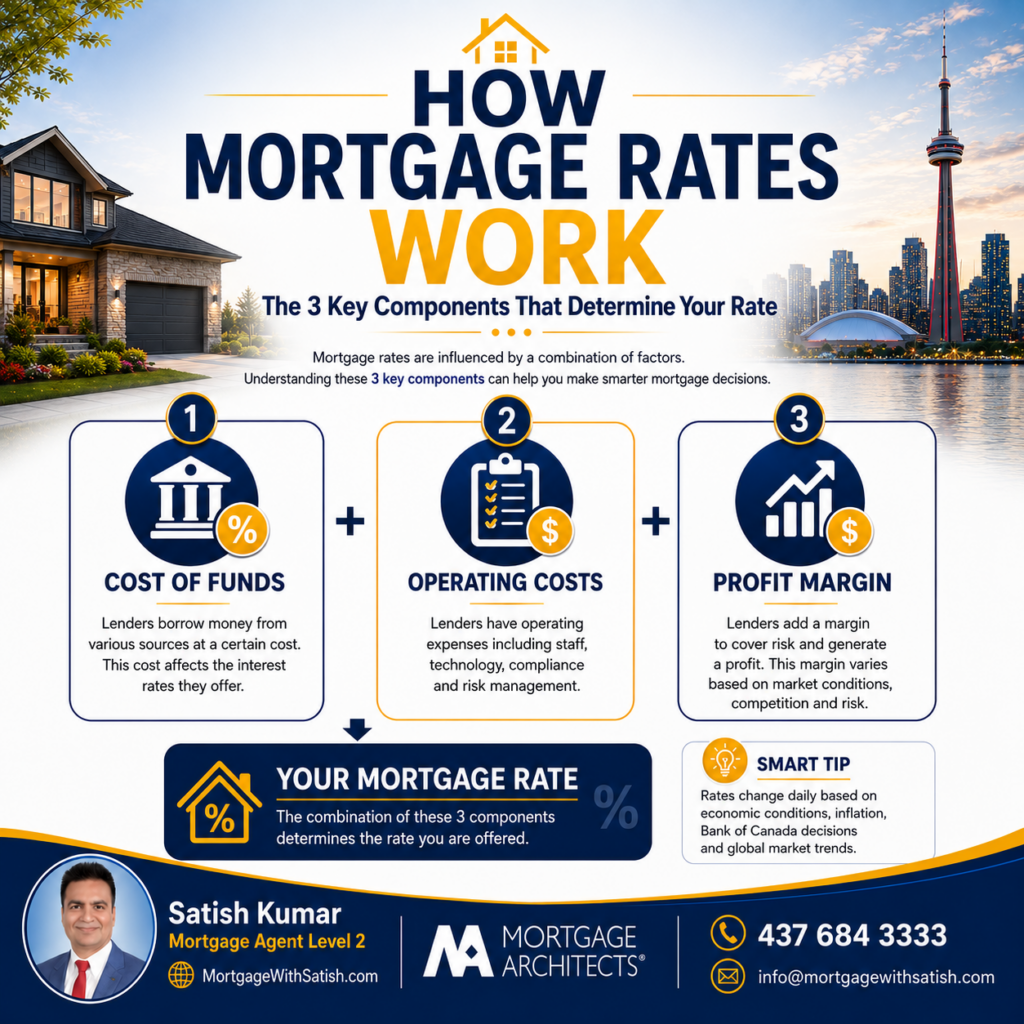
Mortgage rates are influenced by a combination of economic factors and borrower-specific information.
Some of the key influences include:
Economic Conditions
Inflation, employment trends, economic growth, and financial markets all play a role in shaping borrowing costs.
Government Bond Yields
Longer-term fixed mortgage rates are often influenced by Government of Canada bond yields because they reflect market expectations for future interest rates.
Lender Funding Costs
Financial institutions have different funding costs, operating expenses, and pricing strategies, which is one reason rates can vary between lenders.
Competition
Banks, credit unions, monoline lenders, and other financial institutions compete for borrowers, which can influence available mortgage pricing.
Factors That Affect the Mortgage Rate You May Be Offered
Every borrower is unique.
Lenders typically consider several factors when assessing mortgage applications.
1. Credit History
A strong credit profile may provide access to a wider range of mortgage products.
Lenders generally look at:
- Payment history
- Outstanding debts
- Credit utilization
- Length of credit history
2. Down Payment
The size of your down payment can influence the mortgage products available to you.
A larger down payment may improve borrowing flexibility and reduce the loan-to-value ratio.
3. Income Stability
Lenders assess whether your income is sufficient and stable enough to support the mortgage payments.
Employment history, income consistency, and documentation requirements may vary depending on your situation.
4. Debt Levels
Existing financial obligations are considered when evaluating affordability.
Lenders review debt ratios to determine whether the mortgage payments fit within their lending guidelines.
5. Property Type
Mortgage options can vary depending on whether you’re purchasing:
- An owner-occupied home
- A condominium
- A rental property
- A vacation property
- A multi-unit residential property
Different property types may have different lending requirements.
Satish’s Expert Insight
Many people start their mortgage search by asking, “What’s your lowest rate?” While rate is important, I encourage clients to look at the complete mortgage solution. Features such as prepayment options, flexibility, penalties, and long-term suitability can make a meaningful difference over the life of a mortgage. My goal is to help clients understand their options so they can choose the mortgage that best supports their financial plans—not simply the one with the lowest advertised rate.
Ontario Scenario
Rahul and Priya are purchasing their first home in Durham Region.
One lender offers a slightly lower interest rate but includes restrictive prepayment terms and higher penalties for breaking the mortgage early.
Another lender offers a marginally higher rate with more flexible repayment options and portability.
Rather than focusing solely on the interest rate, they compare the complete mortgage features, consider their future plans, and select the option that better aligns with their goals.
The lowest rate isn’t always the best overall value.
Fixed vs. Variable Mortgage Rates
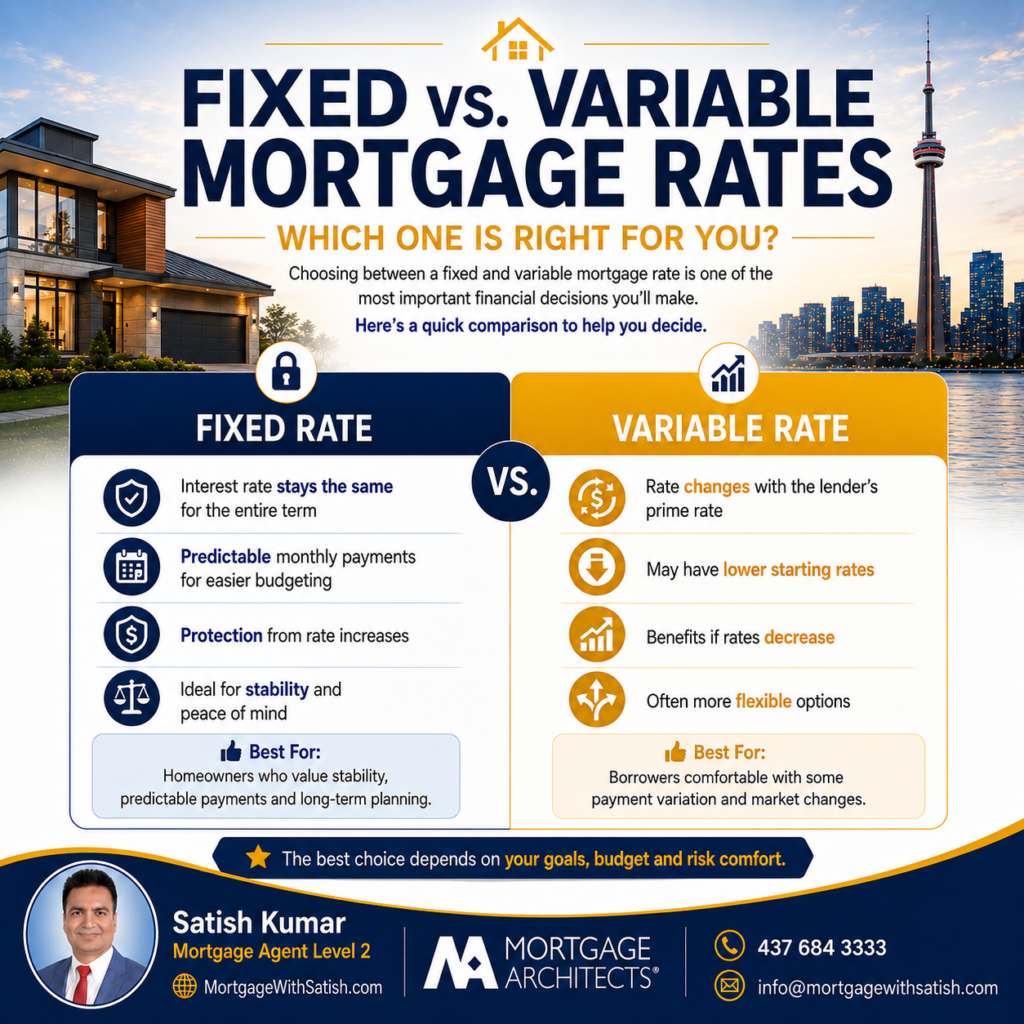
One of the biggest decisions homebuyers face is choosing between a fixed-rate mortgage and a variable-rate mortgage.
Neither option is universally better. The right choice depends on your financial goals, comfort with payment changes, and future plans.
Fixed Mortgage Rates
A fixed-rate mortgage means your interest rate remains the same for the duration of your mortgage term.
Advantages
✔ Predictable monthly payments (for most fixed-payment mortgages)
✔ Easier household budgeting
✔ Protection from rising interest rates
✔ Peace of mind during periods of economic uncertainty
Considerations
- If market rates decline, your rate generally stays the same unless you refinance, which may involve costs.
- Breaking a fixed mortgage before the end of the term can result in significant penalties, depending on your lender and mortgage contract.
Best suited for:
- First-time home buyers
- Families with fixed budgets
- Homeowners who value payment stability
Variable Mortgage Rates
A variable-rate mortgage changes as the lender’s prime rate changes.
Depending on the mortgage product, your payment amount, the portion applied to principal versus interest, or both may change over time.
Advantages
✔ May offer lower starting rates during some market conditions
✔ Often provides greater flexibility with prepayment penalties than many fixed-rate mortgages (depending on the product)
✔ May benefit borrowers if interest rates decrease
Considerations
- Payments or interest costs may increase if rates rise.
- Some borrowers may find payment changes stressful during periods of economic volatility.
Best suited for:
- Borrowers comfortable with changing interest rates
- Homeowners with financial flexibility
- Long-term planners who understand interest rate risk
Fixed vs. Variable Comparison
| Feature | Fixed | Variable |
|---|---|---|
| Interest Rate | Stable during the term | Can change over time |
| Budgeting | More predictable | May vary |
| Response to Rate Cuts | No automatic benefit | May benefit when rates fall |
| Response to Rate Increases | Protected during the term | May see higher borrowing costs |
| Typical Borrower | Prefers stability | Comfortable with market changes |
The “better” option depends on your priorities rather than one mortgage type being universally superior.
Open vs. Closed Mortgages
Many borrowers focus on the interest rate but overlook another important decision: open or closed mortgage terms.
Closed Mortgage
A closed mortgage generally offers lower interest rates but limits how much you can repay early without penalty, subject to your lender’s prepayment privileges.
Suitable for most homeowners who plan to keep their mortgage for the agreed term.
Open Mortgage
An open mortgage typically allows you to repay the mortgage in full or make large lump-sum payments without prepayment penalties.
However, this flexibility often comes with a higher interest rate.
Suitable for borrowers expecting to sell, refinance, or receive funds in the near future.
Choosing the Right Mortgage Term

Mortgage terms commonly range from 6 months to 10 years, with five-year terms being a popular choice in Canada.
When selecting a term, consider:
- How long you expect to stay in the property
- Your comfort with interest rate changes
- Your financial goals
- The likelihood of moving or refinancing before the term ends
A shorter term may allow you to renew sooner, while a longer term provides rate certainty for a longer period.
How to Improve Your Chances of Getting a Competitive Mortgage Rate
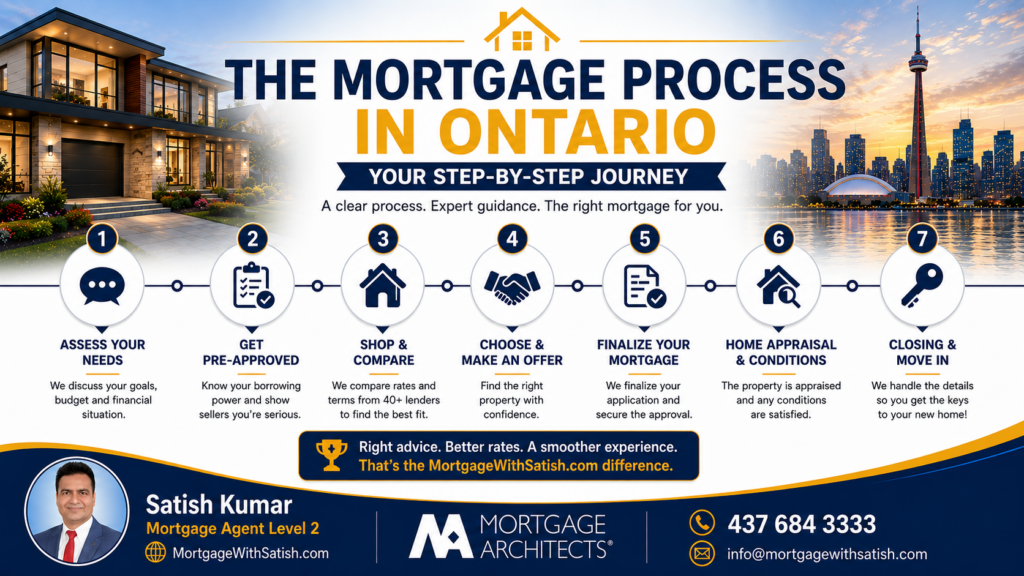
Although no one can guarantee a specific rate, there are practical steps that may improve your financing options.
Improve Your Credit Profile
- Pay bills on time.
- Reduce revolving debt where possible.
- Review your credit report for errors.
Increase Your Down Payment
A larger down payment can improve your loan-to-value ratio and may expand your financing options.
Reduce Existing Debt
Lower debt obligations can improve affordability calculations.
Maintain Stable Income
Consistent employment and well-documented income can strengthen your mortgage application.
Prepare Your Documentation
Having documents organized before applying can help streamline the approval process.
Common Mortgage Rate Mistakes
Always compare Mortgage Rates in Ontario before making your final decision.
Many homeowners unintentionally make decisions that cost them money over time.
Common mistakes include:
❌ Choosing a mortgage based only on the advertised interest rate.
❌ Accepting the first renewal offer without comparing available options.
❌ Ignoring mortgage features such as portability and prepayment privileges.
❌ Not understanding prepayment penalties before signing.
❌ Focusing only on monthly payments instead of the total borrowing cost.
❌ Waiting until the last minute to review mortgage options.
Mortgage Rate Myths vs. Facts
| Myth | Fact |
|---|---|
| The lowest rate is always the best mortgage. | Mortgage features, flexibility, and penalties also matter. |
| Banks always offer the lowest rates. | Different lenders may offer different products and pricing. |
| You should renew automatically with your current lender. | Reviewing available options can help ensure your mortgage still meets your needs. |
| Variable mortgages are always cheaper. | Market conditions change, and outcomes depend on future interest rate movements. |
| Mortgage brokers work with only one lender. | Many mortgage brokers have access to multiple lending institutions and products. |
Satish’s Expert Insight
Over the years, I’ve found that the best mortgage decisions are rarely based on interest rate alone. Every homeowner has different priorities—whether that’s payment stability, flexibility, reducing long-term costs, or preparing for future plans. Taking the time to understand your options before committing to a mortgage can help you make a decision that’s right for your circumstances, not just today’s market.
Ontario Scenario
Sarah owns a home in Ajax and has six months remaining before her mortgage renewal.
Her current lender sends her a renewal offer with a competitive rate. Rather than signing immediately, she reviews her financial goals. She’s considering a home renovation within two years and wants greater flexibility for additional payments.
After comparing available mortgage options and features, she chooses the mortgage that best supports her future plans—even though another product offered a slightly lower rate.
The decision wasn’t based solely on interest rate. It was based on overall value.
What is a mortgage rate?
A mortgage rate is the interest charged by a lender on the money borrowed to purchase or refinance a property.
How often do mortgage rates change?
Rates can change at any time depending on market conditions and lender pricing.
Can I negotiate my mortgage rate?
Some borrowers may be able to negotiate aspects of their mortgage. Available options vary by lender and individual circumstances.
Is the lowest mortgage rate always the best?
Not necessarily. Mortgage features, flexibility, penalties, and suitability are also important considerations.
Should I choose a fixed or variable mortgage?
The appropriate choice depends on your financial goals, budget, and comfort with interest rate changes.
How early should I start shopping before renewal?
Many homeowners begin reviewing their options several months before their mortgage matures to allow time for comparison and planning.
What affects the mortgage rate I’m offered?
Factors may include your credit profile, income, down payment, debt levels, property type, mortgage product, and market conditions.
MortgageWithSatish Action Plan
If You’re Buying Your First Home
✓ Understand your budget.
✓ Save your down payment.
✓ Learn about available government programs.
✓ Get pre-approved before making an offer.
✓ Compare mortgage options—not just interest rates.
If You’re Renewing Your Mortgage
✓ Review your current mortgage terms.
✓ Consider whether your financial goals have changed.
✓ Compare available options.
✓ Understand any costs or restrictions.
✓ Make your decision before your renewal deadline.
If You’re Refinancing
✓ Clarify why you’re refinancing.
✓ Estimate available home equity.
✓ Understand any applicable costs.
✓ Compare refinancing with other borrowing options.
✓ Seek personalized advice before making a decision.
Related Guides
Continue learning with these resources:
- First-Time Home Buyer Guide
- Mortgage Renewal Guide
- Mortgage Refinancing Guide
- HELOC Guide
- Mortgage Pre-Approval Guide
- Fixed vs. Variable Mortgage Guide
- Mortgage Stress Test Guide
- Closing Costs Guide
Final Thoughts
A mortgage is more than an interest rate—it’s a financial commitment that should support your long-term goals.
Whether you’re purchasing your first home, renewing your mortgage, refinancing, or exploring investment opportunities, taking time to understand your options can help you make confident, informed decisions.
At MortgageWithSatish, our philosophy is simple:
Educate first. Advise second. Invite third.
If you have questions about your specific situation, a personalized mortgage review can help you understand the available options and choose a solution that aligns with your financial objectives. Understanding the impact of Mortgage Rates in Ontario is essential for every prospective homeowner.