

Executive Summary
Mortgage renewing is one of the most important financial decisions you’ll make as a homeowner. Many Canadians simply sign the renewal offer sent by their current lender, but doing so without comparing options could cost thousands of dollars over the next mortgage term.
This comprehensive guide explains how mortgage renewal works in Ontario and across Canada, when to start preparing, how to negotiate better rates, when switching lenders makes sense, and how to avoid common renewal mistakes. Whether your priority is reducing monthly payments, paying off your mortgage faster, accessing better features, or planning for future financial goals, understanding your options can help you make a confident decision.
Quick Answer
Mortgage renewal is the process of signing a new mortgage term when your current term expires while your mortgage balance remains outstanding. Homeowners can renew with their existing lender or switch to another lender. Comparing mortgage options before accepting a renewal offer may help you secure a better interest rate, improved features, or greater flexibility depending on your financial circumstances.
Featured Snippet Answer
Mortgage renewal allows homeowners to replace an expiring mortgage term with a new one while keeping the remaining mortgage balance. Before accepting a lender’s renewal offer, compare rates, terms, and features from multiple lenders to ensure the mortgage aligns with your financial goals and current market conditions.
Key Takeaways
- Compare renewal offers before signing.
- Start preparing approximately four months before your mortgage matures.
- A lower interest rate is important, but mortgage features and flexibility also matter.
- Switching lenders may provide better value depending on your situation.
- Consulting a mortgage professional can help you evaluate multiple options instead of reviewing only one lender’s offer.
Table of Contents
Introduction
For many Canadian homeowners, mortgage renewal occurs several times before the mortgage is fully paid off. Although it is a routine part of homeownership, it also presents an opportunity to reassess your financial goals and ensure your mortgage continues to meet your needs.
Interest rates may have changed since you first obtained your mortgage. Your income, family situation, or long-term plans may also be different. These changes make renewal an ideal time to review your mortgage rather than simply accepting the first offer you receive.
Some homeowners prioritize the lowest possible interest rate, while others value flexible prepayment privileges, portability, or payment options that better suit their lifestyle. The right choice depends on your individual circumstances.
Throughout this guide, you’ll learn how the mortgage renewal process works, what options are available, and how to make informed decisions that support your financial goals.
What Is Mortgage Renewal?
Mortgage renewal occurs when the term of your existing mortgage ends but you still have an outstanding balance to repay. Instead of applying for a completely new mortgage, you choose a new mortgage term and interest rate for the remaining balance.
For example, you may have started with a 25-year amortization and selected a five-year fixed-rate mortgage. After five years, your mortgage term ends, but you may still have 20 years remaining on your amortization. At that point, you’ll renew your mortgage for another term.
Unlike purchasing a home, renewal is generally simpler because you already own the property and have an established payment history.
Satish’s Expert Insight
Many homeowners focus exclusively on the interest rate at renewal. While securing a competitive rate is important, it’s equally valuable to consider mortgage flexibility, prepayment privileges, portability, and how the mortgage supports your future plans, such as renovating, investing, or moving.
Key Takeaways
- Mortgage renewal happens when your mortgage term expires.
- The remaining mortgage balance continues under a new term.
- Renewal is an opportunity to review rates, features, and financial goals.
- Comparing options before signing can help you make a more informed decision.
How Mortgage Renewal Works in Canada
Understanding the mortgage renewal process can help you avoid last-minute decisions and give you enough time to compare lenders, negotiate better terms, and choose a mortgage that aligns with your financial goals.
For most Canadian homeowners, the renewal process begins several months before the end of their current mortgage term.
Mortgage Renewal Timeline
The following timeline outlines what typically happens before your mortgage matures.
| Timeline | What You Should Do |
|---|---|
| 120–180 Days Before Renewal | Review your mortgage, financial goals, and current interest rates. Begin comparing lenders. |
| 90–120 Days Before Renewal | Speak with a mortgage broker to explore available mortgage products and compare offers. |
| 30–60 Days Before Renewal | Finalize your mortgage decision and complete any required paperwork if switching lenders. |
| Renewal Date | Your new mortgage term begins. |
Expert Tip: Starting the process early gives you more time to compare options and reduces the pressure of making a decision close to your renewal date.
The Mortgage Renewal Process Step-by-Step

Step 1 – Receive Your Renewal Offer
Most lenders send a mortgage renewal offer several months before your mortgage term expires.
The offer generally includes:
- New interest rate
- Available mortgage terms
- Monthly payment
- Renewal instructions
While convenient, the initial offer may not always represent the lender’s most competitive pricing.
Step 2 – Review Your Financial Situation
Before accepting any renewal offer, consider how your circumstances may have changed since you first obtained your mortgage.
Ask yourself:
- Has your household income changed?
- Are you planning to move?
- Are you expecting a growing family?
- Will you need funds for renovations?
- Are you considering purchasing an investment property?
- Do you want to pay off your mortgage faster?
These questions can influence the mortgage term, payment structure, and features that best suit your needs.
Step 3 – Compare Mortgage Options
One of the biggest mistakes homeowners make is assuming their current lender offers the best solution.
Instead, compare:
- Interest rates
- Fixed versus variable options
- Mortgage terms
- Prepayment privileges
- Portability
- Payment flexibility
- Penalty calculations
- Customer service
A mortgage broker can often compare products from multiple lenders, making it easier to evaluate your options.
Step 4 – Decide Whether to Stay or Switch
Once you’ve compared available products, you’ll need to decide whether to:
- Renew with your current lender
- Switch to another lender
- Refinance if your financial goals have changed
We’ll explore these options in more detail later in this guide.
Step 5 – Complete the Renewal
If renewing with your existing lender, the process is often straightforward and may require only accepting the renewal agreement.
If switching lenders, the new lender will coordinate much of the transfer process. Depending on the circumstances, additional documentation may be required.
Example Mortgage Renewal Journey
Imagine Sarah purchased her home five years ago with a five-year fixed-rate mortgage.
Since then:
- Her salary has increased.
- She has built additional home equity.
- She plans to renovate her kitchen.
- Interest rates have changed.
Instead of automatically accepting her lender’s renewal offer, Sarah compares several lenders, reviews available mortgage features, and chooses a product that better aligns with her long-term financial plans.
This proactive approach helps her make an informed decision rather than simply renewing out of convenience.
Mortgage Renewal vs. Automatic Renewal
Some mortgage agreements may allow for automatic renewal if no action is taken before the maturity date.
While this can prevent the mortgage from expiring without a new term, relying on automatic renewal may mean missing the opportunity to compare products or negotiate better terms.
Whenever possible, review your options before your mortgage reaches maturity.
Benefits of Preparing Early
Starting the renewal process well before your mortgage matures can provide several advantages.
Benefits include:
- More time to compare lenders
- Greater opportunity to negotiate
- Better understanding of available mortgage products
- Reduced stress
- More informed financial decisions
Preparation can also help you identify whether your existing mortgage still meets your evolving needs.
Comparison Table: Early Renewal Planning vs. Last-Minute Renewal
| Feature | Early Planning | Last-Minute Renewal |
|---|---|---|
| Time to compare lenders | Excellent | Limited |
| Opportunity to negotiate | High | Lower |
| Mortgage options available | More | Fewer |
| Stress level | Lower | Higher |
| Decision quality | Generally better informed | Often rushed |
Satish’s Expert Insight
One of the most valuable conversations I have with homeowners begins months before their mortgage maturity date. Early planning creates more opportunities to evaluate mortgage features, compare lenders, and choose a solution that supports future goals rather than focusing solely on the advertised interest rate.
Every homeowner’s circumstances are unique, so the right renewal strategy depends on your financial objectives, lifestyle, and plans for the years ahead.
Key Takeaways
- Begin reviewing your mortgage several months before renewal.
- Compare multiple lenders rather than relying solely on the first renewal offer.
- Consider your long-term financial goals, not just the interest rate.
- Preparing early gives you more flexibility and confidence when choosing your next mortgage term.
Renewing With Your Existing Lender
Many homeowners choose to renew with their current lender because the process is familiar and convenient. In many cases, the lender will send a renewal package that can be accepted with minimal paperwork.
However, convenience should not replace careful evaluation. Before renewing, consider whether the proposed mortgage continues to meet your needs and whether other lenders offer features or terms that may better align with your financial goals.
The next section will compare renewing with your existing lender versus switching to a new lender, helping you understand the potential advantages and considerations of each option.
Renewing With Your Existing Lender vs. Switching to a New Lender
One of the biggest decisions at mortgage renewal is whether to stay with your current lender or move your mortgage to another financial institution. There is no one-size-fits-all answer—the best option depends on your financial goals, the mortgage features you need, and the value offered by competing lenders.
Many homeowners choose to stay with their existing lender because the process is simple and familiar. However, comparing offers from multiple lenders can help you determine whether you’re receiving competitive terms.
Renewing With Your Current Lender
Renewing with your existing lender is often the most straightforward option.
In many cases, you’ll receive a renewal package before your mortgage maturity date. If you’re satisfied with the proposed terms, you may be able to renew with minimal paperwork.
Advantages
- Simple and convenient process
- Minimal documentation in many cases
- No interruption to mortgage payments
- Existing lender already knows your mortgage history
Considerations
- The first renewal offer may not be the lender’s most competitive rate.
- Mortgage features may not align with your future goals.
- Better options may be available from other lenders.
Switching to a New Lender
Switching lenders at renewal gives you the opportunity to compare mortgage products across multiple financial institutions.
Many lenders offer competitive renewal programs designed to attract homeowners from other banks.
Potential Benefits
- Competitive interest rates
- Better mortgage features
- Improved prepayment privileges
- More flexible payment options
- Mortgage products better suited to your financial goals
Depending on the lender and mortgage product, certain costs associated with transferring a mortgage may be reduced or covered. Always review the details carefully before making a decision.
Comparison Table: Stay or Switch?
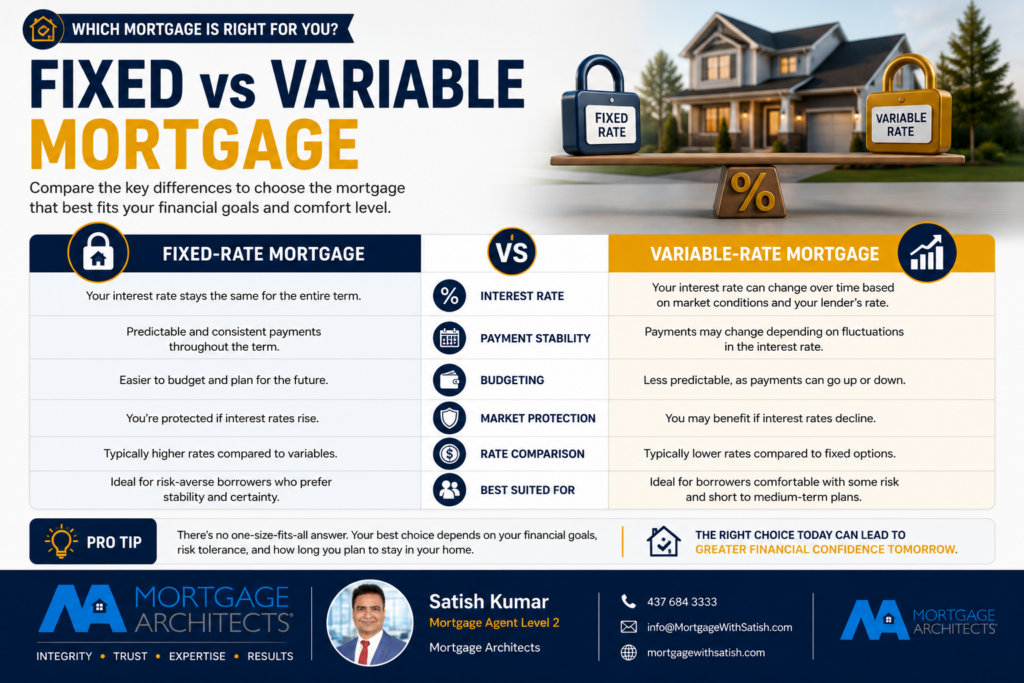
| Feature | Stay with Current Lender | Switch to New Lender |
|---|---|---|
| Convenience | Excellent | Moderate |
| Paperwork | Usually minimal | May require additional documents |
| Opportunity to negotiate | Good | Excellent |
| Product selection | Limited to one lender | Multiple lenders available |
| Access to new features | Limited | Greater choice |
| Rate comparison | Limited | Broader comparison |
Can You Negotiate Your Mortgage Renewal?
Yes.
Many homeowners are surprised to learn that a mortgage renewal offer is not always the final offer.
Before signing:
- Compare rates available from other lenders.
- Review different mortgage terms.
- Understand available mortgage features.
- Discuss your options with a mortgage professional.
Having comparable offers can strengthen your negotiating position and help you evaluate whether your current lender’s proposal represents good value.
Choosing Between a Fixed and Variable Mortgage
One of the most important renewal decisions is selecting the type of interest rate.
Fixed-Rate Mortgage
A fixed-rate mortgage keeps your interest rate unchanged for the duration of the mortgage term.
Advantages
- Predictable monthly payments
- Easier household budgeting
- Protection if interest rates increase
Considerations
- You may not benefit if interest rates decline.
- Early repayment penalties can differ from those of variable-rate mortgages.
Variable-Rate Mortgage
A variable-rate mortgage has an interest rate that may change during the mortgage term, depending on market conditions and your lender’s mortgage product.
Advantages
- Potential to benefit if interest rates decline.
- Some borrowers appreciate the flexibility associated with variable-rate products.
Considerations
- Payments or the allocation between principal and interest may change depending on your mortgage agreement.
- Greater uncertainty compared with a fixed-rate mortgage.
Comparison Table: Fixed vs. Variable Mortgage
| Feature | Fixed Rate | Variable Rate |
|---|---|---|
| Interest Rate | Remains the same during the term | May change over time |
| Payment Stability | Predictable | Depends on mortgage product |
| Budgeting | Easier | Less predictable |
| Response to Market Changes | None during the term | Moves with market conditions |
| Suitable For | Borrowers seeking payment certainty | Borrowers comfortable with interest-rate fluctuations |
How to Choose the Right Mortgage Term
Selecting the right mortgage term involves more than choosing the lowest advertised interest rate.
Ask yourself:
- How long do you plan to stay in your current home?
- Do you expect significant income changes?
- Are you planning major renovations?
- Could you relocate for work?
- Are you planning to purchase an investment property?
- How comfortable are you with changes in interest rates?
The answers to these questions can help determine whether a shorter or longer mortgage term better suits your financial plans.
Mortgage Renewal vs. Mortgage Refinance
Many homeowners confuse mortgage renewal with refinancing, but they serve different purposes.
| Mortgage Renewal | Mortgage Refinance |
|---|---|
| Occurs when the mortgage term expires | Can occur before or after renewal, depending on lender policies |
| Renews the remaining mortgage balance | May involve replacing the existing mortgage with a new one |
| Typically focuses on selecting a new term and interest rate | May be used to access home equity, consolidate debt, or change mortgage terms |
| Usually simpler | May require additional qualification and documentation |
When Renewal Makes Sense
Renewal may be appropriate when:
- You’re satisfied with your current mortgage amount.
- You simply need a new mortgage term.
- Your primary goal is obtaining competitive terms for the remaining balance.
When Refinancing May Be Worth Considering
Depending on your lender’s requirements and your financial circumstances, refinancing may be appropriate if you wish to:
- Access home equity for renovations.
- Consolidate higher-interest debt.
- Adjust your amortization period.
- Finance another major expense.
Satish’s Expert Insight
Every renewal conversation should begin with one question:
“What do you want your mortgage to accomplish over the next few years?”
For some homeowners, lowering monthly payments is the priority. Others may want greater flexibility for future moves, renovations, or investments. The best mortgage is not always the one with the lowest rate—it’s the one that best supports your financial objectives.
Key Takeaways
- Compare your current lender’s renewal offer with alternatives before making a decision.
- Evaluate mortgage features, flexibility, and long-term suitability in addition to the interest rate.
- Choose a fixed or variable mortgage based on your comfort with interest-rate changes and financial goals.
- Understand the difference between renewing your mortgage and refinancing it so you can select the option that best fits your needs.
Costs and Potential Fees at Mortgage Renewal
Many homeowners assume that renewing a mortgage is always free. While a standard renewal with your existing lender often involves few or no direct costs, there can be expenses depending on the choices you make and your lender’s requirements.
Understanding potential costs before your renewal date helps you make informed financial decisions.
Common Costs to Consider
Depending on your situation, you may encounter:
- Property appraisal fees
- Legal or administrative fees
- Mortgage discharge or registration fees
- Title transfer costs (if switching lenders)
- Mortgage default insurance considerations (where applicable)
- Penalties if you refinance before your mortgage maturity date
The exact costs vary by lender and mortgage product, so it’s important to review your mortgage documents and ask questions before making a decision.
When Renewal May Cost Little or Nothing
Many straightforward mortgage renewals with the same lender involve:
- No new mortgage application
- No property appraisal
- Minimal paperwork
- No legal fees
However, this may differ if you’re changing lenders or modifying your mortgage significantly.
When Additional Costs May Apply
Additional expenses may arise if you decide to:
- Switch lenders
- Increase your mortgage amount
- Change your amortization period
- Refinance to access home equity
- Make substantial changes to your mortgage structure
Before proceeding, request a clear explanation of any applicable fees.
Should You Accept the First Renewal Offer?
Many homeowners receive a renewal package from their lender and sign it immediately.
While this is convenient, taking time to compare options can help ensure your mortgage continues to meet your financial needs.
Before accepting a renewal offer, ask yourself:
- Is this interest rate competitive?
- Does this mortgage offer suitable flexibility?
- Are there better products available?
- Will this mortgage support my plans over the next few years?
Even if you ultimately remain with your current lender, reviewing alternatives provides valuable context for your decision.
Common Mortgage Renewal Mistakes

Renewal is an excellent opportunity to optimize your mortgage, but certain mistakes can limit your options or increase costs.
Mistake #1: Renewing Without Comparing Options
Many homeowners renew automatically because it’s convenient.
Comparing available mortgage products helps you understand what features, rates, and terms are available in the market.
Mistake #2: Waiting Until the Last Minute
Leaving renewal until just before your maturity date reduces the time available to compare lenders and evaluate different mortgage options.
Starting the process several months in advance provides greater flexibility.
Mistake #3: Focusing Only on the Interest Rate
A competitive interest rate is important, but it is only one aspect of a mortgage.
Other factors include:
- Prepayment privileges
- Portability
- Payment flexibility
- Penalty calculations
- Customer service
- Future borrowing options
A mortgage with a slightly higher rate may offer features that better support your long-term plans.
Mistake #4: Ignoring Future Plans
Your mortgage should align with where you expect to be over the next several years.
Consider whether you may:
- Move to another home
- Renovate
- Purchase an investment property
- Change careers
- Expand your family
Choosing a mortgage that accommodates these possibilities can reduce future challenges.
Mistake #5: Not Seeking Professional Advice
Every homeowner’s situation is unique.
A mortgage professional can help you compare products from multiple lenders, explain mortgage features, and evaluate options that align with your financial objectives.
Myths vs. Facts
| Myth | Fact |
|---|---|
| I must renew with my current lender. | Homeowners may choose to renew with their current lender or switch to another lender, subject to qualification and lender requirements. |
| The first renewal offer is always the best available. | Renewal offers can often be compared with other available mortgage products before making a decision. |
| Only the interest rate matters. | Mortgage features, flexibility, penalties, and future goals are also important considerations. |
| Mortgage renewal and refinancing are the same. | Renewal continues the remaining mortgage balance under a new term, while refinancing typically involves replacing or modifying the mortgage to meet different financial objectives. |
| Renewal decisions can wait until the last week. | Starting early provides more time to compare options and make informed decisions. |
Benefits of a Well-Planned Mortgage Renewal
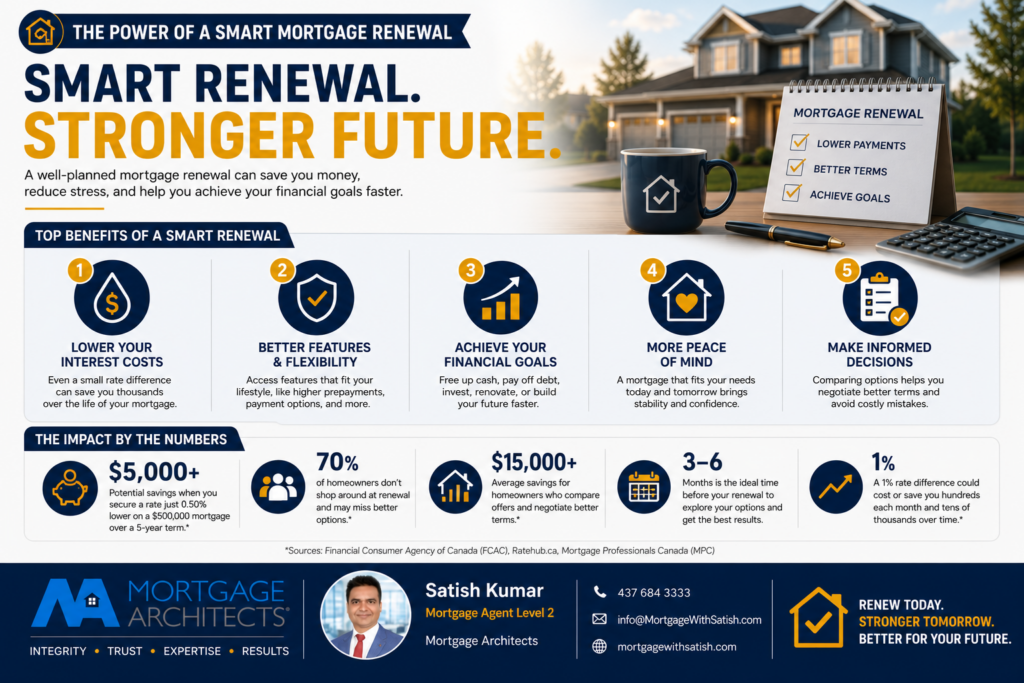
Planning your renewal carefully can provide several advantages:
Financial Benefits
- Opportunity to compare mortgage products
- Potential access to competitive interest rates
- Improved payment flexibility
- Better alignment with long-term financial goals
Lifestyle Benefits
- Greater confidence in your mortgage decision
- Reduced financial stress
- Improved budgeting
- More flexibility for future life changes
Long-Term Benefits
- Mortgage features that better support your evolving needs
- Opportunities to review repayment strategies
- Better understanding of available mortgage options
Mortgage Renewal Checklist
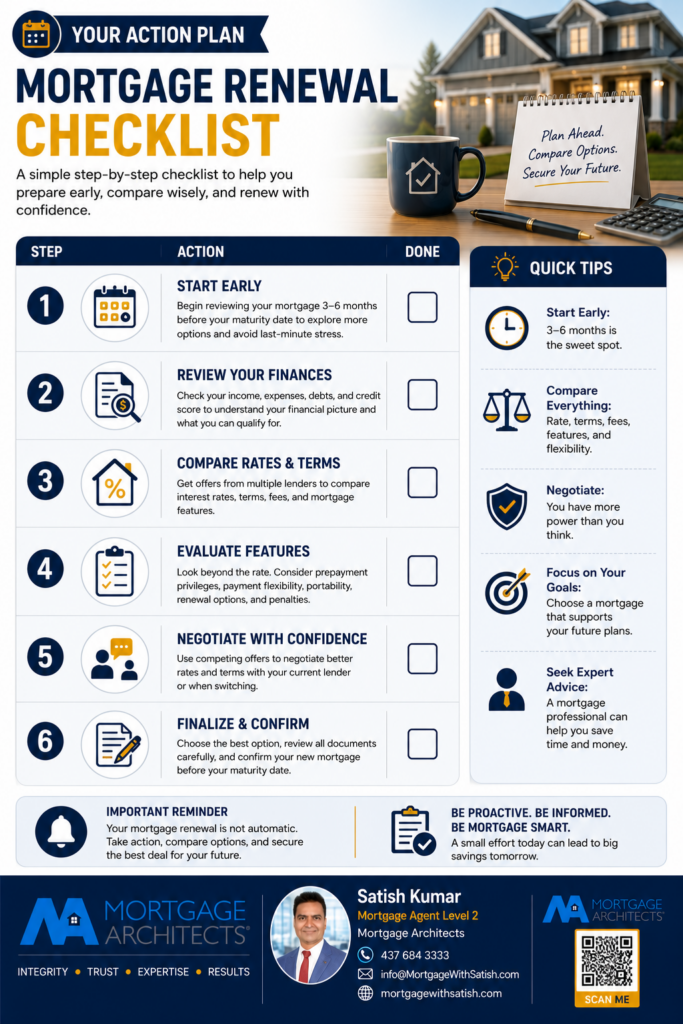
Use this checklist as your preparation guide before your mortgage reaches maturity.
Approximately 120–180 Days Before Renewal
☐ Review your current mortgage.
☐ Check your mortgage maturity date.
☐ Identify your financial goals.
☐ Consider whether your housing needs have changed.
Approximately 90–120 Days Before Renewal
☐ Compare mortgage products.
☐ Review fixed and variable options.
☐ Evaluate mortgage terms.
☐ Discuss your options with a mortgage professional.
Approximately 30–60 Days Before Renewal
☐ Select your preferred lender.
☐ Review all mortgage documents carefully.
☐ Confirm payment details.
☐ Understand your mortgage features.
On Renewal Day
☐ Confirm your new mortgage term.
☐ Verify your payment schedule.
☐ Store your mortgage documents securely.
☐ Review your financial goals for the coming years.
Ontario Homeowner Scenario
Consider a homeowner in Ajax whose five-year mortgage term is ending. During the past five years, their income has increased, and they are planning to renovate their home while also thinking about purchasing an investment property in the future.
Rather than automatically accepting the lender’s renewal offer, they compare mortgage products, review features such as prepayment privileges and portability, and choose a mortgage that better supports both their renovation plans and future investment goals.
This example illustrates how renewal is an opportunity to reassess your mortgage in light of changing financial circumstances.
Satish’s Expert Insight
Mortgage renewal should be viewed as a financial planning milestone—not simply an administrative task. Taking the time to review your goals, compare options, and understand your mortgage features can help ensure your next mortgage term supports where you want to be in the future.
Key Takeaways
- Understand any costs that may apply before renewing your mortgage.
- Avoid rushing into a renewal without comparing available options.
- Consider mortgage features and long-term goals, not just the interest rate.
- Use a structured checklist to stay organized throughout the renewal process.
What is mortgage renewal?
Mortgage renewal is the process of replacing your current mortgage term with a new one when the term expires while keeping the remaining mortgage balance. During renewal, you can choose a new interest rate, mortgage term, and lender if you qualify.
When should I start preparing for mortgage renewal?
It’s generally advisable to begin reviewing your options approximately 120 to 180 days before your mortgage maturity date. Starting early gives you time to compare lenders, understand current mortgage products, and make an informed decision without unnecessary pressure.
Can I switch lenders when renewing my mortgage?
Yes. Mortgage renewal provides an opportunity to compare lenders and, if appropriate, transfer your mortgage to another lender. Switching may offer different mortgage features or terms, depending on your financial situation and qualification.
Do I have to accept my lender’s renewal offer?
No. You are not obligated to accept your current lender’s first renewal offer. Reviewing other available mortgage options can help you determine which product best aligns with your financial goals.
Will renewing my mortgage affect my credit score?
A standard mortgage renewal with your existing lender generally has little impact on your credit profile. If you apply with a different lender, they may perform a credit review as part of their assessment.
Can I negotiate my mortgage renewal rate?
In many cases, homeowners can discuss renewal options with their lender or compare offers from multiple lenders before making a decision. Reviewing available products can help you evaluate the overall value of your mortgage.
Should I choose a fixed or variable mortgage?
The answer depends on your financial objectives, risk tolerance, and comfort with potential interest-rate changes. A fixed-rate mortgage provides payment certainty, while a variable-rate mortgage may appeal to borrowers who are comfortable with market fluctuations.
What happens if I forget to renew my mortgage?
Many lenders have procedures to ensure your mortgage continues after maturity, but the process varies by lender and mortgage agreement. Review your mortgage documents and communicate with your lender well before your maturity date to avoid uncertainty.
Is mortgage renewal the same as refinancing?
No.
Mortgage renewal continues your existing mortgage under a new term.
Mortgage refinancing generally involves replacing or modifying your mortgage to achieve different financial objectives, such as accessing home equity or consolidating debt.
Can I change my mortgage payment frequency at renewal?
Depending on the lender and mortgage product, renewal may provide an opportunity to review available payment options. Speak with your lender or mortgage professional to understand what choices are available.
Can I pay off my mortgage faster after renewing?
Many mortgage products include prepayment privileges that allow homeowners to make additional payments within specified limits. Review your mortgage agreement to understand your available options.
What documents might I need if I switch lenders?
Documentation requirements vary, but homeowners may be asked to provide:
– Proof of income
– Government-issued identification
– Property information
– Mortgage details
– Insurance information
Your new lender will explain the specific requirements for your situation.
Should I renew early if interest rates change?
Whether renewing early is appropriate depends on your mortgage agreement, financial objectives, and any applicable costs. Review your options carefully before making a decision.
Can a mortgage broker help with renewal?
Yes.
A mortgage broker can compare mortgage products from multiple lenders, explain different mortgage features, and help you evaluate available options based on your individual financial circumstances.
What is the biggest mistake homeowners make during mortgage renewal?
One of the most common mistakes is accepting the first renewal offer without reviewing alternative mortgage products or considering whether the mortgage still aligns with long-term financial goals.
Conclusion
Mortgage renewal is much more than signing a new mortgage agreement—it is an opportunity to reassess your financial goals and ensure your mortgage continues to support your changing needs.
Whether you’re focused on payment stability, flexibility, future investments, or paying off your mortgage sooner, taking the time to understand your options can help you make a confident, informed decision.
Rather than viewing renewal as a routine administrative task, treat it as an important financial milestone. Comparing mortgage products, understanding available features, and considering your long-term objectives can help you choose a mortgage that works for you today and in the years ahead.
What Should You Do Next?
If You’re a First-Time Homeowner
- Learn how mortgage renewal works before your first maturity date.
- Understand the differences between mortgage terms and interest-rate options.
- Review your financial goals before selecting your next mortgage.
If You’re Renewing Your Mortgage
- Review your current mortgage carefully.
- Compare available mortgage products.
- Evaluate mortgage features as well as interest rates.
- Begin planning well before your renewal date.
If You’re Considering Refinancing
- Determine whether your goals extend beyond a standard renewal.
- Understand how refinancing differs from renewing.
- Review your options with a mortgage professional.
If You’re an Investor
- Ensure your mortgage continues to support your investment strategy.
- Consider future financing needs and long-term cash-flow objectives.
If You’re Self-Employed
- Review your income documentation well before renewal.
- Explore mortgage products that best suit your financial profile.
Satish’s Action Plan
Use this practical checklist to prepare for a successful mortgage renewal:
☐ Confirm your mortgage maturity date.
☐ Begin reviewing your options several months in advance.
☐ Compare mortgage products from multiple lenders.
☐ Review both interest rates and mortgage features.
☐ Consider your long-term financial goals.
☐ Understand any applicable fees or costs.
☐ Choose the mortgage that best aligns with your future plans.
Call to Action
Your mortgage should support your financial goals—not simply continue by default.
If your mortgage renewal is approaching, take the opportunity to review your options before making a decision. Comparing mortgage products, understanding available features, and selecting the right mortgage strategy can help ensure your next mortgage term aligns with your plans for the future.
If you’d like professional guidance tailored to your situation, I’m here to help you understand your options and make an informed decision with confidence.
Satish Kumar
Mortgage Agent Level 2
Mortgage Architects
Serving homeowners across Ontario