
Choosing between a Fixed vs Variable Mortgage Rates is one of the most important financial decisions you’ll make when buying a home or renewing your mortgage in Canada. Each option has advantages, risks, and trade-offs depending on your financial goals, risk tolerance, and expectations for future interest rates.
This comprehensive guide explains how fixed and variable mortgage rates work, compares their benefits and drawbacks, outlines common mistakes to avoid, and helps you determine which option may be the better fit for your situation. Whether you’re a first-time home buyer, renewing your mortgage, refinancing, or investing in real estate, you’ll gain practical insights to make a confident and informed decision.
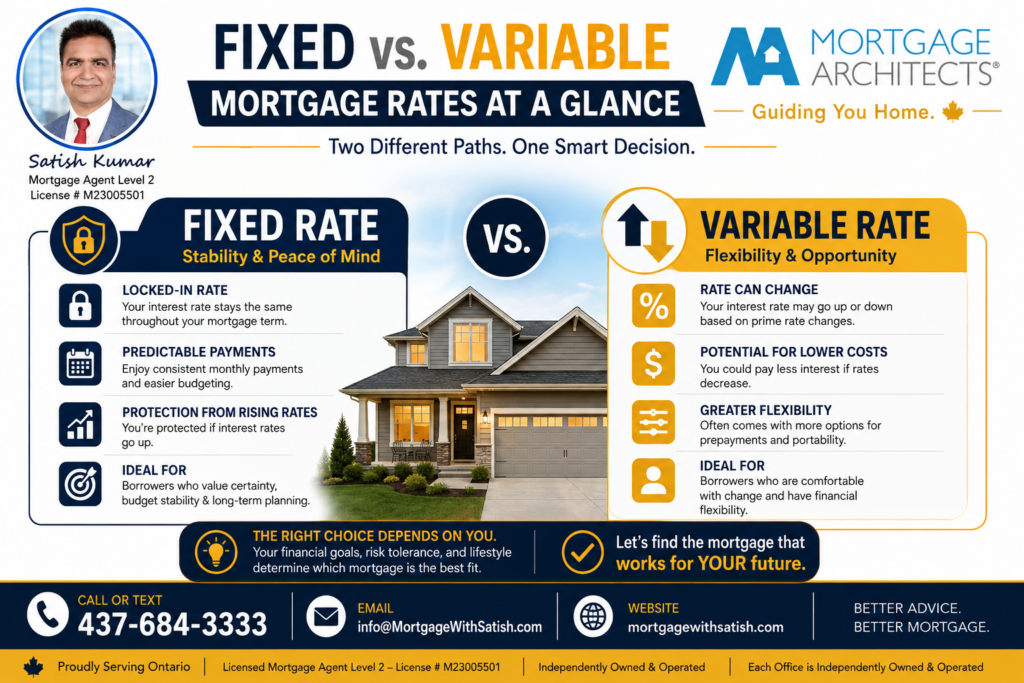
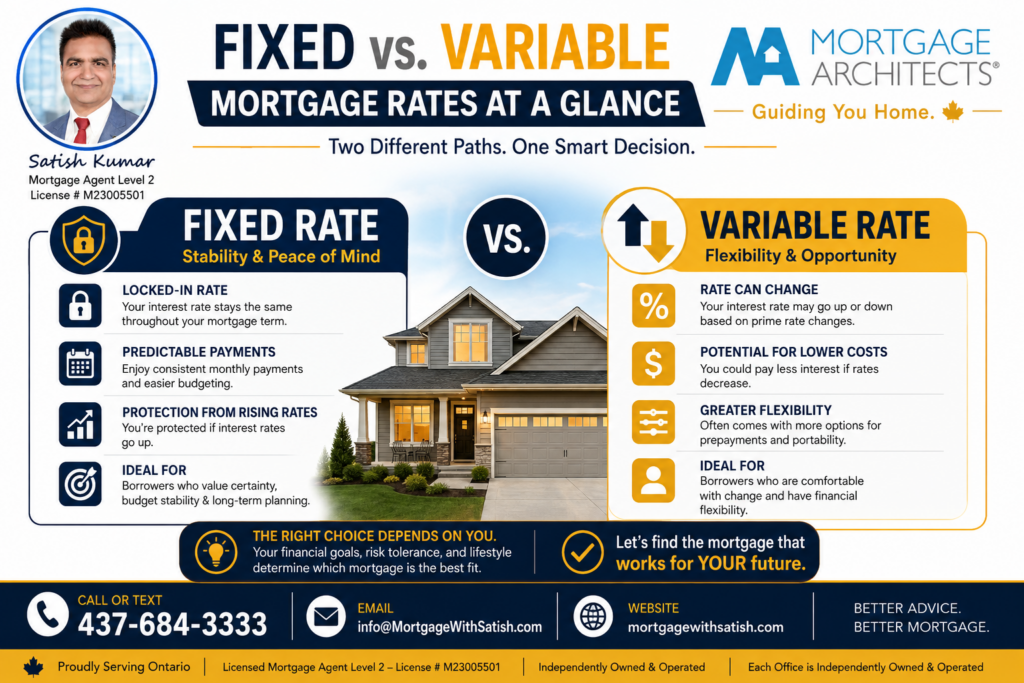
A fixed mortgage rate remains the same throughout your mortgage term, providing predictable monthly payments and protection from interest rate increases. A variable mortgage rate can fluctuate with changes in your lender’s prime rate, meaning your interest costs may rise or fall over time. The best choice depends on your financial goals, budget, and comfort with interest rate changes.
Table of Contents
Fixed vs Variable Mortgage Rates: Why This Decision Matters
Buying a home is one of the largest financial commitments most Canadians will ever make. While many buyers focus on the purchase price, down payment, or monthly payment, choosing the right mortgage rate type can have a lasting impact on your finances.
A mortgage isn’t just about borrowing money—it’s about selecting a repayment strategy that aligns with your lifestyle, income stability, and long-term financial goals.
Selecting the wrong mortgage type could mean:
- Paying thousands of dollars more in interest.
- Facing unexpected payment increases.
- Paying significant penalties if you need to break your mortgage early.
- Experiencing unnecessary financial stress during changing economic conditions.
On the other hand, choosing the right mortgage can provide financial stability, flexibility, and peace of mind throughout your mortgage term.
Satish’s Expert Insight
One of the most common questions I hear from home buyers across Ontario is:
Should I lock in my rate now, or take the chance that variable rates will save me money?
There isn’t a one-size-fits-all answer. The right choice depends on your personal financial situation, your comfort with changing interest rates, and your long-term plans for the property. My role is to help clients understand the trade-offs so they can make an informed decision—not simply choose the lowest advertised rate.
Ontario Home Buyer Example
Consider two first-time home buyers purchasing similar homes in the Greater Toronto Area.
Sarah chooses a five-year fixed mortgage because she prefers predictable monthly payments and wants certainty while managing a young family’s budget.
David chooses a variable mortgage because he has additional savings, expects to make extra payments, and is comfortable with the possibility of interest rate fluctuations.
Neither choice is automatically better. Each mortgage aligns with the borrower’s financial goals, risk tolerance, and personal circumstances.
What Is a Mortgage Interest Rate?
A mortgage interest rate is the percentage charged by a lender for borrowing money to purchase or refinance a property. It determines how much interest you’ll pay over the life of your mortgage in addition to repaying the amount you borrowed.
Your mortgage rate influences:
- Your monthly mortgage payment.
- The total interest paid over time.
- Your borrowing costs.
- Your financial flexibility.
- The overall affordability of your home.
Mortgage rates in Canada are influenced by several factors, including:
- Bank of Canada monetary policy.
- Lender funding costs.
- Economic conditions.
- Inflation trends.
- Your credit profile.
- Down payment amount.
- Mortgage type and term.
Understanding how these factors work together can help you choose the mortgage product that best supports your financial objectives.
How Does a Fixed Mortgage Rate Work?
Quick Answer
A fixed mortgage rate remains the same throughout your mortgage term. Your interest rate does not change even if market interest rates rise or fall, giving you predictable mortgage payments and greater financial certainty.
When you choose a fixed-rate mortgage, your lender guarantees the agreed-upon interest rate for the length of your mortgage term, which commonly ranges from one to five years, although longer terms may also be available.
Because the interest rate remains unchanged during the term:
- Your scheduled mortgage payment stays consistent (assuming no changes such as payment increases or lump-sum prepayments).
- The portion of each payment allocated to principal and interest follows the amortization schedule.
- Your monthly housing budget is easier to manage.
For many Canadian homeowners, especially first-time buyers, predictability is one of the biggest advantages of a fixed-rate mortgage.
How Fixed Mortgage Rates Are Determined
Unlike variable mortgage rates, fixed mortgage rates are not directly tied to a lender’s prime rate.
Instead, lenders consider several factors when setting fixed mortgage rates, including:
- Government of Canada bond yields
- Funding costs
- Market competition
- Economic outlook
- Inflation expectations
- Your financial profile (credit score, income, down payment, and debt ratios)
Because these factors change over time, fixed mortgage rates may increase or decrease for new borrowers, but once your mortgage is funded, your contractual fixed rate remains unchanged for the duration of your term.
Example
Imagine you purchase a home in Ontario with a five-year fixed mortgage.
Even if interest rates increase several times during your mortgage term:
- Your contracted interest rate stays the same.
- Your scheduled mortgage payment remains unchanged.
- You don’t need to worry about monthly payment fluctuations caused by changing interest rates.
This stability can make financial planning much easier.
Ontario Home Buyer Example
Priya and Raj, a young family purchasing their first home in Mississauga, choose a five-year fixed mortgage because they are budgeting for childcare, transportation, and household expenses.
Although they understand that interest rates may rise or fall during their mortgage term, they value the certainty of knowing exactly what their mortgage payment will be each month. For them, predictable cash flow is more important than trying to benefit from potential future rate decreases.
Satish’s Expert Insight
Many first-time home buyers assume a fixed mortgage is automatically the “safest” option. While the payment stability can provide peace of mind, the best choice depends on your financial goals, future plans, and comfort with risk. Understanding the trade-offs is more important than simply choosing the option that feels safest.
Advantages of a Fixed Mortgage Rate
A fixed-rate mortgage offers several benefits:
Predictable Payments
Knowing your mortgage payment in advance makes budgeting easier.
Protection Against Rising Interest Rates
If market rates increase after your mortgage closes, your contracted rate remains unchanged until renewal.
Easier Financial Planning
Stable housing costs help families plan for:
- Childcare
- Education
- Retirement savings
- Investments
- Vacations
- Home improvements
Reduced Financial Stress
Some borrowers prefer knowing exactly what they’ll pay every month rather than monitoring interest rate changes.
Potential Considerations
A fixed-rate mortgage may not be ideal for everyone.
Some considerations include:
- Interest rates are often higher than comparable variable rates at the start of the term.
- Breaking a fixed mortgage early may result in higher prepayment penalties.
- You won’t automatically benefit if market rates decline during your term.
These factors should be discussed before selecting a mortgage product.
How Does a Variable Mortgage Rate Work?
Quick Answer
A variable mortgage rate changes as your lender’s prime rate changes. When prime rates increase or decrease, your mortgage interest rate adjusts accordingly, which can affect your borrowing costs over time.
A variable-rate mortgage is generally expressed as:
Prime ± Adjustment
For example:
Prime – 0.60%
If your lender’s prime rate changes, your mortgage rate changes by the same amount according to the terms of your mortgage agreement.
Why Do Variable Rates Change?
Variable mortgage rates are influenced primarily by changes to a lender’s prime lending rate, which may be adjusted in response to economic conditions and broader interest rate movements.
When borrowing costs in the economy rise or fall, lenders may adjust their prime rates, which in turn can affect many variable-rate mortgage products.
Two Common Variable Mortgage Structures
Depending on your mortgage product, one of two things may happen when rates change:
Option 1 – Payment Changes
Some mortgages adjust the required monthly payment as interest rates change.
- Higher rates may increase your payment.
- Lower rates may decrease your payment.
Option 2 – Payment Stays the Same
Other mortgages keep the payment amount constant, but the portion allocated to interest and principal changes.
- When rates rise, more of your payment goes toward interest.
- When rates fall, more goes toward paying down the principal.
Your lender can explain how your specific mortgage product operates.
Ontario Home Buyer Example
Michael, a software engineer in Toronto, chooses a variable mortgage because he has a stable income, maintains an emergency fund, and plans to make regular lump-sum payments.
He understands that interest rates can change, but he is comfortable with that possibility because his financial plan allows him to absorb fluctuations if they occur.
Satish’s Expert Insight
Variable-rate mortgages aren’t simply about trying to get the lowest interest rate. They’re best suited to borrowers who understand how changing rates may affect their finances and who have the flexibility to manage that uncertainty. Choosing a variable rate should be a deliberate financial decision rather than a guess about future interest rates.
Advantages of a Variable Mortgage Rate
Potential for Lower Borrowing Costs
When interest rates remain stable or decrease, a variable-rate mortgage may result in lower overall interest costs.
Greater Flexibility
Some variable-rate mortgages may have lower penalties if you need to break your mortgage early, although this depends on your mortgage agreement.
Opportunity to Benefit from Falling Rates
If market conditions lead to lower interest rates, your borrowing costs may decrease according to the terms of your mortgage.
Potential Considerations
Variable-rate mortgages also involve uncertainty.
Depending on future interest rate movements:
- Borrowing costs may increase.
- Monthly cash flow could be affected.
- Budgeting may become more challenging for some households.
Borrowers should be comfortable with these possibilities before selecting a variable-rate mortgage.
Fixed vs. Variable Mortgage Rates: Quick Comparison
| Feature | Fixed Mortgage | Variable Mortgage |
|---|---|---|
| Interest Rate | Remains the same during the term | May change over time |
| Payment Stability | Typically predictable | Depends on mortgage product |
| Protection from Rising Rates | Yes | No |
| Benefit if Rates Decline | No | Potentially, depending on product |
| Budgeting | Easier for many households | May require greater flexibility |
| Suitable For | Borrowers who value certainty | Borrowers comfortable with changing rates |
Which Mortgage Is Better for First-Time Home Buyers?
Quick Answer
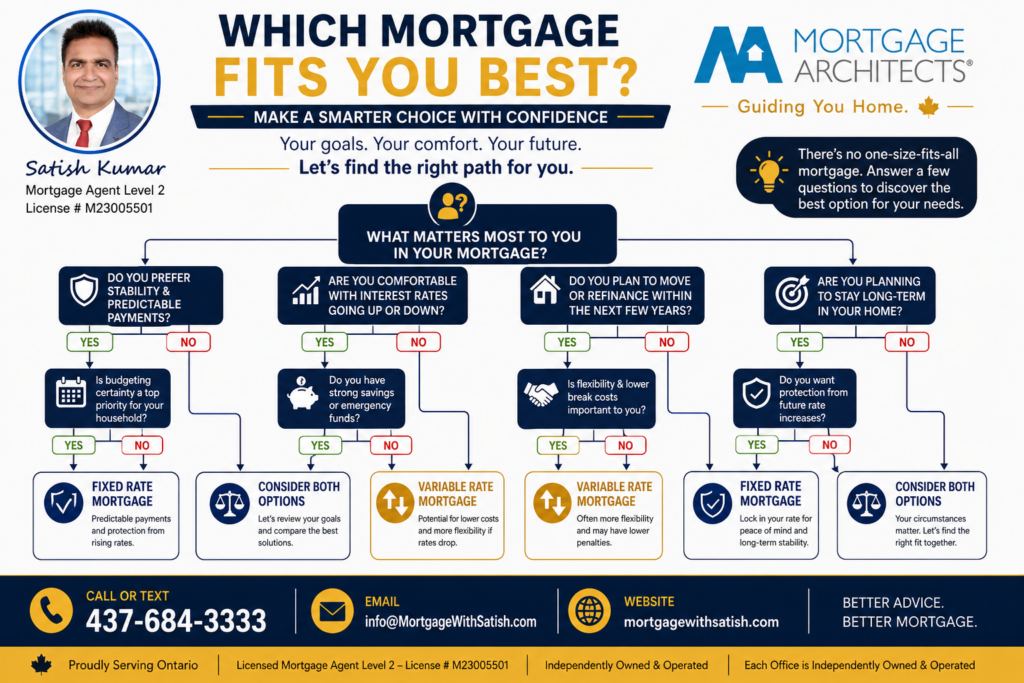
There is no universal “best” mortgage for every first-time home buyer. The right choice depends on your financial goals, monthly budget, future plans, and comfort with interest rate changes. A mortgage that works well for one family may not be the ideal solution for another.
Buying your first home is exciting, but it also comes with many financial decisions. One of the biggest is choosing between a fixed-rate and a variable-rate mortgage.
Instead of asking:
“Which mortgage is better?”
Ask yourself:
- How stable is my monthly income?
- Would changing mortgage payments cause financial stress?
- Do I expect to move within the next few years?
- Am I comfortable if interest rates change?
- Do I value payment stability more than flexibility?
Answering these questions will help you identify the mortgage type that best matches your financial situation.
Buyer Profile Comparison
| Buyer Profile | Fixed Rate | Variable Rate |
|---|---|---|
| First-Time Home Buyer | ⭐⭐⭐⭐⭐ | ⭐⭐⭐ |
| Young Family | ⭐⭐⭐⭐⭐ | ⭐⭐ |
| Self-Employed Borrower | ⭐⭐⭐⭐ | ⭐⭐⭐ |
| Experienced Homeowner | ⭐⭐⭐⭐ | ⭐⭐⭐⭐ |
| Real Estate Investor | ⭐⭐⭐ | ⭐⭐⭐⭐⭐ |
| Borrower with Stable Emergency Savings | ⭐⭐⭐ | ⭐⭐⭐⭐⭐ |
Remember: These are general guidelines. Your personal financial circumstances matter more than any comparison table.
Ontario Case Study #1 – First-Time Home Buyer
Jessica, a first-time home buyer in Ajax, recently purchased her first townhouse.
She wanted predictable housing costs because she was also managing:
- Student loan payments
- Car expenses
- Rising household costs
Although she understood that variable rates could move lower or higher, she chose a fixed-rate mortgage because knowing her monthly payment helped her budget with confidence.
For Jessica, financial certainty was more valuable than trying to benefit from future interest-rate changes.
Ontario Case Study #2 – Experienced Homeowner
Daniel, who owned his second property in Vaughan, had:
- Significant home equity
- A strong emergency fund
- Stable employment
- Additional investment income
Because he was financially prepared to manage changing interest rates, he selected a variable-rate mortgage that aligned with his long-term investment strategy.
His decision reflected his comfort with risk—not an assumption that one mortgage type is always superior.
Satish’s Expert Insight
One of the biggest misconceptions I encounter is that there is a “right answer” for everyone.
There isn’t.
I’ve helped clients choose both fixed and variable mortgages because the recommendation always depends on their financial priorities. A young family focused on stability may have very different needs from an experienced investor who values flexibility.
Fixed vs. Variable During Different Interest-Rate Environments
Interest-rate conditions can influence how each mortgage type behaves over time.
Let’s explore several common scenarios.
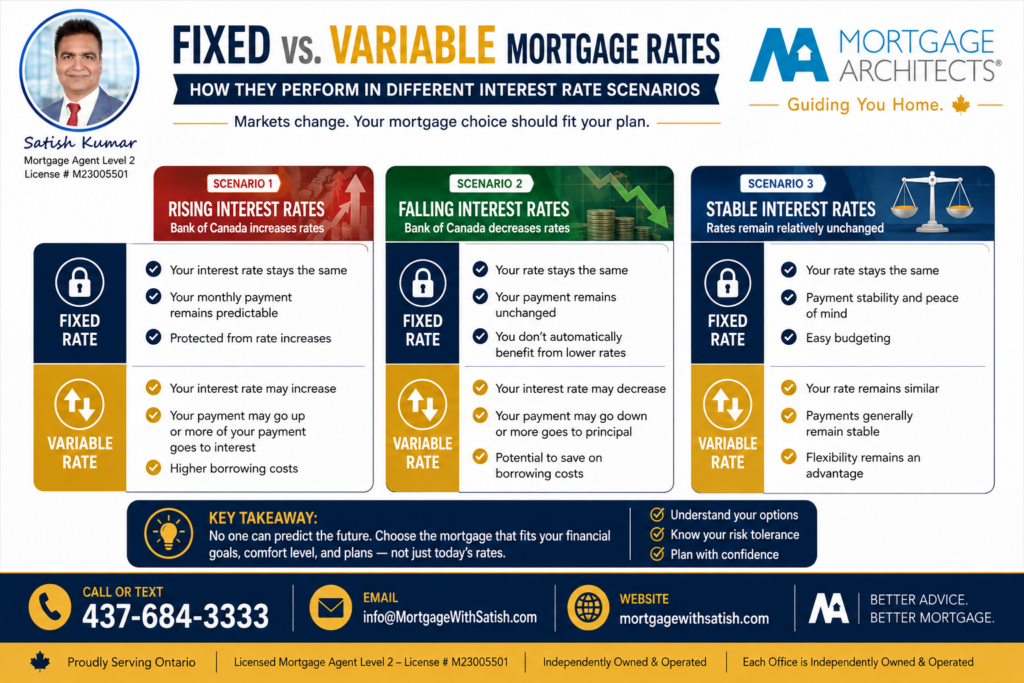
Scenario 1 – Interest Rates Rise
If market borrowing costs increase:
Fixed Mortgage
✓ Your contracted interest rate remains unchanged during your mortgage term.
✓ Your scheduled payment generally stays the same.
Variable Mortgage
Depending on your mortgage agreement:
- Your interest rate may increase.
- Your payment or the interest portion of your payment may change.
Example
Imagine two homeowners purchasing similar homes.
Homeowner A selects a fixed mortgage.
Homeowner B selects a variable mortgage.
If borrowing costs rise during their mortgage term, Homeowner A continues paying the same contracted rate, while Homeowner B may experience higher borrowing costs according to the terms of the mortgage.
Scenario 2 – Interest Rates Fall
When market borrowing costs decrease:
Fixed Mortgage
Your contractual rate remains unchanged until renewal.
Variable Mortgage
Depending on your mortgage product, you may benefit from lower borrowing costs.
Scenario 3 – Stable Interest Rates
If interest rates remain relatively unchanged:
Both mortgage types may perform similarly over the short term.
The deciding factor often becomes:
- Your preference for certainty.
- Your flexibility.
- Potential prepayment considerations.
- Long-term financial plans.
Decision Checklist
Answer the following questions.
Question 1
Do you prefer knowing exactly what your mortgage payment will be every month?
Yes
→ Fixed mortgage may be worth exploring.
Question 2
Can your household comfortably manage changes in borrowing costs?
Yes
→ Variable mortgage may also be an option to discuss.
Question 3
Will you likely move or refinance within the next few years?
This may influence the importance of mortgage flexibility and potential prepayment penalties.
Question 4
Would unexpected payment increases create financial stress?
If so, payment stability may become a higher priority.
Decision Matrix
| Your Priority | Mortgage Type Worth Considering |
|---|---|
| Predictable monthly payments | Fixed Rate |
| Budget certainty | Fixed Rate |
| Long-term family planning | Fixed Rate |
| Flexibility | Variable Rate |
| Comfortable with changing rates | Variable Rate |
| Strong emergency savings | Variable Rate |
| Conservative financial approach | Fixed Rate |
Common Misconceptions
Myth
Fixed mortgages are always cheaper.
Fact
Borrowing costs depend on the interest-rate environment, mortgage product, and your financial situation. Neither mortgage type is universally less expensive.
Myth
Variable mortgages are too risky.
Fact
Variable mortgages can be appropriate for borrowers who understand the potential for changing borrowing costs and have the financial flexibility to manage them.
Myth
Everyone should choose whatever rate is lowest today.
Fact
The lowest advertised rate isn’t always the best financial decision. Flexibility, penalties, payment stability, and future plans are equally important considerations.
Questions to Ask Before Choosing
Before selecting a mortgage, consider asking:
- What are the prepayment privileges?
- What are the penalties if I break my mortgage?
- How will my payments be affected if interest rates change?
- Can I increase my payments?
- Can I make lump-sum payments?
- What happens at renewal?
- Does this mortgage fit my long-term financial goals?
Satish’s Expert Insight
The lowest interest rate often attracts the most attention, but it’s only one part of the decision. I encourage clients to look at the complete mortgage package—including flexibility, repayment options, penalties, and how the mortgage supports their future plans. A mortgage should work for your life, not just your budget today.
Mortgage Renewal: Should You Stay with the Same Mortgage Type?
Quick Answer
Mortgage renewal is an excellent opportunity to review your financial goals, current interest rate environment, and mortgage needs. Instead of automatically renewing with the same lender or mortgage type, compare your options to ensure they still align with your circumstances.
Many Canadian homeowners simply sign their lender’s renewal offer without exploring alternatives. While this may seem convenient, it isn’t always the most cost-effective or suitable decision.
At renewal, ask yourself:
- Have my financial goals changed?
- Has my household income increased?
- Am I planning to move?
- Do I need greater payment certainty?
- Would more flexibility benefit me?
Your answers may suggest keeping your current mortgage type—or switching to another option.
When It May Make Sense to Choose a Fixed Mortgage at Renewal
A fixed-rate mortgage may be worth considering if:
- You prefer stable monthly payments.
- Your household budget has become tighter.
- You expect major life events, such as a growing family or career change.
- You value certainty over flexibility.
- Predictable housing costs are a priority.
When It May Make Sense to Explore a Variable Mortgage
A variable-rate mortgage may be worth discussing if:
- You have stable income and strong cash reserves.
- You are comfortable with changing borrowing costs.
- You expect to make additional mortgage payments.
- Flexibility is an important consideration.
- Your long-term financial strategy supports managing interest-rate changes.
Ontario Renewal Example
Amanda and Chris purchased their home in Brampton five years ago using a fixed-rate mortgage.
At renewal:
- Their incomes had increased.
- They had built substantial emergency savings.
- They planned to make annual lump-sum payments.
Rather than automatically accepting their lender’s renewal offer, they compared several mortgage options with a mortgage professional and selected a solution that better matched their updated financial goals.
Satish’s Expert Insight
Many homeowners focus only on the renewal rate. In my experience, renewal is also the perfect time to review prepayment privileges, flexibility, penalties, refinancing opportunities, and long-term financial objectives. The lowest rate doesn’t always provide the greatest overall value.
Breaking Your Mortgage Early
Quick Answer
If you repay your mortgage before the end of your mortgage term, your lender may charge a prepayment penalty. The amount depends on your mortgage agreement and whether you have a fixed-rate or variable-rate mortgage.
Homeowners sometimes need to break their mortgage because they are:
- Selling their home.
- Refinancing.
- Relocating.
- Separating from a spouse.
- Consolidating debt.
- Purchasing another property.
Understanding potential penalties before choosing a mortgage can help avoid unexpected costs later.
Why Prepayment Penalties Matter
Breaking a mortgage early can sometimes cost thousands of dollars.
That’s why it’s important to consider more than just the advertised interest rate when choosing between fixed and variable mortgages.
Questions to Ask Before Signing
Before committing to any mortgage, ask:
- How are prepayment penalties calculated?
- Can I transfer my mortgage to another property?
- What prepayment privileges are included?
- Can I make lump-sum payments?
- Can I increase my regular payment?
- What happens if I refinance?
Understanding these details now can help prevent expensive surprises later.
Seven Costly Mortgage Mistakes to Avoid
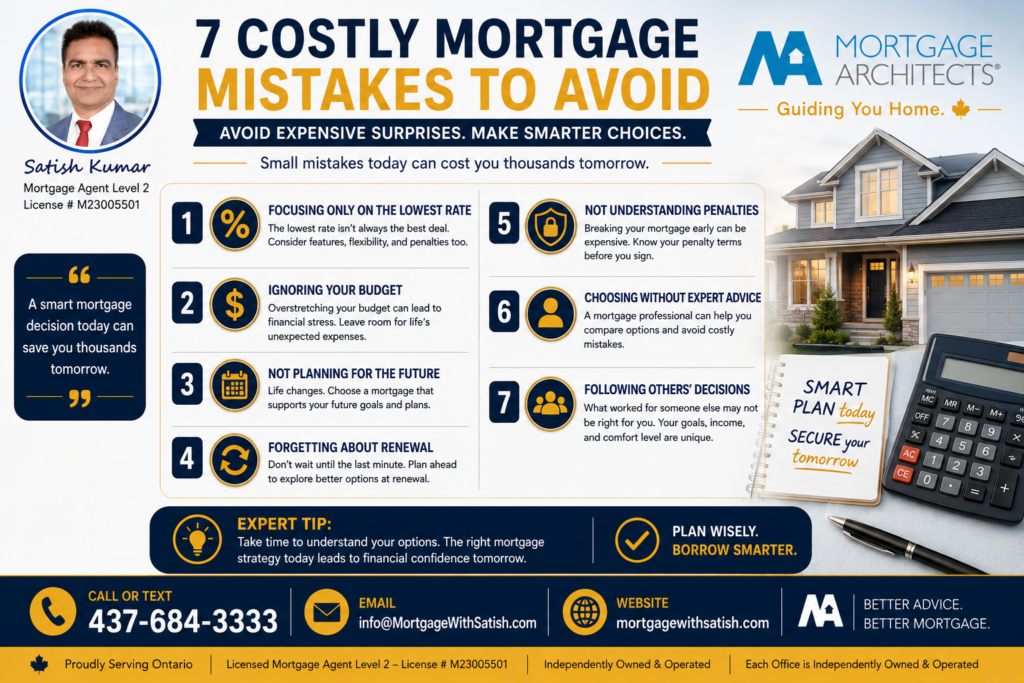
Choosing the wrong mortgage doesn’t always happen because of the interest rate. Often, it’s the result of overlooking important details.
Mistake #1 – Choosing Based Only on the Lowest Rate
A lower advertised rate doesn’t automatically mean a better mortgage.
Important features include:
- Flexibility
- Prepayment options
- Portability
- Penalties
- Overall suitability
Mistake #2 – Ignoring Your Budget
A mortgage should fit comfortably within your monthly budget—not stretch it to the limit.
Always leave room for:
- Property taxes
- Utilities
- Home maintenance
- Insurance
- Unexpected expenses
Mistake #3 – Not Planning for Future Life Changes
Think about:
- Marriage
- Children
- Career changes
- Retirement
- Investment goals
Your mortgage should support your future—not limit your options.
Mistake #4 – Forgetting About Renewal
Many borrowers focus on today’s interest rate but overlook what happens when the mortgage term ends.
Planning ahead makes renewal much easier.
Mistake #5 – Not Understanding Mortgage Penalties
Prepayment penalties vary by mortgage product.
Knowing how they work before signing can help avoid unnecessary costs.
Mistake #6 – Choosing Without Professional Advice
Every borrower has different financial goals.
Working with an experienced mortgage professional can help you compare options objectively and understand the trade-offs involved.
Mistake #7 – Assuming Friends or Family Have the Right Answer
A mortgage that worked well for someone else may not be the best choice for your financial situation.
Your mortgage decision should be based on your own goals, income, and risk tolerance.
Mortgage Myths vs. Facts
| Myth | Reality |
|---|---|
| Fixed mortgages are always the safest choice. | The right choice depends on your financial goals and circumstances. |
| Variable mortgages always save money. | Borrowing costs can change over time, and outcomes vary. |
| The lowest rate is always the best mortgage. | Flexibility, penalties, and mortgage features also matter. |
| Renewal offers are always competitive. | Comparing options at renewal may reveal alternatives worth considering. |
| Mortgage decisions should focus only on today’s rates. | Long-term financial planning is equally important. |
Mortgage Selection Checklist
Before choosing your mortgage, ask yourself:
✅ Do I understand both mortgage options?
✅ Can I comfortably manage changing borrowing costs?
✅ How important is payment stability?
✅ What are the prepayment privileges?
✅ What are the penalties for breaking the mortgage?
✅ Am I planning to move during the mortgage term?
✅ Have I compared more than one lender?
✅ Have I received professional mortgage advice?
Satish’s Expert Insight
The mortgage you choose today should still make sense three or five years from now. Rather than focusing solely on today’s interest rate, I encourage clients to think about flexibility, future plans, and how their mortgage fits into their broader financial picture. Taking a little extra time before signing can help you make a more confident decision.
Key Takeaways
- There is no universally “best” mortgage type.
- Fixed-rate mortgages provide payment stability and predictability.
- Variable-rate mortgages offer flexibility for borrowers comfortable with changing borrowing costs.
- Renewal is an opportunity to reassess your financial goals—not just accept the first offer.
- Understanding penalties, prepayment options, and long-term plans is just as important as comparing interest rates.
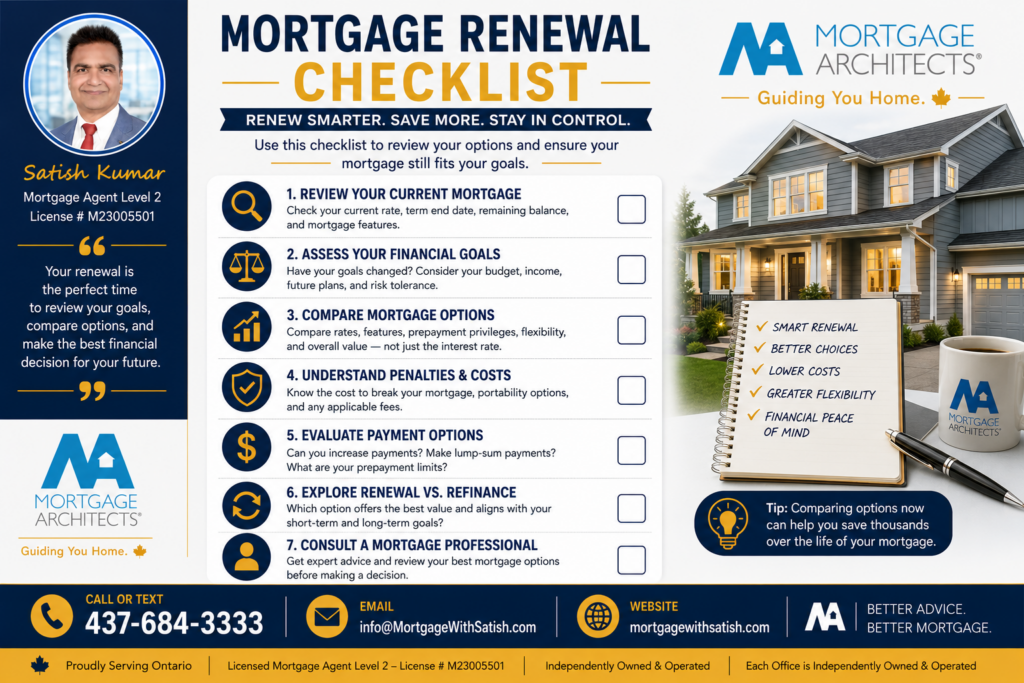
Is a fixed or variable mortgage better in Canada?
There isn’t a single answer that fits everyone. A fixed-rate mortgage offers predictable payments, while a variable-rate mortgage may suit borrowers who are comfortable with changing borrowing costs. The right choice depends on your financial goals, budget, and risk tolerance.
Are fixed mortgage rates always higher than variable rates?Are fixed mortgage rates always higher than variable rates?
Not always. The relationship between fixed and variable rates changes over time based on economic conditions and lender pricing. Comparing the complete mortgage package—not just the interest rate—is important.
Can I switch from a variable mortgage to a fixed mortgage?
Many lenders allow borrowers to convert a variable-rate mortgage to a fixed-rate mortgage during the term, although the available options and conditions vary by lender.
Can I switch from a fixed mortgage to a variable mortgage?
This may be possible, but it often involves breaking your existing mortgage, which could result in prepayment penalties. Review your mortgage agreement and speak with your lender or mortgage professional before making changes.
Which mortgage is better for first-time home buyers?
Many first-time buyers appreciate the stability of fixed payments, while others may prefer the flexibility of a variable-rate mortgage. The best option depends on your income, budget, and comfort with changing interest rates.
Do fixed mortgage payments ever change?
Scheduled payments for a fixed-rate mortgage are generally predictable during the mortgage term unless you voluntarily increase payments, make lump-sum prepayments, or modify your mortgage agreement.
How often do variable mortgage rates change?
Variable mortgage rates typically change when a lender adjusts its prime lending rate. The timing and frequency depend on economic conditions and lender decisions.
What happens if interest rates increase?
A fixed-rate mortgage continues at the contracted rate during the term. With a variable-rate mortgage, borrowing costs may increase according to the terms of your mortgage agreement.
Can I make extra mortgage payments?
Many mortgage products allow prepayments, but the amount and timing vary. Always review your mortgage agreement to understand your prepayment privileges.
Which mortgage usually has lower penalties?
Penalty calculations vary by lender and mortgage product. It’s important to understand how penalties work before choosing a mortgage, particularly if you may move or refinance before the end of your term.
Should I simply accept my lender’s renewal offer?
Not necessarily. Renewal is an opportunity to compare options, review your financial goals, and ensure your mortgage still meets your needs.
Is the lowest mortgage rate always the best choice?
No. A mortgage should be evaluated based on interest rate, flexibility, prepayment privileges, penalties, portability, and how well it aligns with your long-term financial plans.
How do I know which mortgage is right for me?
Consider factors such as:
– Your monthly budget
– Income stability
– Future plans
– Emergency savings
– Risk tolerance
– Payment preferences
A mortgage professional can help you compare options and understand the trade-offs.
Can I refinance before my mortgage term ends?
Yes, but refinancing before maturity may result in prepayment penalties depending on your mortgage agreement.
Should investors choose fixed or variable mortgages?
Some investors value flexibility, while others prioritize predictable borrowing costs. The appropriate mortgage type depends on the investment strategy, cash flow, and financial objectives.
Action Plan: Choose Your Mortgage with Confidence
Follow these practical steps before selecting or renewing your mortgage:
Step 1 – Review Your Financial Situation
Assess your:
- Monthly income
- Household expenses
- Existing debts
- Emergency savings
- Future financial goals
Step 2 – Understand Your Risk Tolerance
Ask yourself:
- Would changing mortgage payments cause financial stress?
- Do I prefer predictable housing costs?
- Am I comfortable with uncertainty?
Step 3 – Compare Mortgage Options
Don’t compare only interest rates.
Evaluate:
- Mortgage features
- Prepayment privileges
- Flexibility
- Penalties
- Portability
- Renewal options
Step 4 – Consider Your Long-Term Plans
Think about:
- Moving
- Growing your family
- Renovations
- Investment properties
- Career changes
- Retirement planning
Step 5 – Get Professional Mortgage Advice
Every borrower’s financial situation is unique.
Understanding the trade-offs between different mortgage products can help you make a decision that supports your long-term goals.
Final Thoughts
Choosing between a fixed-rate and a variable-rate mortgage isn’t about predicting the future—it’s about selecting a mortgage that fits your financial situation, your comfort with risk, and your long-term plans.
For some borrowers, predictable payments provide valuable peace of mind. For others, flexibility may better align with their financial strategy.
Rather than focusing solely on today’s interest rates, consider the complete mortgage package, including payment stability, prepayment options, penalties, and your future plans.
An informed decision today can help you feel more confident throughout your mortgage journey.
Ready to Discuss Your Mortgage Options?
Whether you’re:
- Buying your first home
- Purchasing your next property
- Renewing your mortgage
- Refinancing
- Investing in real estate
I’m here to help you understand your options and compare mortgage solutions that fit your financial goals.
Satish Kumar
Mortgage Agent Level 2
Mortgage Architects
📞 437-684-3333
📧 info@MortgageWithSatish.com
🌐 mortgagewithsatish.com