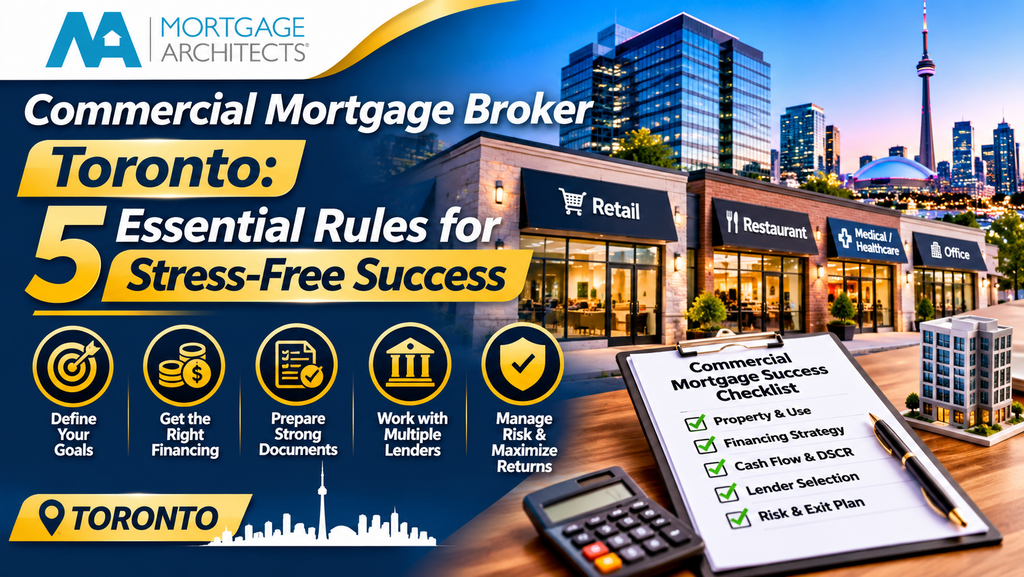
Finding the right commercial mortgage broker Toronto clients can trust means knowing the key Ontario rules and steps to manage risk and costs when buying or refinancing a business-use property.
Written by Satish Kumar, Licensed Mortgage Agent with Mortgage Architects (12728). Last updated November 4, 2026.
Quick answer
A commercial mortgage broker Toronto uses arranges financing for business-use or income-generating properties, connecting borrowers with lenders and navigating Ontario regulations. Licensing, disclosures, and clear information about fees and risks are crucial for successful borrowing in Ontario’s commercial real estate market.
Key takeaways
- In Ontario, commercial mortgage brokers must be licensed by FSRA unless exempt.
- Brokers must give written disclosures covering their role, fees, risks, and conflicts of interest.
- Rules for costs and timing differ if the borrower is a business or the mortgage is for business purposes.
- Commercial loan terms can vary widely by property, lender, and business plan.
- Checking licensing and disclosures helps borrowers avoid surprises during the process.
What does a commercial mortgage broker Toronto arrange?
A commercial mortgage broker Toronto helps clients secure financing for properties used for business or rental income, such as offices, retail, or multi-unit residential buildings.
This type of mortgage is not for owner-occupied homes, but typically for properties like office towers, shopping plazas, factories, or apartment buildings. The broker matches borrowers to lenders able to finance these commercial projects and guides them through the application and closing process.
- Types of properties: Office, retail, industrial, apartment buildings, development sites
- Clients served: Investors, business owners, partnerships, corporations
- Purpose: Purchase, refinance, renovation, development, expansion
The process often involves special documentation, due diligence on property income, business plans, and potential private lenders depending on the deal structure.
Is a commercial mortgage broker Toronto required to be licensed?
Yes, in most cases, any commercial mortgage broker Toronto must be licensed with the Financial Services Regulatory Authority of Ontario (FSRA), unless a specific exemption applies.
Ontario law requires that mortgage brokerages and agents acting in commercial transactions hold an FSRA licence. Before working with a broker or accepting mortgage recommendations, you can check the licence status through FSRA, Ontario’s financial regulator.
This licensing requirement is designed to protect borrowers and ensure professionals follow the province’s disclosure, conduct, and advertising rules.
| Who must be licensed? | Exceptions |
|---|---|
| Most individuals or companies brokering commercial mortgages | Certain exemptions (for example, some private-party direct deals or internal corporate lending) |
What disclosures does a commercial mortgage broker Toronto have to provide?
Commercial mortgage brokers Toronto clients use must provide written disclosures, describing their role, fees and remuneration, lender/borrower relationships, conflicts, and material risks of the proposed mortgage.
Transparency is required about:
- The broker’s client relationship (representing the borrower, lender, or both)
- All brokerage, lender, or referral fees
- Conflicts of interest (existing or potential)
- Risks of the mortgage being proposed
For some borrowers, Ontario’s cost-of-borrowing rules also require these disclosures at least two business days before committing, unless the client signs a waiver. Business-purpose and corporate mortgages are generally exempt from these timing rules, but all commercial brokers must still disclose relationships, fees, and risks.
What does Ontario’s ‘business-purpose exception’ mean for commercial mortgage broker Toronto clients?
The business-purpose exception means that if the borrower is a corporation or the mortgage is for business purposes, some cost-disclosure rules do not apply.
Ontario’s Cost of Borrowing and Disclosure to Borrowers regulation usually does not cover mortgages where:
- The borrower is not an individual (e.g., a corporation)
- The mortgage is obtained for business, not personal, purposes (even if the borrower is a person)
Other rules, such as disclosure of fees, roles, risks, and conflicts, still apply for commercial mortgage transactions. This exception may affect the timing and type of information a borrower receives, making it important to ask for everything in writing early in the process.
How should Toronto borrowers compare commercial mortgage options?
Commercial mortgage broker Toronto clients should compare more than just the interest rate—total terms, fees, risks, and closing timelines matter.
Since commercial mortgage terms vary with the property type, lender, and business plan, it’s important to look at:
- Full fee breakdown: brokerage, lender, referral, legal, and appraisal costs
- Loan amount vs. property value (loan-to-value ratio)
- Amortization, payment frequency, and prepayment/renewal terms
- Material risks associated with the deal or the property
- Conditions for funding and closing deadlines
Having clear understanding of each term and requirement can help Toronto borrowers (from small business owners to large investors) avoid delays or financial surprises. For more details about types of mortgage costs and planning, see the CMHC guide to planning and managing your mortgage.
Can a commercial mortgage broker Toronto recommend private lenders?
Yes, a commercial mortgage broker Toronto can bring deals to private lenders, but prescribed disclosures about risks, fees, and parties involved are required.
Private lenders—such as individuals, mortgage investment corporations, or groups—often consider loans that banks may not. Still, the broker must outline the details, including:
- How the lender is compensated
- Main risks for borrowers and investors
- Conflicts of interest if any party is related or has a stake in the transaction
This is crucial for transparency and for investors or borrowers to evaluate if the private mortgage is suitable for their business or investment plan.
What this means for Ontario homebuyers
For homebuyers and investors in Ontario, a commercial mortgage is not simply a bigger version of a residential loan. Instead, it is tailored to the property’s income, business plan, and unique risks. The rules above ensure that commercial mortgage broker Toronto professionals provide licensing, disclosure, and conflict management to help borrowers make informed decisions. If you’re moving from residential to commercial property, understanding these differences matters for your financing success.
Frequently asked questions
How do I check if my commercial mortgage broker Toronto is licensed?
You can confirm if your commercial mortgage broker Toronto holds a valid licence by searching the broker or brokerage name on FSRA, Ontario’s financial regulator. This helps protect borrowers and ensures the broker is authorized to transacting in Ontario.
What are typical documents a commercial mortgage broker Toronto asks for?
Documents often include your purchase agreement, financial statements, business plan, rent rolls, property details, appraisals and legal entity paperwork. Requirements can vary depending on the lender and property type.
When do I receive disclosure about fees from my commercial mortgage broker Toronto?
Disclosure of all brokerage, referral, and lender fees should be provided in writing before you agree to the mortgage. Some timing rules may not apply to business-purpose or corporate deals but you can still ask your broker for written breakdowns of every cost in advance.
Does the broker represent me or the lender?
Your commercial mortgage broker Toronto should disclose in writing whether they represent you, the lender, or both. This relationship can affect the advice you receive and any recommendations about mortgage products or lenders.
Do commercial mortgage rates in Toronto follow a standard range?
Commercial mortgage rates and terms in Toronto vary by lender, property type, location, and business plan. There is no province-wide or city-wide standard rate. Comparing all terms and asking detailed questions helps ensure you understand the full cost and risk.
If you’re ready to explore your options, you can book a free discovery call to discuss your commercial property plans and next steps.
Related Guides From Satish
Official Resources
- Mortgages: what to know (Financial Consumer Agency of Canada)
- Financial Services Regulatory Authority of Ontario (FSRA)
Disclaimer: This post is for general information only and does not provide personalized mortgage or financial advice. Mortgage options and rules may change and vary by lender and borrower. Please check all requirements with a licensed Ontario mortgage professional.