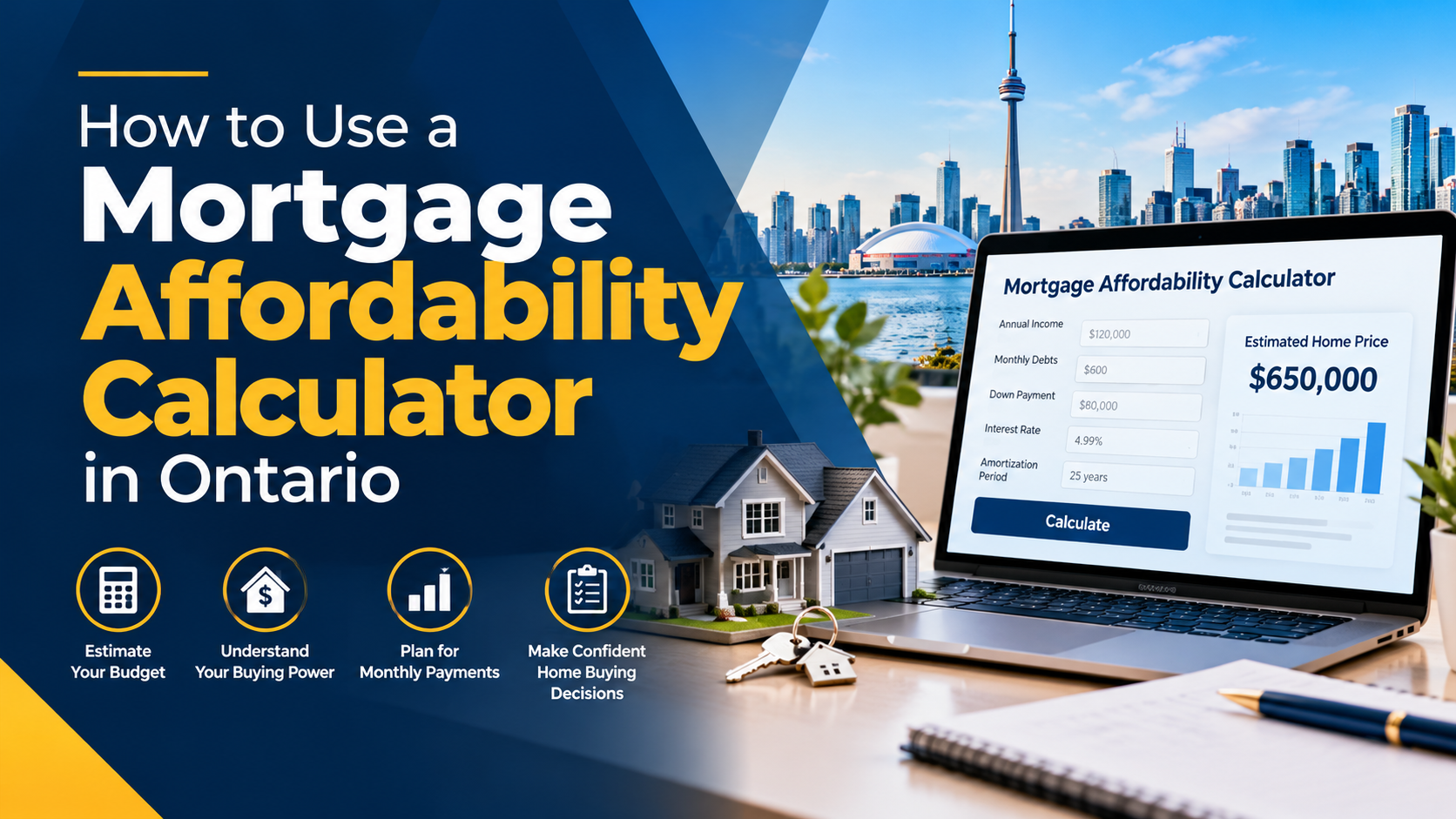
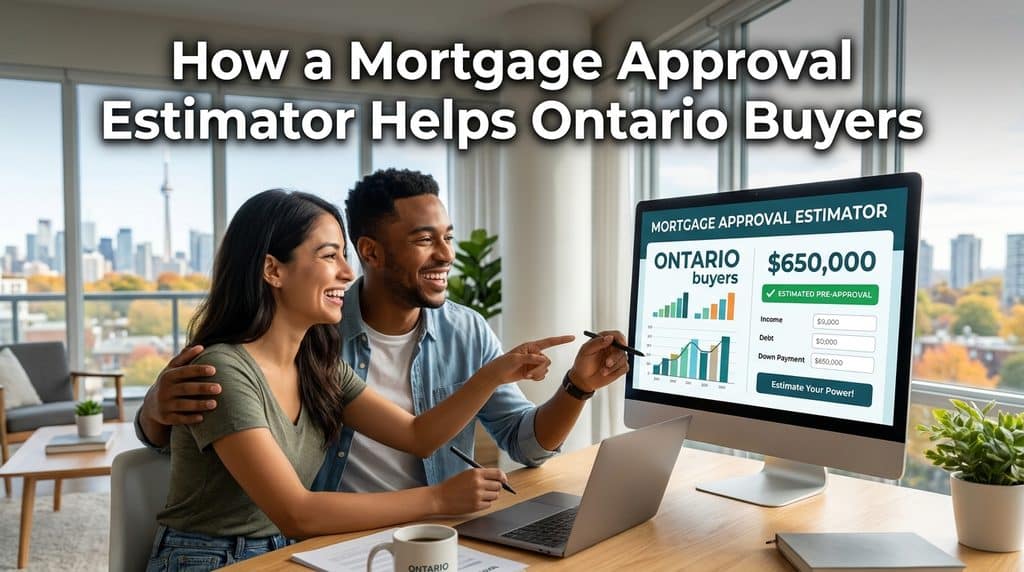
Understanding how much mortgage you may be approved for is a key step in your Ontario home buying journey. A mortgage approval estimator is a tool designed to help you estimate how much home you may be able to afford. It is not a lender’s approval, but it can be a powerful planning guide, especially for first-time buyers in Durham Region and the GTA.
Key takeaways
- A mortgage approval estimator gives a planning number, not a lender’s approval or guaranteed amount. Actual approval depends on a lender’s review.
- Reliable estimators include your income, debts, down payment, property taxes, heating, and, if applicable, condo fees.
- Lenders use federal rules, including the mortgage stress test, to determine affordability—not just advertised rates.
- Specific Ontario housing costs like property tax and condo fees can make a big difference in your estimate.
- Results are not a promise; review your number with a mortgage agent for a realistic assessment.
What does a mortgage approval estimator do?
A mortgage approval estimator helps Ontario homebuyers see whether their income, debts, and housing costs fit within common lender affordability limits. It will:
- Estimate your mortgage amount and payment using your down payment, loan length, and a sample interest rate. Try the CMHC mortgage calculator to see how different scenarios affect your monthly cost.
- Check your Gross Debt Service (GDS) ratio: housing costs—including mortgage principal and interest, property taxes, heating costs, and, if applicable, condo fees—as a share of gross household income. CMHC’s debt service calculator uses a maximum of 39% for GDS.
- Calculate your Total Debt Service (TDS) ratio: housing costs plus any other recurring debts (like car loans or minimum credit card payments) as a share of gross income. Maximum TDS is usually 44% (CMHC debt service calculator).
- Offer an affordability estimate when you enter your living situation and monthly expenses, much like the CMHC affordability calculator.
This lets you check if you’re in line with the common lender criteria before you even start shopping for a specific home.
How does the mortgage stress test affect your estimate?
Canada’s federal stress test rules require lenders to qualify most mortgage applicants at the higher of 5.25% or the contract rate plus 2%, not simply the rate you see advertised (source; source). This means that when you use a mortgage approval estimator, you should see both:
- Your actual projected payment at the expected contract rate (what you might actually pay).
- The payment at the qualifying (stress test) rate, which is often higher and determines how much mortgage the lender will consider you for.
An estimator that only uses the advertised rate may overstate your true maximum. Be sure your tool includes the stress test so you have a more realistic budget.
What should you include in your estimate?
Accurate results depend on entering realistic, specific numbers. The CMHC debt service calculator recommends using the actual expenses for the home you’re considering—not your current home. For Ontario households, important details are:
- Property taxes: Rates vary greatly across the GTA and Durham Region, and between condo and freehold homes.
- Heating costs: Enter an honest monthly average for the property type.
- Condo or maintenance fees: If buying a condo, include the precise monthly fee.
- Other debts: Report all recurring debt payments, including car loans and minimum credit card payments, which factor into your affordability calculation via TDS.
The limits of an estimator: not a guarantee
It’s important to remember that a mortgage approval estimator is simply a planning tool—and is not a loan approval, commitment, or promise of any kind. The CMHC calculators make it clear they are for estimates only. Your actual approval depends on your chosen lender’s review of your full application, your financial profile, and the property you select. Rules and rates change regularly and vary by lender and borrower.
How to use an online estimator wisely
- Treat your estimator result as a budget check—not a shopping target. It simply shows whether you’re in the ballpark to consider homebuying.
- If you’re comparing homes, enter taxes and fees for each to find the real monthly carrying cost.
- Use recent Canadian rate data as your starting point and see how changes affect your eligibility.
- Double-check everything with a mortgage professional before making offers.
What this means for Ontario homebuyers
For buyers in Durham Region and the GTA, a mortgage approval estimator is a smart way to jumpstart your planning. By inputting your income, debts, down payment, and property-specific costs, you can see how your budget fits typical lender guidelines—including the stress test. Remember:
- The result is an estimate, not a binding approval.
- Lender guidelines, such as the 39% GDS and 44% TDS rules, help you determine a comfortable, sustainable budget (CMHC tool).
- Your own comfort with monthly payments should matter just as much as the maximum on any calculator.
Always review your estimate and next steps with a local mortgage agent. Nova Scotia and Ontario both rely on these calculations, but local costs and property taxes can vary a lot even between neighbourhoods.
Frequently asked questions
How accurate is a mortgage approval estimator?
The accuracy depends on the details you enter and the tool’s assumptions. CMHC calculators use widely accepted guidelines, but the result is always an estimate, not a guarantee. Lender approval depends on their full review of your application.
Does the estimator include the mortgage stress test?
The best estimators will show both your payment at the contract rate and at the qualifying (stress test) rate. The stress test can mean you qualify for less than you expect. Ensure the tool you use covers this (learn more about the stress test).
Do I need to include all my debts and costs?
Yes, for an accurate estimate you should include car loans, credit cards, property taxes, heating, and condo fees. Leaving any out may overstate how much mortgage a lender could consider for you.
Is the calculator result the same as a lender’s pre-approval?
No. An online mortgage approval estimator gives you a ballpark number, but it is not a lender’s pre-approval or commitment. For the next step, meet with a mortgage professional and submit a full application.
Ready for a clearer picture of your homebuying options? Book a free discovery call with Satish Kumar, Licensed Mortgage Agent with Mortgage Architects, to review your unique scenario—and get answers to all your questions.
Disclaimer: This content is for general information only and is not personalized mortgage or financial advice. Please consult a licensed mortgage professional for advice regarding your specific situation.