

Executive Summary
Buying your first home is one of the biggest financial decisions you’ll ever make. While the process can seem overwhelming, understanding how mortgages, down payments, government programs, and closing costs work can help you buy with confidence.
Whether you’re purchasing a condo in Toronto, a townhouse in Ajax, a detached home in Durham Region, or an investment property in another Ontario community, preparation is the key to success.
This guide explains every major step of the first-time home buying journey—from saving for a down payment to getting mortgage approval and closing on your new home. It also covers important federal and Ontario-specific programs that may reduce your upfront costs, such as the First Home Savings Account (FHSA), the Home Buyers’ Plan (HBP), and Ontario’s Land Transfer Tax Refund for eligible buyers.
Quick Answer
A first-time home buyer in Canada is generally someone purchasing their first qualifying home and may be eligible for government programs, tax credits, and rebates. The exact eligibility depends on the specific program. Preparing your finances, obtaining a mortgage pre-approval, and understanding your total purchase costs can make the buying process smoother and improve your chances of securing the right mortgage.
Featured Snippet Answer
First-time home buyers in Ontario can benefit from mortgage pre-approval, government savings programs such as the FHSA and Home Buyers’ Plan, and eligible tax credits or rebates. Understanding down payment requirements, closing costs, and mortgage qualification rules before shopping for a home helps reduce surprises and supports a more confident purchase.
Key Takeaways
- Buying your first home requires more than just saving a down payment.
- Mortgage pre-approval should be completed before house hunting.
- Several federal and Ontario programs may reduce your purchase costs.
- Understanding affordability helps avoid financial stress after closing.
- Professional mortgage advice can help you compare lenders and mortgage options.
Table of Contents
Introduction
Buying your first home is exciting, but it also comes with many important financial decisions. Many buyers focus only on finding the perfect property, when the most successful purchases actually begin months earlier with careful planning.
As an Ontario Mortgage Agent, one of the most common situations I see is buyers finding their dream home before understanding how much they can comfortably afford. That can lead to disappointment, rushed decisions, or unnecessary financial pressure.
Instead, think of home buying as a series of well-planned steps:
- Understand your finances.
- Build your savings.
- Improve your credit if needed.
- Obtain mortgage pre-approval.
- Understand available government programs.
- Shop confidently within your budget.
Following this approach can make the buying process far less stressful and help you avoid costly mistakes.
Who Is Considered a First-Time Home Buyer?
The definition of a “first-time home buyer” varies depending on the specific federal or provincial program. Some programs consider whether you have owned or lived in a home within a defined period, while others have different eligibility rules. Always review the requirements for the particular benefit you’re using before assuming you qualify.
Common examples include:
- Individuals purchasing their very first home.
- Couples buying their first principal residence together (program rules vary).
- Eligible newcomers to Canada, depending on the specific program.
- Buyers who meet the eligibility requirements for the FHSA or Home Buyers’ Plan.
Satish’s Expert Insight
Many buyers believe that once they’ve owned any property, they permanently lose access to every first-time buyer program. In reality, each program has its own eligibility rules. Reviewing those rules early in the planning process can help you take advantage of benefits you may still qualify for.
Key Takeaways
- “First-time home buyer” does not have a single universal definition.
- Eligibility depends on the specific federal or provincial program.
- Review each program individually before making financial decisions.
Why Planning Early Makes a Huge Difference
Buying a home is not simply about qualifying for a mortgage—it’s about becoming financially prepared for homeownership.
Starting your preparation 6–12 months before buying gives you time to:
- Improve your credit score.
- Save a larger down payment.
- Reduce existing debt.
- Build stable employment history.
- Increase your savings for closing costs.
- Open and contribute to an FHSA if eligible.
- Organize documents for faster mortgage approval.
Comparison Table: Buying Without a Plan vs Buying with a Plan
| Without Planning | With Proper Planning |
|---|---|
| Limited lender options | More lender choices |
| Smaller down payment | Larger savings |
| Higher monthly payments | Better affordability |
| Greater risk of mortgage denial | Stronger approval chances |
| Unexpected closing costs | Budget prepared in advance |
| More stress | Greater confidence |
Satish’s Expert Insight
The buyers who enjoy the smoothest transactions are rarely those with the highest incomes—they’re usually the ones who started preparing well before they began viewing homes. A few months of planning can improve mortgage options, reduce stress, and strengthen your negotiating position.
Key Takeaways
- Preparation often matters more than timing the market.
- Saving beyond the down payment is essential.
- Early financial planning creates more mortgage flexibility.
The Complete Home Buying Journey
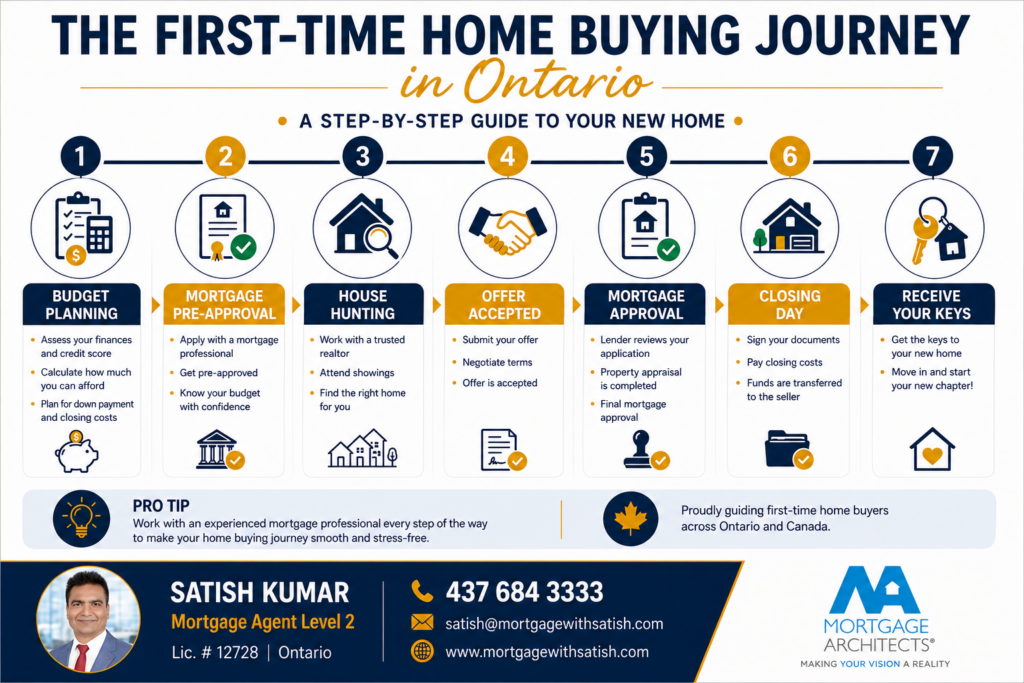
Buying your first home is a process, not a single event. Understanding each step helps you stay organized, avoid surprises, and make confident decisions.
Step 1: Review Your Financial Health
Before applying for a mortgage, evaluate your:
- Income stability
- Monthly expenses
- Existing debt
- Credit history
- Savings
- Employment history
Most lenders assess your overall financial picture rather than focusing on just one factor.
Step 2: Determine Your Budget
Buying the maximum amount a lender approves isn’t always the best financial decision.
Consider:
- Monthly mortgage payment
- Property taxes
- Home insurance
- Utilities
- Condo fees (if applicable)
- Maintenance and repairs
- Emergency savings
A comfortable mortgage is usually better than stretching your finances to the limit.
Step 3: Get Mortgage Pre-Approved
A mortgage pre-approval is one of the smartest steps you can take before shopping for a home.
It helps you:
- Understand your purchasing budget
- Estimate monthly payments
- Demonstrate you’re a serious buyer
- Reduce uncertainty during negotiations
- Identify potential qualification issues early
A pre-approval is based on the information available at the time of application. Final approval still depends on factors such as the property, updated financial information, and lender requirements.
MortgageWithSatish Expert Insight
Many buyers start attending open houses before getting pre-approved. While this can be exciting, it often leads to disappointment if the homes they fall in love with are outside their approved budget. Starting with a pre-approval keeps your search realistic and focused.
Key Takeaways
- Review your finances before applying.
- Choose a comfortable budget, not just the maximum approval.
- Obtain mortgage pre-approval before making offers.
- Final mortgage approval depends on both you and the property.
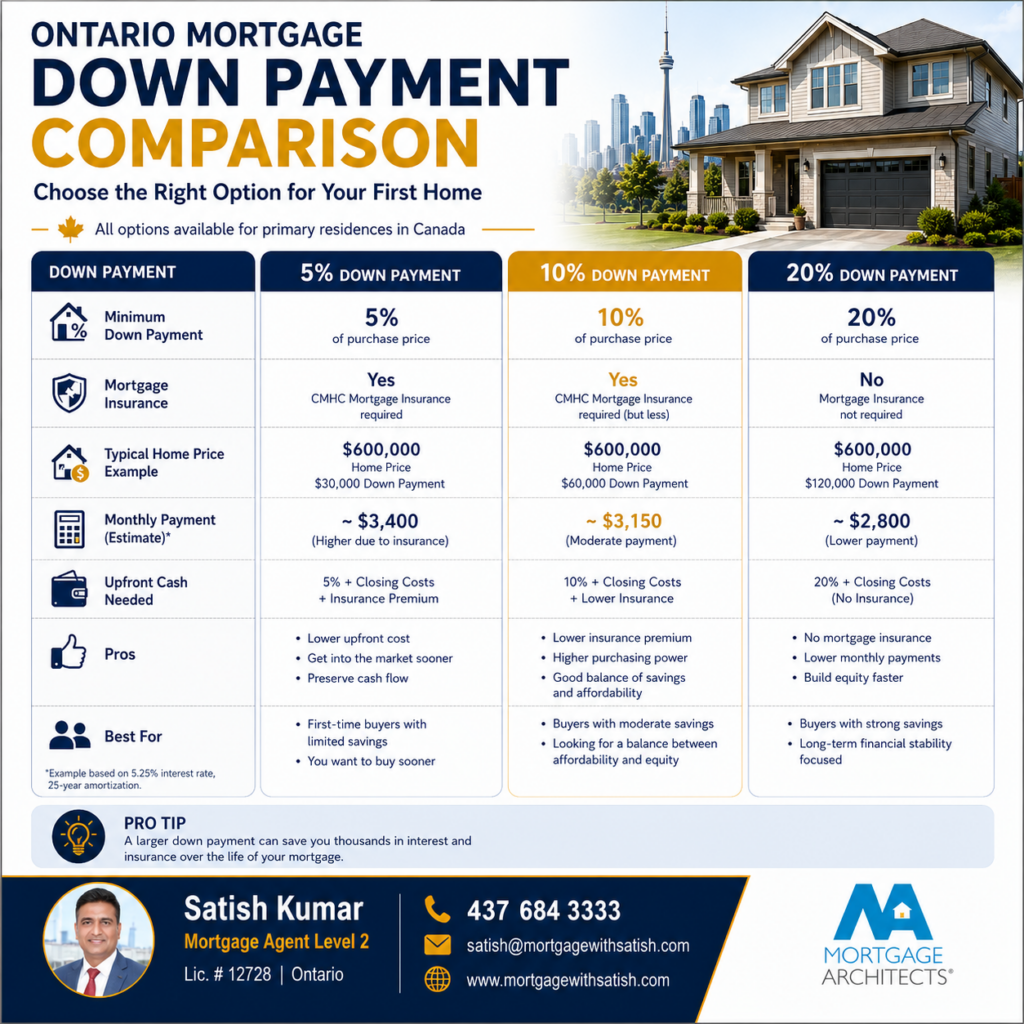
How Much Down Payment Do You Need?
Your required minimum down payment depends on the purchase price of the home and applicable mortgage rules. Higher down payments generally reduce borrowing costs and may provide more financing options. Current requirements are established under federal mortgage rules and should always be verified before purchasing. ([CMHC])
Saving beyond the minimum down payment is equally important because you’ll also need funds for closing costs and moving expenses.
Example Down Payment Comparison
| Down Payment | Advantages | Considerations |
|---|---|---|
| Minimum Required | Enter the market sooner | May require mortgage default insurance |
| Moderate Down Payment | Lower mortgage balance | More savings needed before buying |
| Larger Down Payment | Lower monthly payments and borrowing costs | Longer time required to save |
Satish’s Expert Insight
Many first-time buyers focus entirely on reaching the minimum down payment. In practice, having additional savings for legal fees, land transfer taxes, moving costs, and unexpected expenses often results in a much smoother home-buying experience.
Key Takeaways
- The required down payment depends on the home’s purchase price.
- Saving more than the minimum can improve affordability.
- Plan for both your down payment and closing costs.
Understanding Mortgage Default Insurance
Mortgage default insurance protects lenders when a mortgage has a lower down payment than the threshold established under federal rules.
For borrowers, this insurance:
- Makes homeownership possible with a smaller down payment.
- Allows buyers to enter the housing market sooner.
- Is generally added to the mortgage balance rather than paid upfront, subject to program rules. ([CMHC])
Comparison Table: Insured vs. Uninsured Mortgage
| Feature | Insured Mortgage | Uninsured Mortgage |
|---|---|---|
| Down Payment | Lower | Higher |
| Mortgage Default Insurance | Required when applicable | Not required |
| Interest Rates | Often competitive | Varies by lender |
| Borrowing Amount | Subject to program rules | Subject to lender guidelines |
Satish’s Expert Insight
Some buyers view mortgage default insurance as simply an extra cost. However, for many first-time buyers, it can be the bridge that allows them to purchase years earlier than waiting to save a much larger down payment.
Key Takeaways
- Mortgage default insurance may be required depending on your down payment and mortgage.
- It helps many buyers qualify sooner.
- Review the total cost before deciding on your financing strategy.
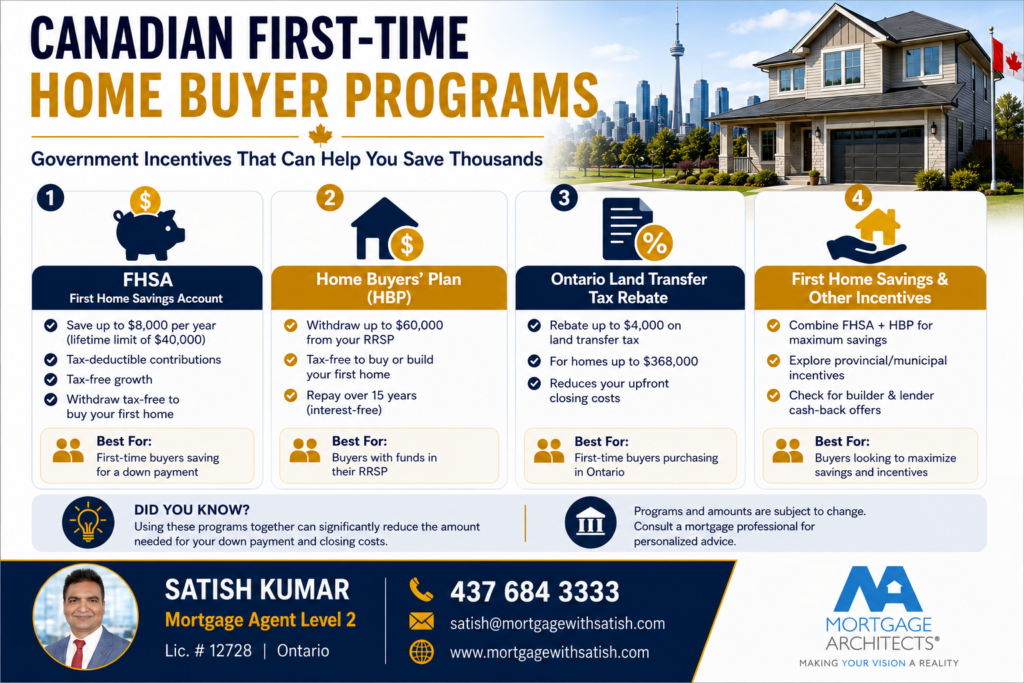
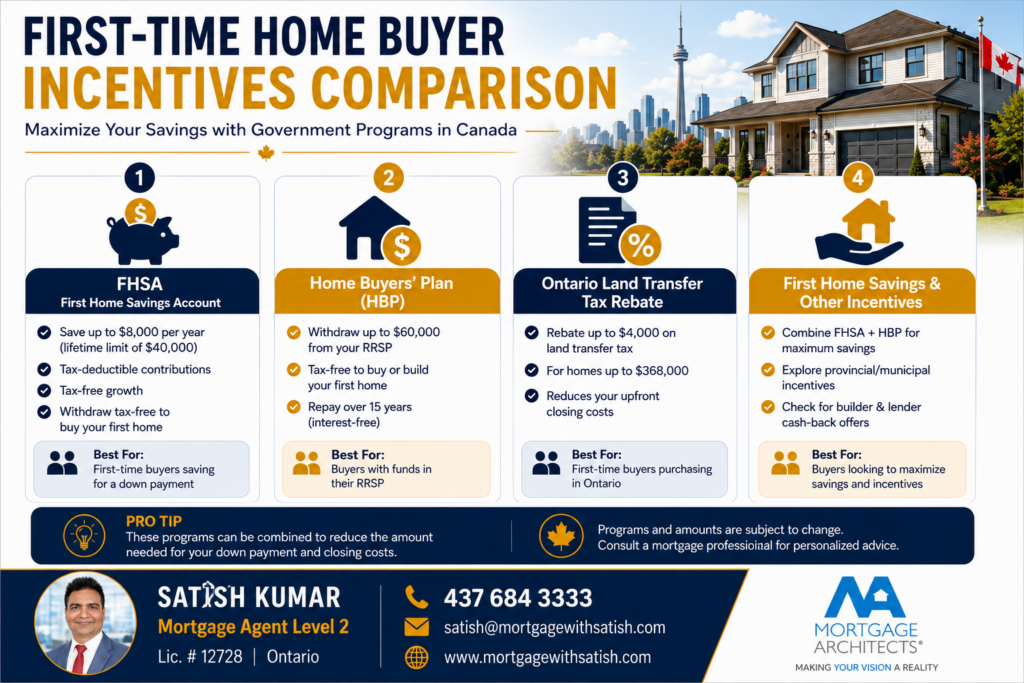
Government Programs for First-Time Home Buyers
Canada offers several programs designed to help eligible first-time buyers save for and purchase a home.
Common programs include:
- First Home Savings Account (FHSA)
- Home Buyers’ Plan (HBP)
- First-Time Home Buyers’ Tax Credit
- Ontario Land Transfer Tax Refund (for eligible purchasers)
Eligibility requirements differ for each program, so review the official rules before relying on any benefit.
FHSA vs. Home Buyers’ Plan (HBP)
Both programs can help eligible buyers purchase their first home, but they work differently.
Comparison Table
| Feature | FHSA | Home Buyers’ Plan (HBP) |
|---|---|---|
| Purpose | Save for a first home | Withdraw from RRSP for home purchase |
| Source of Funds | Contributions to FHSA | Existing RRSP savings |
| Tax Treatment | Contributions may be tax-deductible; qualifying withdrawals may be tax-free | Qualifying withdrawals are generally tax-free but must be repaid to the RRSP over time under program rules |
| Best For | Buyers building savings | Buyers with established RRSP savings |
Always confirm current contribution limits, withdrawal rules, and eligibility with the applicable federal program information before making financial decisions.
Satish’s Expert Insight
Many buyers assume they must choose either the FHSA or the Home Buyers’ Plan. Depending on your circumstances and current program rules, some buyers may be able to benefit from both as part of an overall home-buying strategy.
Key Takeaways
- FHSA and HBP serve different purposes.
- Understand how each program fits your financial plan.
- Verify current eligibility and contribution rules before relying on either program.
Ontario Land Transfer Tax Refund
Ontario first-time home buyers who meet the eligibility requirements may qualify for a refund of all or part of the provincial land transfer tax.
This refund can significantly reduce closing costs, especially for buyers purchasing their first principal residence in Ontario.
Remember:
- Municipal land transfer taxes may also apply in certain municipalities.
- Eligibility requirements must be satisfied before claiming a refund.
Satish’s Expert Insight
Many buyers budget only for their down payment and forget about land transfer tax until just before closing. Understanding available rebates early can improve your overall financial planning.
Key Takeaways
- Ontario offers land transfer tax relief for eligible first-time buyers.
- Rules differ from municipal land transfer taxes.
- Confirm eligibility before closing.
Understanding Closing Costs
Your down payment is only one part of the money you’ll need when buying a home.
Common closing costs include:
- Legal fees
- Title insurance
- Property appraisal (when required)
- Home inspection
- Land transfer taxes
- Adjustments for property taxes or utilities
- Moving expenses
Setting aside additional savings beyond your down payment helps avoid last-minute financial stress.
Practical Closing Cost Checklist
✔ Down payment
✔ Legal fees
✔ Title insurance
✔ Home inspection
✔ Appraisal (if required)
✔ Property tax adjustments
✔ Utility adjustments
✔ Moving expenses
✔ Emergency fund
Satish’s Expert Insight
One of the most common causes of stress before closing isn’t mortgage approval—it’s discovering unexpected closing expenses. Planning for these costs from the beginning makes the entire process much smoother.
Key Takeaways
- Closing costs extend well beyond your down payment.
- Budget early for professional fees and adjustments.
- Maintain an emergency reserve after closing.
Choosing the Right Mortgage
Not every mortgage is the same.
Factors to consider include:
- Fixed or variable interest rate
- Mortgage term
- Amortization period
- Payment frequency
- Prepayment privileges
- Portability
- Penalty calculations
- Flexibility for future refinancing
The right choice depends on your financial goals, income stability, and comfort with payment changes.
Comparison Table: Fixed vs. Variable Mortgage
| Fixed Rate | Variable Rate |
|---|---|
| Payment stability | May fluctuate depending on product features |
| Easier budgeting | Can benefit if rates decline |
| Greater certainty | More exposure to interest rate changes |
| Often preferred by risk-averse buyers | Often considered by buyers comfortable with market fluctuations |
Neither option is universally better. The best choice depends on your individual circumstances and risk tolerance.
Satish’s Expert Insight
Choosing between a fixed and variable mortgage isn’t about predicting interest rates perfectly. It’s about selecting the option that allows you to sleep comfortably at night while supporting your long-term financial goals.
Key Takeaways
- Compare more than just interest rates.
- Review flexibility, penalties, and repayment features.
- Choose a mortgage that aligns with your financial objectives.

Common Mistakes First-Time Home Buyers Should Avoid
Even well-prepared buyers can make avoidable mistakes that lead to financial stress or missed opportunities. Understanding these pitfalls can help you make informed decisions throughout your home-buying journey.
1. Shopping Before Getting Pre-Approved
Looking at homes before knowing your budget often leads to disappointment and wasted time.
Better Approach: Obtain a mortgage pre-approval before starting your home search.
2. Focusing Only on the Purchase Price
Many buyers overlook ongoing ownership costs.
Remember to budget for:
- Property taxes
- Home insurance
- Utilities
- Maintenance
- Condo fees (if applicable)
- Future repairs
3. Using All Your Savings for the Down Payment
A home purchase shouldn’t leave your bank account empty.
Maintain an emergency fund for unexpected expenses after moving in.
4. Making Major Financial Changes Before Closing
Avoid:
- Financing a vehicle
- Applying for new credit cards
- Changing jobs without careful consideration
- Missing bill payments
- Large unexplained bank deposits
These changes can affect your mortgage approval before closing.
5. Ignoring Mortgage Features
The lowest interest rate isn’t always the best mortgage.
Also compare:
- Prepayment privileges
- Portability
- Refinance flexibility
- Penalty calculations
- Payment options
6. Skipping Professional Advice
Buying a home involves legal, financial, and lending considerations.
Working with experienced professionals helps reduce mistakes and improves confidence throughout the process.
Key Takeaways
- Plan beyond the purchase price.
- Protect your financial profile until your purchase closes.
- Compare mortgage features—not just interest rates.
- Build an emergency fund before becoming a homeowner.
Myths vs. Facts
| Myth | Fact |
|---|---|
| You need a 20% down payment to buy a home. | Many buyers qualify with a smaller down payment, subject to current mortgage rules. |
| Pre-approval guarantees a mortgage. | Final approval depends on the property, updated financial information, and lender requirements. |
| The lowest interest rate is always the best option. | Mortgage features and flexibility are just as important. |
| Government programs automatically apply to everyone. | Every program has specific eligibility requirements. |
| Buying a home is always better than renting. | The right decision depends on your financial goals, lifestyle, and long-term plans. |

How much money do I need to buy my first home?
You’ll generally need enough for your required down payment, closing costs, and an emergency reserve. The exact amount depends on the home’s purchase price and your financing.
What credit score do I need?
There is no single minimum credit score that guarantees approval. Lenders consider your overall financial profile, including income, debt, employment, and credit history.
Should I get pre-approved before looking at homes?
Yes. A mortgage pre-approval helps establish your budget and demonstrates to sellers that you’re a serious buyer.
How long does a mortgage pre-approval last?
Pre-approval periods vary by lender. Confirm the validity period with your mortgage professional before relying on it during your home search.
What documents will I need?
Typical documentation may include:
– Government-issued identification
– Employment verification
– Income documents
– Tax information
– Bank statements
– Down payment verification
Requirements vary by lender and borrower circumstances.
Can I use gifted funds for my down payment?
Many lenders permit gifted down payments under certain conditions. Documentation requirements vary.
What is mortgage default insurance?
Mortgage default insurance protects the lender and enables many buyers to purchase a home with a lower down payment when applicable.
What is an FHSA?
The First Home Savings Account (FHSA) is a registered savings plan designed to help eligible first-time buyers save for a qualifying home purchase while receiving valuable tax advantages.
What is the Home Buyers’ Plan (HBP)?
The Home Buyers’ Plan allows eligible buyers to withdraw funds from their RRSP for a qualifying home purchase, subject to program rules and repayment requirements.
Should I choose a fixed or variable mortgage?
Neither option is universally better. Your choice should reflect your financial goals, cash flow, and comfort with interest rate changes.
Can I qualify if I’m self-employed?
Yes. Many lenders offer mortgage solutions for self-employed borrowers, although documentation requirements may differ.
What are closing costs?
Closing costs include legal fees, land transfer taxes (where applicable), title insurance, adjustments, inspections, and other purchase-related expenses.
Should I use all of my savings for my down payment?
Generally, no. Maintaining an emergency fund after closing can help you manage unexpected expenses.
Can I buy a home with existing debt?
Possibly. Lenders evaluate your income, debt obligations, credit profile, and overall affordability.
Why should I work with a mortgage agent?
A mortgage agent can help you compare mortgage options, explain lender requirements, identify suitable financing solutions, and guide you through the application process.
Conclusion
Buying your first home is both exciting and challenging. While the process involves many important decisions, careful planning can make it significantly more manageable.
Understanding mortgage qualification, budgeting for the full cost of homeownership, comparing mortgage options, and making use of available government programs can help you move forward with confidence.
The goal isn’t simply to purchase a home—it’s to purchase a home you can comfortably afford while supporting your long-term financial well-being.
What Should You Do Next?
If You’re a First-Time Home Buyer
- Review your monthly budget.
- Estimate your total savings.
- Check your credit report.
- Build an emergency fund.
- Speak with a mortgage professional before beginning your home search.
If You’re Planning to Buy Within 12 Months
- Increase your down payment savings.
- Reduce high-interest debt.
- Gather income and employment documents.
- Learn about available government programs.
- Obtain a mortgage pre-approval when you’re ready.
If You’re Self-Employed
- Organize your financial records.
- Prepare income documentation.
- Discuss available mortgage options with an experienced mortgage professional.
MortgageWithSatish Action Plan
Use this checklist as you prepare for homeownership.
✅ Review your finances
✅ Set a realistic home-buying budget
✅ Build your down payment
✅ Save for closing costs
✅ Maintain an emergency fund
✅ Improve your credit profile if needed
✅ Learn about the FHSA and Home Buyers’ Plan
✅ Obtain mortgage pre-approval
✅ Compare mortgage options
✅ Purchase a home that supports your long-term financial goals
Call to Action
Purchasing your first home is a major milestone, and every buyer’s situation is unique. Taking the time to understand your options before making an offer can help you avoid costly surprises and make informed decisions.
If you’re considering buying your first home in Ontario, a personalized mortgage review can help you understand your financing options, estimate affordability, and prepare for a smoother home-buying experience. The right guidance at the beginning of the process can make every step that follows more confident and less stressful.