If you’re carrying credit card balances, personal loans, lines of credit or other high-interest debt while also owning a home, you may have considered using your home equity to consolidate those debts.
A debt consolidation mortgage can allow a homeowner to replace several higher-interest debts with mortgage financing, usually through a refinance or another home-equity solution.
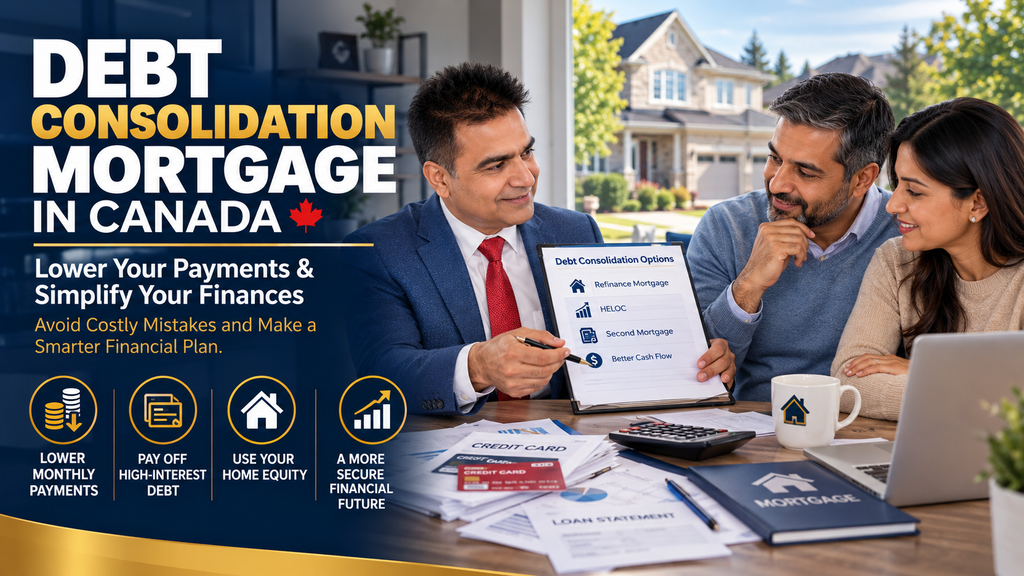
The potential benefit is straightforward: one payment, potentially lower borrowing costs and improved monthly cash flow.
But there is an important distinction that many homeowners miss:
Lowering your monthly payment is not the same thing as reducing your total cost of borrowing.
The Financial Consumer Agency of Canada (FCAC) specifically warns that debt consolidation can simplify payments and potentially save money when higher-interest debt is moved to a lower-interest product, but extending the repayment period can result in more interest being paid over time. FCAC also warns that if the spending behaviour that created the debt continues, a borrower may accumulate new debt.
For homeowners in Ontario, the right approach is therefore not simply to ask:
How much can I borrow?
Instead, ask:
Will this restructuring actually improve my financial position after penalties, fees, interest and repayment strategy are considered?
Quick Answer: What Is a Debt Consolidation Mortgage?
A debt consolidation mortgage is a mortgage or mortgage-related home-equity solution used to pay off multiple debts and combine them into a new borrowing structure.
For example, a homeowner might have:
- Credit card balances
- A personal loan
- A car loan
- A line of credit
- Other eligible debts
Depending on the borrower’s equity, income, credit profile, property and lender requirements, the homeowner may refinance the mortgage and use additional proceeds to pay off some or all of those debts.
The result can be fewer payments and potentially lower interest costs.
However, the debt doesn’t disappear. It has simply been restructured.
And when unsecured debt is moved onto a mortgage, the home becomes part of the security for that borrowing.
Table of Contents
1. What Is Debt Consolidation?
Debt consolidation means combining multiple debts into one borrowing arrangement.
Instead of making separate payments to several creditors, you may have one consolidated payment.
For example:
| Existing Debt | Balance |
|---|---|
| Credit Card #1 | $12,000 |
| Credit Card #2 | $8,000 |
| Personal Loan | $15,000 |
| Line of Credit | $10,000 |
| Total | $45,000 |
A homeowner with sufficient equity might explore using mortgage refinancing or another home-equity product to repay those debts.
The objective is not simply to create one payment.
The objective should be to create a more sustainable repayment plan.
FCAC notes that consolidation can simplify finances and potentially reduce interest costs, but borrowers should consider whether the new repayment period could increase total interest.
2. How Does a Debt Consolidation Mortgage Work?
The basic process usually looks like this:
Step 1: Determine your home’s current value
Your lender may require an appraisal or another method of determining property value.
Step 2: Determine your existing mortgage balance
For example:
Home value: $800,000
Existing mortgage: $450,000
Step 3: Identify the debts you want to consolidate
For example:
- Credit cards: $25,000
- Personal loan: $15,000
- Line of credit: $10,000
Total:
$50,000
Step 4: Calculate available equity
Home equity is broadly the difference between the value of your home and the debt secured against it.
Step 5: Review qualification
The lender will assess factors such as:
- Income
- Credit history
- Existing debts
- Property value
- Mortgage balance
- Loan-to-value ratio
- Debt-service ratios
- Employment or business income
- Mortgage payment
- Property taxes and other obligations
Step 6: Compare the complete cost
This is critical.
The analysis should include:
- Current mortgage rate
- New mortgage rate
- Existing debt rates
- Mortgage penalty
- Legal fees
- Appraisal
- Discharge or administration fees
- New amortization
- Total interest
- Expected monthly payment
3. Why Are Homeowners Using Debt Consolidation?
The most common reason is usually cash-flow pressure.
Imagine someone has five different debt payments every month.
Even if the homeowner earns enough to make the payments, managing several high-interest balances can make it difficult to reduce principal.
A consolidation strategy may simplify the structure.
Potential objectives include:
Reduce the number of payments
Instead of managing multiple creditors, the homeowner may have one primary mortgage payment.
Potentially reduce interest costs
Mortgage-secured borrowing may have a lower interest rate than unsecured credit products.
FCAC notes that home-equity products may have lower rates than other types of borrowing, while also warning that the home is used as security.
Improve monthly cash flow
This can create additional room in the household budget.
Create a structured repayment plan
A mortgage has a defined payment structure and amortization.
But there is an important warning:
A lower payment does not automatically mean a lower total cost.
4. How Much Can You Borrow for Debt Consolidation?
For many conventional uninsured mortgage refinances, the total borrowing is generally constrained by the property’s value and lender underwriting.
FCAC states that homeowners may generally borrow up to 80% of their home’s value through home-equity borrowing, although specific products have different limits and qualification requirements.
For example:
Home value: $800,000
80%: $640,000
Existing mortgage: $450,000
The mathematical difference is:
$640,000 − $450,000 = $190,000
That does not mean the homeowner automatically qualifies for $190,000 of debt consolidation.
Why?
Because the borrower still has to qualify for the proposed financing, and costs such as penalties and transaction expenses may reduce the amount available.
5. How Much Home Equity Do You Need?
There is no single answer because it depends on:
- Property value
- Existing mortgage
- Other secured debts
- Amount being consolidated
- Lender guidelines
- Income
- Credit
- Debt-service ratios
- Property type
- Mortgage structure
A useful starting formula is:
Potential borrowing capacity − existing secured debt = potential available equity
But equity alone doesn’t guarantee approval.
A homeowner can have substantial equity and still have difficulty qualifying for a conventional refinance because of income, credit or debt-service considerations.
6. What Debts Can Be Consolidated?
Depending on the lender and transaction, homeowners may explore consolidation of:
Credit cards
Often among the highest-cost forms of consumer borrowing.
Personal loans
A mortgage refinance may potentially replace an existing personal loan.
Lines of credit
A line of credit may be included depending on the lender and structure.
Car loans
Whether consolidating a vehicle loan makes financial sense depends on its rate, remaining term and prepayment conditions.
Other eligible debts
Certain other obligations may be considered depending on the lender and circumstances.
The key question should not be:
“Can I put this debt into my mortgage?”
It should be:
“Should I put this debt into my mortgage?”
Those are two very different questions.
7. Debt Consolidation Mortgage vs HELOC vs Second Mortgage
These options are often confused.
| Option | Basic Structure | Potential Benefit | Important Consideration |
|---|---|---|---|
| Mortgage refinance | Replace/increase existing mortgage | One structured payment | May trigger penalty and new qualification |
| HELOC | Revolving credit secured by home | Flexible access | Usually variable rate and requires repayment discipline |
| Second mortgage | Additional mortgage behind first | Can access equity without replacing first mortgage | Usually higher rate than first mortgage |
| Personal loan | Unsecured or secured loan | Does not necessarily use home as security | May have higher rate |
| Credit counselling | Debt-management support | May help restructure repayment | Not a mortgage product |
| Consumer proposal | Formal insolvency process | Can address certain unmanageable debts | Must be administered by a Licensed Insolvency Trustee |
FCAC notes that HELOCs can be used for debt consolidation, but they are generally variable-rate products and the home is used as security.
A consumer proposal is different again. It is a formal legal process administered by a Licensed Insolvency Trustee, not a mortgage strategy.
8. The Biggest Potential Advantage: Monthly Cash Flow
Consider an illustrative example.
Suppose a homeowner has:
- $20,000 credit card debt
- $15,000 personal loan
- $15,000 line of credit
Total debt:
$50,000
If these debts require substantial monthly payments, the homeowner may have limited cash flow left after debt servicing.
If the $50,000 could be incorporated into a mortgage refinance at a lower borrowing cost, the required monthly payment on that portion could potentially be significantly lower.
That can create breathing room.
But the homeowner needs a plan for what happens to that additional cash flow.
A smart question is:
“Where will the monthly savings go?”
If the answer is simply:
“I’ll have more money available to spend,”
the consolidation may not solve the underlying problem.
If the answer is:
“I’ll direct the savings toward accelerated mortgage repayment and rebuilding my emergency fund,”
the strategy may have a very different long-term outcome.
9. The Biggest Mistake: Looking Only at the Monthly Payment
This is one of the most important lessons in debt consolidation.
Imagine you move $50,000 of short-term debt into a mortgage.
Your monthly payment could fall dramatically.
That sounds attractive.
But if the $50,000 is effectively repaid over a much longer period, the total interest could be substantially higher than expected.
FCAC specifically warns that consolidation can extend the repayment period and increase the total interest paid.
Think in three numbers:
1. Monthly payment
What will you pay each month?
2. Total interest
How much will the borrowing cost over the repayment period?
3. Time to become debt-free
How long will it take to actually eliminate the debt?
A good consolidation analysis considers all three.
10. Mortgage Penalties and Refinancing Costs
This is where some consolidation calculations fall apart.
If you are in the middle of a closed mortgage term, refinancing may mean breaking your existing mortgage.
Your lender may charge a prepayment penalty.
FCAC states that a prepayment penalty may apply when you:
- Break your mortgage
- Transfer it to another lender before the end of the term
- Repay the mortgage early
- Exceed permitted prepayment privileges
Depending on the mortgage, the penalty can be significant.
Other costs may include:
- Appraisal
- Legal fees
- Mortgage discharge
- Administration fees
- Title-related costs
- Potential lender fees
FCAC recommends determining the cost of breaking the existing mortgage before proceeding.
This creates an important calculation:
Potential interest savings + cash-flow benefit
versus
Mortgage penalty + fees + additional long-term interest
That is the calculation I would want a homeowner to see before making a decision.
11. Does Debt Consolidation Affect Your Credit Score?
It can.
A mortgage refinance generally involves a new credit application and underwriting.
However, what happens afterward can be just as important.
If high credit-card balances are paid off, your credit utilization may improve.
But if the cards are immediately used again, the borrower can end up with:
A larger mortgage + new credit-card debt.
That is one of the most dangerous outcomes of debt consolidation.
The FCAC recommends reviewing your credit report and notes that good credit history can improve the chances of qualifying for a lower-rate consolidation product.
12. What Do Lenders Look At?
A debt consolidation mortgage is still a mortgage transaction.
Lenders may consider:
Income
Can you demonstrate sufficient income to support the proposed financing?
Credit history
What does your repayment history look like?
Existing debt
How much debt do you already carry?
Debt-service ratios
Can your income support the proposed debt obligations?
Home value
What is the property worth?
Existing mortgage
How much is currently owing?
Loan-to-value
How much will be borrowed relative to the property’s value?
Property type
Detached homes, townhomes, condos and other property types may be treated differently by lenders.
Overall financial picture
A lender is not simply looking at your house.
The lender is looking at the borrower + property + debt + repayment capacity.
13. What If Your Credit Has Already Been Damaged?
This is where the conversation becomes more nuanced.
A homeowner who has missed payments or accumulated significant credit-card debt may not qualify for the same mortgage options as someone with excellent credit and strong income.
Depending on the circumstances, alternatives may include:
- A conventional mortgage refinance
- A HELOC
- A second mortgage
- An alternative mortgage
- A private mortgage
- Credit counselling
- A Licensed Insolvency Trustee
The important point is that a higher-cost mortgage should not be viewed as a permanent solution simply because it provides immediate debt relief.
If an alternative lender is involved, I would want a clear exit strategy:
What needs to happen for the homeowner to refinance into a lower-cost mortgage later?
That could involve:
- Improving credit
- Reducing balances
- Rebuilding payment history
- Increasing documented income
- Lowering debt-service ratios
- Building additional equity
14. Ontario Example: A Homeowner With $60,000 of Debt
Let’s look at a simplified example.
Before consolidation
Home value: $850,000
Existing mortgage: $500,000
Other debts:
- Credit cards: $25,000
- Personal loan: $15,000
- Line of credit: $20,000
Total consumer debt: $60,000
The homeowner is considering a refinance.
The analysis would start by looking at the property’s value and existing secured debt, then determining whether the proposed mortgage fits within the lender’s maximum loan-to-value and underwriting requirements.
But the calculation doesn’t end there.
We would also examine:
- Current mortgage rate
- Mortgage penalty
- Remaining term
- New mortgage rate
- Legal and appraisal costs
- New payment
- Total interest
- Debt-service ratios
- Credit history
- Monthly cash-flow improvement
- Repayment plan
The key question:
Does consolidating the $60,000 improve the homeowner’s financial position after all costs are included?
That is the question worth answering.
15. When Might Debt Consolidation Make Sense?
Debt consolidation may be worth exploring when:
You have significant high-interest debt
For example, multiple credit-card balances.
You have sufficient home equity
There must be enough usable equity for the proposed financing.
You can qualify
The proposed mortgage still has to meet applicable lender requirements.
Your monthly cash flow is under pressure
Consolidation may simplify the payment structure.
You have a plan to stop accumulating debt
This is essential.
The numbers work after fees and penalties
A lower rate by itself isn’t enough.
16. When Might Debt Consolidation Not Be Appropriate?
It may not be the right solution when:
- The debt is relatively small.
- You can eliminate it quickly through cash flow.
- The mortgage penalty is very high.
- The new financing would have a substantially higher rate.
- There is insufficient equity.
- Your financial situation remains unstable.
- The debt was caused by an ongoing spending pattern that has not changed.
- Consolidation would simply create room to borrow again.
- A formal debt solution may be more appropriate.
FCAC specifically recommends considering alternatives and getting advice when debt is becoming difficult to manage.
17. What About Consolidating Debt When Your Mortgage Renews?
Mortgage renewal can be an important opportunity to review your entire financial picture.
FCAC notes that homeowners may consider consolidating higher-interest debts when renewing and increasing the mortgage amount, and also reminds borrowers that they don’t necessarily have to renew with their existing lender.
However, there is an important distinction:
Straight mortgage switch
Moving an uninsured mortgage to another federally regulated lender at renewal without increasing the loan amount or amortization can have different qualification treatment.
Refinance
If you increase the mortgage amount to take out equity for debt consolidation, you’re generally dealing with a refinance rather than a simple straight switch.
That distinction matters.
OSFI’s current minimum qualifying-rate guidance states that the uninsured mortgage stress-test rules generally apply to newly underwritten mortgages, while straight switches at renewal that do not increase the loan amount or amortization are treated differently.
So if your renewal is approaching and you want to consolidate debt, start the conversation before the renewal date.
18. Alternatives to a Debt Consolidation Mortgage
Debt consolidation through a mortgage isn’t the only option.
Option 1: HELOC
A HELOC can provide revolving access to home equity.
FCAC says HELOCs may be used for debt consolidation, but they generally have variable rates and require disciplined repayment.
Option 2: Home Equity Loan
A home-equity loan provides a lump sum secured against the property.
Option 3: Second Mortgage
A second mortgage can potentially access equity without replacing the first mortgage.
However, second-mortgage rates are generally higher than first-mortgage rates.
Option 4: Personal Debt Consolidation Loan
This does not necessarily use your home as security.
Option 5: Credit Counselling
A qualified credit counsellor may help you create a debt-management strategy.
Option 6: Consumer Proposal
If debts have become unmanageable, a consumer proposal may need to be considered.
A consumer proposal is a formal legal process administered by a Licensed Insolvency Trustee.
Debt Consolidation: Myth vs Reality
| Myth | Reality |
|---|---|
| Debt consolidation makes debt disappear | It restructures debt; you still owe the money |
| Lower payment means lower total cost | A longer repayment period can increase total interest |
| Home equity automatically means approval | Income, credit, property and lender criteria still matter |
| A HELOC is always better than refinancing | Each option has different costs and risks |
| Paying off cards means the problem is solved | New balances can rebuild the debt |
| You should always consolidate everything | Some debts may be better left outside the mortgage |
| Renewal automatically means you can take equity out | Increasing the mortgage amount is a refinance decision |
| The lowest rate is automatically the best solution | Penalties, fees, amortization and flexibility also matter |
Satish’s Expert Insight
“Don’t judge a debt consolidation mortgage by the payment alone.”
One of the first things I would look at with a homeowner is the complete before-and-after picture.
Suppose someone tells me:
“My payment will drop by $1,500 per month.”
That sounds positive.
But I want to know:
- What is the mortgage penalty?
- What are the closing costs?
- How much additional interest will be paid?
- How long will the consolidated debt remain outstanding?
- What happens to the homeowner’s credit cards?
- What is the repayment strategy?
- Does the borrower have enough monthly cash flow to start paying the mortgage down faster?
The goal shouldn’t simply be to make the debt look easier.
The goal should be to make the debt more manageable and more intentional.
Ontario mortgage brokerages are required to consider mortgage suitability and disclose material risks. FSRA specifically identifies factors such as affordability, prepayment penalties, fees, amortization and long-term goals as relevant to suitability.
That is why I believe a proper debt-consolidation discussion should look at the whole financial picture—not just the interest rate.
20. Debt Consolidation Checklist
Before proceeding, ask these 10 questions:
Equity
☐ What is my home’s current market value?
☐ How much do I currently owe against the property?
Debt
☐ Which debts should actually be consolidated?
☐ What interest rate am I paying on each debt?
Mortgage
☐ What is my current mortgage rate?
☐ What is my prepayment penalty?
New financing
☐ What would the new mortgage payment be?
☐ What would the total cost of borrowing be?
Financial behaviour
☐ What caused the debt in the first place?
☐ What is my plan to prevent the balances from returning?
If you cannot answer the last question, that deserves as much attention as the mortgage itself.
Can I consolidate credit card debt into my mortgage in Canada?
Potentially, yes. Homeowners may be able to refinance their mortgage and use additional proceeds to pay eligible credit-card balances, subject to equity, qualification and lender requirements.
How much equity do I need to consolidate debt?
It depends on the property value, existing mortgage and amount of debt you want to consolidate.
FCAC states that homeowners may generally borrow up to 80% of their home’s value through home-equity borrowing, although individual products and lender requirements vary.
Is debt consolidation the same as refinancing?
Not exactly.
Refinancing is the financing transaction.
Debt consolidation is one possible purpose for the additional borrowing.
A homeowner may refinance to consolidate credit cards, renovate a home, invest in another property or achieve another financial objective.
Will debt consolidation lower my monthly payment?
It may.
But the result depends on the amount borrowed, interest rate, amortization and debts being replaced.
A lower payment does not necessarily mean a lower total cost.
Does debt consolidation hurt your credit score?
Applying for new credit can affect your credit profile, but paying down high-balance revolving debt may improve credit utilization over time.
The long-term effect depends on what happens after consolidation.
Can I consolidate debt if my credit score is low?
Possibly, but the available mortgage options may be different.
Credit history, income, equity, property and lender requirements all matter.
Can I consolidate debt at mortgage renewal?
Potentially.
If you want to increase the mortgage amount to pay off other debts, you are generally looking at a refinance rather than a simple mortgage switch.
Start planning before the renewal date.
Is a HELOC better than a debt consolidation mortgage?
They serve different purposes.
A HELOC provides revolving access to home equity and generally has a variable rate. A mortgage refinance provides a structured mortgage balance and repayment schedule.
The appropriate structure depends on your financial circumstances and repayment plan.
What happens if I consolidate my debt and then use my credit cards again?
You can end up with both:
A larger mortgage + new credit-card debt.
This is one of the biggest risks of debt consolidation.
The consolidation should ideally be accompanied by a change in the borrowing behaviour that created the debt.
Can I consolidate debt if I am self-employed?
Potentially.
Self-employed borrowers may have additional documentation requirements depending on how their income is structured and the lender being considered.
The assessment should focus on the borrower’s complete financial picture.
Should I consolidate my car loan into my mortgage?
Not automatically.
Compare the car loan’s:
Interest rate
Remaining balance
Remaining term
Prepayment conditions
against the proposed mortgage financing.
A low-rate car loan may not benefit from being stretched over a much longer mortgage amortization.
What if a bank declines my debt consolidation refinance?
A bank decline does not necessarily mean there are no financing options, but it does mean you should understand why the application was declined.
Depending on the circumstances, options may include:
– Reworking the application
– Reducing the requested amount
– Waiting and improving credit
– Considering a different lender
– HELOC
– Second mortgage
– Alternative financing
– Credit counselling
– Licensed Insolvency Trustee advice
The appropriate route depends on the reason for the decline and your overall financial position.
22. Your Next Step: Calculate the Whole Picture
If you’re considering debt consolidation, don’t start by asking:
“What mortgage rate can I get?”
Start with:
1. What do I owe?
List every debt and balance.
2. What am I paying?
Record each interest rate and monthly payment.
3. What is my home worth?
Obtain a realistic property valuation.
4. What would it cost to refinance?
Include penalty, legal, appraisal and other costs.
5. What would the new payment be?
Calculate the proposed mortgage payment.
6. What is the total interest?
Don’t stop at the monthly payment.
7. What is my repayment plan?
Decide how the consolidated debt will actually be eliminated.
8. What alternatives should I compare?
Consider a refinance, HELOC, second mortgage, personal loan, credit counselling or other appropriate options.
Conclusion
A debt consolidation mortgage in Canada can be a useful financial strategy for some homeowners carrying expensive consumer debt.
It can potentially:
- Simplify multiple payments
- Improve monthly cash flow
- Replace higher-cost debt with lower-cost secured borrowing
- Help create a more structured repayment plan
But it also changes the nature of the debt.
Previously unsecured debt may become secured against your home. A longer amortization may increase total interest. Breaking your existing mortgage can create significant penalties. And if the underlying spending problem isn’t addressed, the debt can return.
That’s why the right question isn’t:
“Can I consolidate my debt into my mortgage?”
It’s:
“Does this strategy improve my financial position after considering the rate, penalty, fees, amortization, total interest, risk and repayment plan?”
That is the calculation worth doing before you make a decision.
Carrying credit-card debt, personal loans or multiple high-interest payments?
I can help you understand the mortgage and home-equity options available for your situation, including the potential costs and trade-offs.
Satish Kumar
Mortgage Agent Level 2
Mortgage Architects
437 684 3333
info@MortgageWithSatish.com
mortgagewithsatish.com
This article is for general educational purposes and does not constitute mortgage, financial, legal, tax or insolvency advice. Mortgage products, rates, qualification requirements and lender policies vary. Your situation should be reviewed before making a borrowing decision.
Fixed vs Variable Mortgage Rates in Canada: Avoid Costly Mistakes and Choose the Right Mortgage with ConfidenceFixed vs Variable Mortgage Rates in Canada: Avoid Costly Mistakes and Choose the Right Mortgage with Confidence