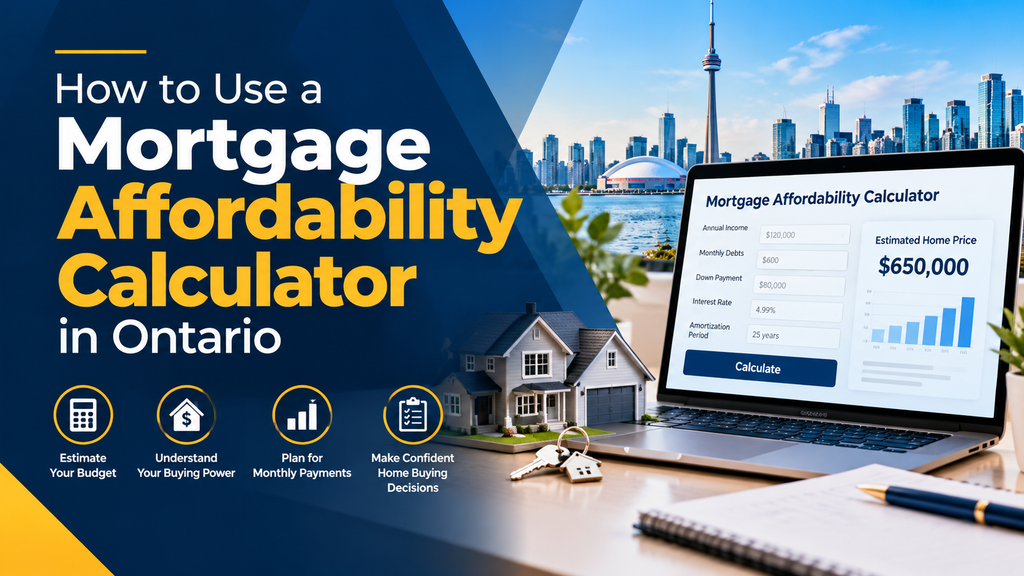
If you’re thinking of buying your first home in Ontario or the GTA, a mortgage affordability calculator can be an essential tool. It gives you an idea of the maximum mortgage and purchase price a lender may consider for you. But it’s important to know what goes into this estimate, the factors unique to Ontario, and why it should be just the beginning of your financial planning, not the final answer.
Key takeaways
- A mortgage affordability calculator estimates—not guarantees—how much you might be able to borrow.
- Key factors include your income, debts, down payment, property taxes, heating costs and condo fees.
- Ontario buyers should also account for land transfer taxes and other closing costs outside the calculator’s results.
- The estimate shows your qualification ceiling. Spend some time reviewing your budget before shopping for homes.
- Calculator estimates depend on current mortgage stress test rules, qualifying rates and ever-changing lender criteria.
What does a mortgage affordability calculator do?
A mortgage affordability calculator helps you estimate the maximum mortgage and purchase price a lender might consider based on your financial situation. In other words, it answers the question: “What’s the most I could qualify to borrow right now?” The answer is based on government-recommended formulae, lender guidelines and your own numbers for income, debt, and home-related costs. It does not guarantee you’ll be approved, nor does it recommend how much you should personally spend on a home.
Major Canadian sources like CMHC provide calculators that include these important factors. To get a meaningful estimate, it’s crucial to use realistic numbers for your area and household.
How is mortgage affordability calculated?
The estimate you get from a mortgage affordability calculator isn’t a guess; it’s based on standardized rules for housing and debt costs compared to your income. Several specific numbers matter most:
- Gross Debt Service (GDS) ratio: This is the share of your gross household income that goes to covering your mortgage payment, property taxes, heating, and half of condo fees (if any). According to CMHC’s Debt Service Calculator, the standard maximum GDS is 39%.
- Total Debt Service (TDS) ratio: This is the share of your income spent on those housing costs plus other debts, such as car payments or credit cards. CMHC lists 44% as the maximum TDS.
- Qualifying rate: Lenders are required to test your borrowing capacity at the greater of your contract rate plus 2%, or 5.25%. This is the so-called stress test. As a result, even if rates are lower, your affordability estimate uses a higher payment than you might actually pay to ensure you could handle increases in the future.
- Down payment: The calculator asks you to enter your actual down payment. If your down payment is under 20%, you’ll also pay a mortgage insurance premium, which is factored in by calculators like those from WOWA and CMHC.
What you input for income, debts, taxes and costs heavily influences the estimate—so be as accurate as possible.
Ontario-specific tips for using a mortgage affordability calculator
Ontario homebuyers have a few extra considerations. Calculators use your reported property taxes, so for more accurate results, look up the actual taxes on the home or area you’re considering; default settings might not reflect the right numbers for a specific location. This is especially true in the Durham Region and GTA, where property taxes can vary widely by municipality and property type.
Don’t forget to include heating costs (required in all major calculators), and if you’re buying a condo, input the monthly condo fees since a portion is included in the GDS and TDS calculations.
Also, remember that the calculator’s result does not include closing costs. These can include the Ontario Land Transfer Tax, plus an additional municipal land transfer tax in Toronto. First-time buyers in both cases may be eligible for rebates but should verify qualification in advance. The result from the calculator is related to the purchase price only; you need to estimate and budget for these closing costs yourself.
If your down payment is less than 20%, confirm the mortgage insurance premium and any related Ontario tax with your lender or insurer, as these affect your cash needed to close.
Why the calculated ‘maximum’ isn’t always your real-life budget
The calculator estimate is meant to provide a qualification ceiling—the highest amount a lender might consider. It assumes that amounts used for property taxes, heating, condo fees, and other debts are accurate and that all your income is usable for qualification. But it cannot account for future changes to your household’s budget, like plans for parental leave, maintenance, savings, or other expenses you prioritize. You might decide to buy less house in order to have more left over each month for other needs.
Use the calculator to test different scenarios—like a lower target purchase price, or increasing your down payment—to see how it shifts your estimates. The best practice is to compare the estimated maximum with what feels comfortable in your monthly and annual budget, rather than simply choosing the highest amount available.
Next steps: Pre-approvals and verification
Before house hunting or making an offer, it’s wise to get a lender’s pre-approval. This is when your numbers—income, debts, down payment, property taxes, and all costs—are checked by a lender. The pre-approval will confirm how the bank or mortgage lender is using the qualifying rate, your down-payment source, the final mortgage insurance premium, and expected closing funds. Remember, calculator estimates are just a starting point; only your lender or mortgage agent can confirm what you’re eligible to borrow under current rules and rates, which change frequently.
What this means for Ontario homebuyers
A mortgage affordability calculator is a valuable first tool for Ontario buyers and is widely used by clients in Durham Region and the GTA. By entering your true income, debts, estimated home costs, and taxes, you can get a realistic sense of the maximum mortgage a lender might consider. Always keep in mind the factors that affect your estimate, especially the current mortgage stress test rates and insurance rules for down payments below 20%.
Combine the calculator’s result with your own knowledge of your budget and future plans. Review your numbers with your agent or lender, and don’t hesitate to ask for clarification about which costs must be set aside or added on top—especially closing costs like land transfer tax and insurance premiums, which are not included in the purchase price estimate.
Frequently asked questions
How accurate is a mortgage affordability calculator for Ontario homebuyers?
A mortgage affordability calculator gives you a useful estimate based on Ontario guidelines, but it cannot guarantee approval. Use actual numbers for your income, debts, property taxes and costs for the best results.
Do affordability calculators include closing costs?
No, major calculators estimate only what you might borrow and the purchase price cap. Ontario land transfer taxes, legal fees and other costs are extra and need separate budgeting.
Does the calculator show what I should spend, or just what I might qualify for?
The calculator shows your estimated borrowing ceiling, not a spending recommendation. Consider your monthly comfort zone and other life expenses before choosing a price target.
How do mortgage insurance premiums affect my estimate?
If your down payment is below 20%, the insurance premium is added to your mortgage, reducing how much goes directly toward your home. Calculators designed for Canada, like CMHC’s, include this in the estimation.
Curious about how much home you can afford or the steps for mortgage pre-approval? Book a free discovery call to discuss your mortgage options and clarify the numbers that matter to you, with no pressure or obligation.
Disclaimer: This article provides general information only and is not personalized mortgage or financial advice. Please consult a licensed mortgage agent or lender for advice tailored to your individual situation.