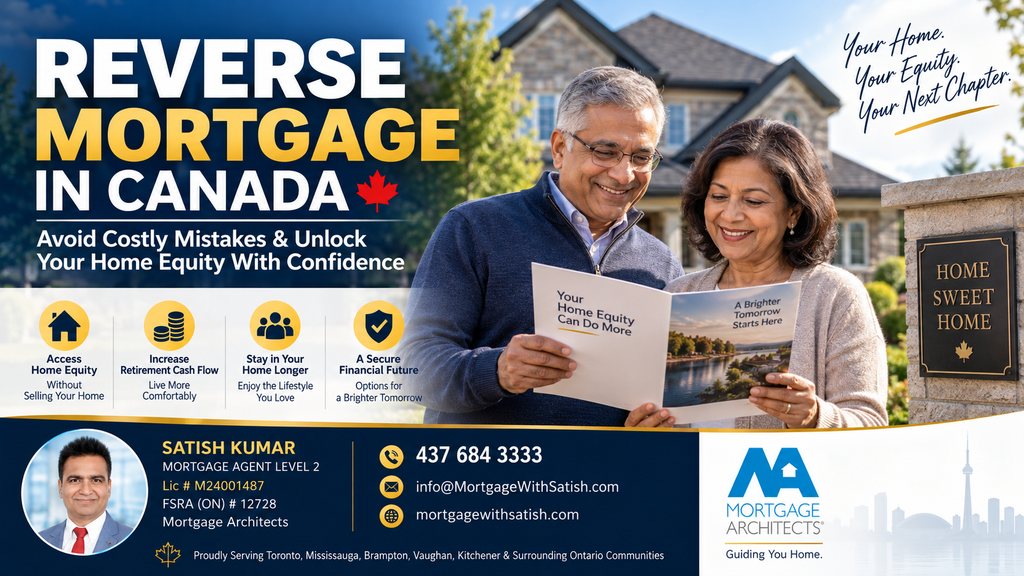
For many Canadian homeowners aged 55 and older, their home is their largest financial asset—but much of that wealth may be tied up in the property.
A reverse mortgage can allow an eligible homeowner to access part of that home equity without selling the home and without making regular mortgage payments. The homeowner continues to own and live in the property, while interest accumulates on the amount borrowed.
That flexibility can be valuable, particularly for homeowners who want to remain in their home, supplement retirement cash flow, fund renovations, consolidate debt or cover major expenses.
But a reverse mortgage is not free money.
The interest rate is generally higher than a conventional mortgage or HELOC, the outstanding balance can grow over time, and the amount of equity available to the homeowner or estate can decline.
The right question is therefore not:
Can I get a reverse mortgage?
It is:
Does a reverse mortgage make sense for my retirement, cash flow, home and long-term plans?
That distinction is at the heart of this guide.
A reverse mortgage is a loan that allows eligible Canadian homeowners, generally age 55 or older, to access part of their home equity without selling their home or making regular mortgage payments. You continue to own the home, but interest is added to the loan balance and the debt is generally repaid when you sell the property, move out permanently or the last borrower dies.
According to the Financial Consumer Agency of Canada, homeowners may generally be able to borrow up to 55% of the home’s current value, although the actual amount depends on factors such as age, property value, condition, type and lender.
What is a reverse mortgage in Canada?
A reverse mortgage is a home-equity loan designed primarily for homeowners aged 55 or older. It lets eligible homeowners convert part of their home equity into cash while continuing to own and live in their home. Unlike a conventional mortgage, there are generally no required regular mortgage payments, but interest accumulates and the balance is usually repaid when the home is sold, the borrower moves out permanently or the last borrower dies.
Table of Contents
What Is a Reverse Mortgage?
A reverse mortgage allows an eligible homeowner to borrow against the equity in their home.
Unlike a traditional mortgage, you are not making regular principal-and-interest payments that gradually reduce the loan.
Instead:
Home equity → borrowed funds → interest accumulates → balance is repaid later
You remain the homeowner.
You can generally continue living in the property as long as you meet the conditions of your mortgage agreement.
The FCAC confirms that reverse mortgages allow homeowners to convert part of their home equity into tax-free borrowed money while retaining ownership of the home
How Does a Reverse Mortgage Work?
Let’s use a simplified example.
Suppose:
Home value: $900,000
Existing mortgage: $100,000
Home equity: $800,000
The amount a homeowner can access will depend on the lender’s calculations, including age and property characteristics. It is not simply a matter of taking 55% of the $800,000 equity.
The lender assesses the property and borrower circumstances to determine the available amount.
Once approved, the funds may be provided as:
- A lump sum
- Scheduled payments
- A combination of both
Some lenders also offer products specifically designed around recurring retirement cash flow.
The Most Important Difference
With a traditional mortgage:
You make payments → principal generally declines.
With a reverse mortgage:
You receive funds → interest accumulates → balance generally grows.
That is why understanding the long-term cost is so important. Can Qualify for a Reverse Mortgage in Canada?
Reverse mortgages are generally designed for homeowners 55 or older.
The exact eligibility criteria vary by lender and product.
The FCAC states that eligibility generally involves:
- Being a homeowner
- Usually being at least 55
- Using a qualifying property as your primary residence
- Meeting the lender’s property requirements
The amount available can depend on:
- Age
- Age of other owners on title
- Property value
- Property type
- Property condition
- Location
- Existing mortgage or secured debt
- Lender requirements
Do You Need Employment Income?
One reason reverse mortgages can be attractive to retirees is that the assessment is different from a conventional income-based mortgage.
The focus is generally more heavily connected to the homeowner’s age, property and equity position rather than simply employment income.
However, this does not mean every homeowner automatically qualifies.
The lender still needs to assess the property and the proposed transaction.You Need a High Credit Score?
A reverse mortgage is fundamentally different from a conventional mortgage because the primary security is the property and the loan is designed around home equity.
Some lenders may not use traditional income or credit qualification in the same way as a conventional mortgage.
However, lender-specific requirements still apply.
Do not assume that “no minimum credit score” means “no financial review.”
The application still needs to satisfy the lender’s criteria. Much Can You Borrow?
The FCAC states that homeowners may usually borrow up to 55% of the home’s current value, although the actual amount depends on the homeowner’s circumstances and lender.
Age is particularly important.
Generally, an older homeowner may be able to access a larger percentage of the property’s value than a younger eligible homeowner.
Existing mortgage debt also matters.
For example:
Home Value
$800,000
Existing Mortgage
$150,000
The existing mortgage generally needs to be dealt with as part of the transaction.
That means the amount of new equity available to the homeowner is affected by the existing debt.
Do not calculate your potential reverse mortgage simply by multiplying your home value by 55%.
The actual amount must be determined through a lender assessment.
How Can You Receive Reverse Mortgage Funds?
Depending on the product, funds may be available through:
Lump Sum
You receive a larger amount upfront.
This may be useful for:
- Major renovations
- Debt consolidation
- A large unexpected expense
- Helping family with a major financial need
Regular Advances
Some products allow recurring payments.
This can be useful for:
- Retirement cash flow
- Monthly living expenses
- In-home support
- Healthcare-related costs
Combination
A homeowner may use part of the available amount immediately and access additional funds later, depending on the lender and product.
The FCAC notes that lenders may offer different ways to receive the funds, including lump-sum and periodic payments.
What Can You Use a Reverse Mortgage For?
One of the major attractions is flexibility.
Depending on lender terms, homeowners may use the funds for purposes such as:
- Home renovations
- Accessibility modifications
- Healthcare expenses
- Paying off debt
- Everyday expenses
- Retirement cash flow
- Helping family members
- Major purchases
- Aging-in-place needs
The FCAC specifically identifies uses such as home repairs, regular bills, healthcare expenses and debt repayment.
Reverse Mortgage Rates in Canada
One of the most important points to understand is that reverse mortgage rates are generally higher than conventional mortgage and HELOC rates.
The FCAC specifically warns that reverse mortgage interest rates are usually higher than those of traditional mortgages and HELOCs.
Current 2026 market coverage shows that reverse-mortgage pricing is an active area of comparison, with recent lender competition and rate changes generating significant consumer interest.
Because rates and lender products change, I would not publish a static “best rate” in an evergreen article.
Instead, compare the actual offer available to you at the time you apply.
Why the Interest Rate Isn’t the Whole Story
Suppose one lender offers:
6.2%
and another offers:
6.4%
It might seem obvious that 6.2% is better.
But what if the second mortgage has:
- Lower setup costs
- Better prepayment flexibility
- Better access to additional funds
- Different penalty provisions
- A structure better suited to your retirement plan?
The mortgage with the lower headline rate may not necessarily be the better overall solution.
Compare the Complete Cost
Look at:
- Interest rate
- Setup fees
- Legal costs
- Appraisal
- Administration fees
- Prepayment provisions
- Renewal terms
- Exit costs
- Available borrowing structure
Reverse Mortgage vs HELOC
This is one of the most important comparisons for homeowners aged 55+.
| Feature | Reverse Mortgage | HELOC |
|---|---|---|
| Typical age focus | 55+ | No specific age requirement |
| Regular payments | Generally not required | Interest payments generally required |
| Interest | Accumulates to balance | Usually paid periodically |
| Borrowing amount | Generally up to 55% of home value, subject to lender | HELOC rules differ |
| Income qualification | Different from traditional mortgage underwriting | Income and credit generally important |
| Credit requirements | Lender-specific | Lender-specific |
| Home ownership | You retain ownership | You retain ownership |
| Equity | Generally decreases as balance grows | Depends on borrowing and repayment |
| Best suited to | Certain retirement cash-flow/equity needs | Borrowers able to manage ongoing payments |
The FCAC notes that HELOCs and reverse mortgages differ significantly in borrowing structure, interest and repayment requirements.
Which Is Better: Reverse Mortgage or HELOC?
Neither is automatically better.
A HELOC may be more attractive when a homeowner:
- Has sufficient income
- Can comfortably make required payments
- Wants flexible access to funds
- Wants to minimize borrowing costs
A reverse mortgage may be worth considering when a homeowner:
- Wants to remain in the home
- Has substantial equity
- Has limited retirement cash flow
- Does not want regular mortgage payments
- Needs access to equity
The right answer depends on the borrower’s complete financial picture.
Reverse Mortgage vs Refinancing
Traditional refinancing can sometimes provide access to more home equity than a reverse mortgage.
CMHC notes that homeowners aged 55+ may have several ways to access home equity, including refinancing, HELOCs and reverse mortgages.
But refinancing generally involves a stronger focus on:
- Income
- Debt
- Credit
- Monthly payment capacity
- Mortgage qualification
A reverse mortgage may be more suitable for someone whose home is valuable but whose retirement income makes conventional borrowing difficult.
Does a Reverse Mortgage Affect OAS or GIS?
This is one of the most searched and most misunderstood questions.
The FCAC states that money borrowed through a reverse mortgage does not affect Old Age Security (OAS) or Guaranteed Income Supplement (GIS) benefits.
That is because the money is borrowed rather than treated as employment or investment income.
However, retirement-benefit situations can be complex.
If you receive income-tested benefits or have a more complicated tax situation, it is sensible to confirm the implications for your specific circumstances with an appropriate tax or benefits professional.
Is Reverse Mortgage Money Taxable?
A reverse mortgage is a loan.
The money you borrow is therefore generally not taxable income.
The FCAC describes reverse-mortgage proceeds as tax-free borrowed money.
That does not mean the transaction has no financial consequences.
The interest and accumulated balance can substantially affect the amount of equity remaining in the property.
What Happens to Your Home?
You continue to own your home.
A reverse mortgage does not mean the lender becomes the homeowner.
You remain responsible for obligations under the mortgage agreement, which can include:
- Property taxes
- Home insurance
- Maintaining the property
- Keeping the home in acceptable condition
- Complying with mortgage conditions
Failure to meet contractual obligations can create serious consequences.
What Happens When You Sell the Home?
When the home is sold, the reverse mortgage is generally repaid from the sale proceeds.
The remaining amount belongs to the homeowner or estate after the mortgage and other transaction costs are dealt with.
What Happens When the Borrower Dies?
The reverse mortgage generally becomes repayable when the last borrower dies, subject to the mortgage contract.
The estate typically has to settle the outstanding amount.
The FCAC cautions that the estate may have a set period in which to repay the debt, and the estate may receive less equity than originally expected because interest has accumulated.
This is one of the most important conversations families should have before the reverse mortgage is taken out.
What If the Home Value Falls?
This is another area where borrowers should understand the actual contract rather than rely on assumptions.
OSFI’s 2026 capital requirements describe reverse mortgages as non-recourse loans secured by property, subject to the lender’s contractual conditions. Under a qualifying non-recourse structure, if the sale proceeds are insufficient to cover the amount owing, the lender’s recovery is generally limited by the home’s value, subject to the applicable conditions and exclusions.
The precise protection depends on the mortgage agreement.
Always read the lender’s actual terms.
Reverse Mortgage Pros and Cons
Advantages
1. Stay in Your Home
You can access equity without selling the property.
2. No Required Regular Mortgage Payments
This can improve monthly cash flow.
3. Access Home Equity
You may unlock part of the wealth accumulated in your property.
4. Flexible Use
Funds can potentially be used for retirement expenses, renovations, healthcare or debt consolidation.
5. Tax-Free Borrowed Funds
Reverse-mortgage proceeds are generally not taxable income.
6. Potential OAS/GIS Compatibility
The FCAC states that reverse-mortgage proceeds do not affect OAS or GIS benefits.
Disadvantages
1. Higher Interest Cost
Reverse mortgage rates are generally higher than conventional mortgage or HELOC rates.
2. Your Loan Balance Grows
Because interest accumulates, the amount owing can increase.
3. Your Home Equity Can Decline
As the loan grows, the equity remaining in the property can decrease.
4. Less Equity for Your Estate
Your beneficiaries may inherit less home equity.
5. Other Financing May Be Limited
A reverse mortgage can affect your ability to use other secured financing against the property.
When Does a Reverse Mortgage Make Sense?
A reverse mortgage may be worth exploring when several of the following apply:
- You are 55+
- You own a substantial amount of home equity
- You want to remain in your home
- Your retirement income is limited
- You want to reduce monthly debt payments
- You have significant home-related expenses
- You need funds for aging in place
- You understand the long-term cost
- You have considered what happens to your estate
When Might a Reverse Mortgage NOT Be the Right Choice?
Think carefully if:
- You plan to move soon
- You have substantial income and qualify comfortably for cheaper financing
- Your primary objective is leaving maximum home equity to heirs
- You have very little equity
- You are uncomfortable with a growing loan balance
- You could comfortably use a lower-cost HELOC or refinance
- You haven’t discussed the decision with your family or professional advisers
A reverse mortgage should solve a financial problem—not create a bigger one.
Ontario-Specific Considerations
Ontario has specific rules governing mortgage brokerages arranging reverse mortgages.
Under Ontario Regulation 188/08, a brokerage cannot arrange or enter into a reverse mortgage with a borrower unless it receives a written statement signed by a lawyer confirming that the borrower received independent legal advice about the proposed reverse mortgage.
This is an important consumer protection.
FSRA also emphasizes that mortgage brokerages must consider suitability and disclose material risks when recommending mortgage products.
For an Ontario homeowner, this means the process should not simply be:
“Here is your money. Sign here.”
You should understand:
- What you’re borrowing
- What it costs
- How interest accumulates
- What happens when you sell
- What happens after death
- What your estate may need to repay
- What alternatives are available
Ontario Scenario #1 — Staying in the Family Home
Raj and Anita, both in their early 70s, own a home in Mississauga with substantial equity.
Their retirement income comfortably covers their basic expenses, but they want to:
- Renovate their aging kitchen
- Improve accessibility
- Help with healthcare-related expenses
- Stay in their home for the foreseeable future
They don’t want to sell.
A reverse mortgage could be one option worth comparing.
But before proceeding, they should also evaluate whether refinancing or another home-equity solution could provide the funds at a lower overall cost.
The lesson: Having enough equity doesn’t automatically make a reverse mortgage the best choice.
Ontario Scenario #2 — Debt Consolidation
Michael, 68, has a significant balance on several debts.
His home has appreciated substantially, but his monthly retirement cash flow is tight.
He is considering a reverse mortgage to consolidate the debt and eliminate several monthly payments.
This could potentially improve his monthly cash flow.
But he should compare:
Current monthly debt payments
versus
Reverse mortgage interest + fees + long-term equity impact
The right question isn’t just:
“Will my monthly payment disappear?”
It is:
What will this strategy cost me over five, ten or fifteen years
Ontario Scenario #3 — Helping Adult Children
A homeowner may consider accessing home equity to help a child:
- Purchase a first home
- Pay tuition
- Start a business
- Deal with a financial emergency
This can be emotionally compelling.
But borrowing against retirement housing to help family requires careful thought.
Before proceeding, ask:
- Can I comfortably afford the long-term cost?
- What happens if property values fall?
- What happens if I need long-term care?
- What happens to my estate?
- Can my child realistically repay or compensate me?
Helping family should not jeopardize your own retirement security.
Common Reverse Mortgage Mistakes
Mistake #1: Looking Only at the Interest Rate
The lowest rate isn’t necessarily the lowest total cost.
Mistake #2: Assuming “No Monthly Payments” Means “Free”
You are not avoiding interest.
The interest is accumulating rather than being paid every month.
Mistake #3: Ignoring the Estate
A reverse mortgage can significantly affect the amount of equity left to beneficiaries.
Mistake #4: Borrowing the Maximum Available
Just because a lender offers a certain amount doesn’t mean you should take all of it.
Borrow only what you actually need unless there is a clear financial reason for accessing more.
Mistake #5: Not Comparing Alternatives
Always consider:
- Conventional refinance
- HELOC
- Home equity loan
- Downsizing
- Selling and moving
- Family-supported options
- Other retirement resources
Mistake #6: Not Getting Independent Legal Advice
For Ontario broker-arranged reverse mortgages, independent legal advice is a specific regulatory requirement.
Satish’s Expert Insight
I would never tell a homeowner that a reverse mortgage is automatically “good” or “bad.”
It depends on why you need the money and what you want your home to accomplish for you during retirement.
For one homeowner, accessing equity can mean staying in a family home for another ten years.
For another, the same product could unnecessarily reduce an estate when a lower-cost financing alternative was available.
That’s why I like to start with the homeowner’s goals:
Where do you want to live?
How much monthly cash flow do you need?
How much equity do you want to preserve?
What do you want to leave to your family?
Once those questions are clear, the mortgage decision becomes much easier to evaluate.
Reverse Mortgage Decision Checklist
Before signing anything, ask yourself:
About Your Home
☐ How much is my home worth?
☐ How much mortgage debt remains?
☐ How much equity do I have?
☐ Do I expect to remain in this home for many years?
About Your Cash Flow
☐ Why do I need the money?
☐ How much do I actually need?
☐ Do I need a lump sum or recurring income?
☐ Can another financing option meet the same need?
About Cost
☐ What is the interest rate?
☐ What are the setup costs?
☐ What are the legal and appraisal costs?
☐ What are the prepayment provisions?
☐ How much could I owe after 5, 10 and 15 years?
About Your Family
☐ Have I discussed the decision with my spouse/partner?
☐ Have I discussed the impact on my estate?
☐ Do my beneficiaries understand what happens to the property?
About Alternatives
☐ Did I compare a HELOC?
☐ Did I compare conventional refinancing?
☐ Did I consider downsizing?
☐ Did I review other retirement resources?
A Simple Reverse Mortgage Decision Framework
| Your Situation | Option Worth Exploring |
|---|---|
| Strong income + substantial equity | Conventional refinance / HELOC |
| 55+ + substantial equity + limited monthly cash flow | Reverse mortgage |
| Need occasional access to funds + can make payments | HELOC |
| Large one-time expense + strong income | Home equity loan / refinance |
| Want to remain home + reduce monthly debt burden | Reverse mortgage may be worth evaluating |
| Planning to move soon | Compare carefully before using a reverse mortgage |
| Primary goal is maximizing inheritance | Compare alternatives carefully |
| Complex retirement situation | Review with mortgage + legal/tax professionals |
What age can you get a reverse mortgage in Canada?
Reverse mortgages are generally available to homeowners aged 55 or older, although specific lender requirements apply.
How much can you borrow?
The FCAC states that homeowners may usually borrow up to 55% of the current value of the home, subject to age, property and lender criteria.
Do I have to make monthly payments?
Generally, no regular mortgage payments are required, although the exact terms depend on the lender and product.
Do I still own my house?
Yes. You remain the homeowner.
Is reverse mortgage money taxable?
Reverse mortgage proceeds are borrowed funds and are generally tax-free.
Does a reverse mortgage affect OAS?
The FCAC states that reverse mortgage proceeds do not affect OAS or GIS benefits.
Can I use a reverse mortgage to pay off my existing mortgage?
Potentially, depending on the lender and qualification. FCAC notes that reverse-mortgage proceeds may be used to pay off existing mortgage or HELOC debt secured against the home.
Can I get a reverse mortgage if I still have a mortgage?
Potentially. The existing mortgage generally needs to be dealt with as part of the transaction.
What happens when I sell?
The reverse mortgage balance and applicable costs are generally repaid from the sale proceeds.
What happens when the last borrower dies?
The reverse mortgage generally becomes due, subject to the mortgage agreement. The estate then needs to settle the debt.
Is a reverse mortgage better than a HELOC?
Not automatically. A HELOC can be less expensive but generally requires the borrower to manage ongoing payments and qualify based on lender requirements. A reverse mortgage may be more appropriate for some homeowners with substantial equity and limited cash flow.
The 5 Questions I Recommend Asking Before You Apply
If you are considering a reverse mortgage, don’t begin with:
“How much can I borrow?”
Start with these five questions:
1. Why do I need the money?
2. How much do I actually need?
3. What will this cost me over time?
4. What alternatives could accomplish the same goal?
5. What will this mean for my home and estate?
Those five questions can prevent an expensive mistake.
Final Thoughts
A reverse mortgage can be a powerful financial tool for the right homeowner.
It can help someone remain in a home they love, supplement retirement cash flow, fund renovations, deal with unexpected expenses or reduce financial pressure.
But it also comes with a trade-off:
You are converting part of your future home equity into money you can use today.
That can be worthwhile—but it should be a deliberate decision.
If you’re a homeowner aged 55+ in Ontario, don’t make the decision based solely on an advertisement promising “tax-free cash” or “no monthly payments.”
Look at the complete picture:
Your home.
Your cash flow.
Your retirement.
Your family.
Your estate.
Your alternatives.
Then choose the financing strategy that makes sense for your circumstances.
Ready for a Reverse Mortgage Review?
If you’re considering accessing your home equity, I can help you compare the available mortgage strategies and understand the trade-offs.
Whether your goal is:
- Retirement cash flow
- Debt consolidation
- Home renovations
- Healthcare or aging-in-place expenses
- Paying off an existing mortgage
- Helping family
- Accessing home equity
the first step is understanding your options.
Satish Kumar
Mortgage Agent Level 2
Mortgage Architects
📞 437 684 3333
📧 info@MortgageWithSatish.com
🌐 mortgagewithsatish.com
FSRA (ON) #12728