
Executive Summary
A Home Equity Line of Credit (HELOC) is one of the most flexible borrowing options available to Canadian homeowners. By using the equity you’ve built in your home, a HELOC provides access to revolving credit that can be used for renovations, debt consolidation, education expenses, investment opportunities, or emergency financial needs.
Unlike a traditional loan, you borrow only what you need, when you need it, and interest is generally charged only on the amount you actually use. However, a HELOC is secured against your home, making responsible borrowing essential.
This comprehensive Ontario-focused guide explains how a HELOC works, who qualifies, borrowing limits, repayment options, advantages, risks, and how it compares with mortgage refinancing and home equity loans.
Quick Answer
A Home Equity Line of Credit (HELOC) is a revolving line of credit secured by your home’s equity. It allows homeowners to borrow funds up to an approved credit limit, repay them, and borrow again as needed. Interest is typically charged only on the amount borrowed, making a HELOC a flexible financing option for ongoing or unexpected expenses.
⭐A Home Equity Line of Credit (HELOC) lets eligible homeowners borrow against the equity in their property through a revolving credit facility. Unlike a traditional loan, a HELOC allows you to access funds when needed, repay the balance, and borrow again within your approved limit while paying interest only on the outstanding balance.
Key Takeaways
- A HELOC is secured by your home’s available equity.
- It provides flexible access to funds when you need them.
- Interest is generally charged only on the amount borrowed.
- A HELOC differs from refinancing because it keeps your existing mortgage intact while adding a revolving credit facility.
- Responsible borrowing helps protect your long-term financial stability.
Table of Contents

Introduction
For many Ontario homeowners, their home is more than just a place to live—it’s also one of their largest financial assets. As mortgage payments reduce the outstanding balance and property values change over time, homeowners often build equity that may be available for future financial needs.
A Home Equity Line of Credit (HELOC) allows eligible homeowners to access a portion of that equity without selling their property. Whether you’re planning renovations, consolidating higher-interest debt, funding post-secondary education, investing in another property, or preparing for unexpected expenses, a HELOC can provide ongoing access to funds while offering greater flexibility than many traditional loan products.
However, because a HELOC is secured against your home, it’s important to understand how it works, when it may be appropriate, and the responsibilities that come with using it.
This guide explains everything Ontario homeowners should know before applying for a HELOC so you can make informed borrowing decisions with confidence.
What Is a Home Equity Line of Credit (HELOC)?
A Home Equity Line of Credit (HELOC) is a revolving line of credit that is secured by the equity in your home.
Unlike a traditional loan where you receive a lump sum upfront, a HELOC provides access to an approved credit limit that you can use as needed. As you repay the borrowed amount, that credit becomes available again, giving you ongoing access to funds throughout the life of the line of credit.
Think of a HELOC as similar to a credit card, but one that is secured by your home and typically offers lower borrowing costs because of that security.
Homeowners commonly use a HELOC for:
- Home renovations and improvements
- Debt consolidation
- Education expenses
- Emergency financial needs
- Investment opportunities
- Major purchases
- Supplementing retirement income
- Building a financial safety net
Ontario Example
A homeowner in Ajax has owned their property for several years and has built significant equity through regular mortgage payments and market appreciation.
Instead of refinancing their mortgage, they choose to open a HELOC to finance a phased home renovation. Because the renovations will be completed over several months, they appreciate being able to draw funds only when needed rather than borrowing the entire amount upfront.
Satish’s Expert Insight
In my experience working with Ontario homeowners, a HELOC works best when flexibility is the priority. If you’re planning ongoing renovation projects or want access to funds for future opportunities, borrowing only what you need—when you need it—can be more practical than increasing your mortgage balance through refinancing.
Key Takeaways
- A HELOC is a revolving line of credit secured by your home’s equity.
- You borrow only the amount you need.
- Credit becomes available again as you repay it.
- A HELOC is designed for flexibility rather than a one-time lump-sum loan.
How Does a HELOC Work?
A HELOC functions differently from a standard mortgage or personal loan.
Once approved, your lender establishes a maximum credit limit based on your home’s equity and your financial qualifications.
You can:
- Borrow funds whenever needed.
- Repay any portion of the balance.
- Borrow again up to your approved limit.
- Continue using the available credit as long as your account remains in good standing and subject to the lender’s terms.
Interest is generally charged only on the amount you have actually borrowed—not on your full approved credit limit.
Example
Suppose you’re approved for a $150,000 HELOC.
If you borrow $20,000 to renovate your kitchen, interest is generally charged only on that $20,000 outstanding balance—not on the remaining unused credit.
Later, after repaying $10,000, that amount becomes available to borrow again, giving you continued financial flexibility.
Common Uses of a HELOC
Many Ontario homeowners use a HELOC for:
Home Renovations
Upgrade kitchens, bathrooms, basements, or improve energy efficiency.
Debt Consolidation
Consolidate higher-interest consumer debt into one secured borrowing solution.
Education Costs
Help finance tuition or educational expenses while maintaining flexibility.
Investment Opportunities
Access equity for eligible investment opportunities while understanding the associated risks.
Emergency Expenses
Maintain a financial safety net for unexpected home repairs or personal emergencies.
Large Planned Purchases
Finance major purchases without taking multiple personal loans.
Satish’s Expert Insight
One of the biggest advantages of a HELOC is control. Rather than borrowing more than necessary, homeowners can access funds gradually as expenses arise. This disciplined approach may help reduce overall interest costs, provided the borrowed funds are managed responsibly.
Key Takeaways
- A HELOC provides ongoing access to available home equity.
- Interest is generally charged only on the amount borrowed.
- Repayments restore your available credit.
- A HELOC can support a wide range of planned and unexpected financial needs.
Who Can Qualify for a HELOC?
Not every homeowner automatically qualifies for a Home Equity Line of Credit (HELOC). Because a HELOC is secured against your home, lenders evaluate both the property’s available equity and your overall financial profile before approving an application.
While every lender has its own underwriting guidelines, most consider the following factors.
1. Home Equity
Your home’s equity is one of the most important qualification factors.
Home equity is calculated as:
Current Market Value − Outstanding Mortgage Balance
Generally, the more equity you’ve built, the more borrowing flexibility you may have.
Example:
| Home Value | Mortgage Balance | Home Equity |
|---|---|---|
| $950,000 | $500,000 | $450,000 |
Lenders determine the maximum borrowing amount based on regulatory limits, lender policies, and your individual financial profile.
2. Stable Income
Lenders want to ensure you can comfortably manage repayments.
Income may come from:
- Full-time employment
- Part-time employment
- Self-employment
- Pension income
- Investment income
- Other eligible income sources
Stable income improves your ability to qualify for a competitive HELOC.
3. Credit History
Your credit profile plays an important role in approval.
Lenders review:
- Credit score
- Payment history
- Existing credit obligations
- Previous borrowing behaviour
A stronger credit profile may provide access to better lending options.
4. Debt Service Ratios
Lenders also evaluate your current financial commitments.
Common obligations include:
- Mortgage payments
- Property taxes
- Heating expenses
- Credit cards
- Vehicle loans
- Personal loans
- Existing lines of credit
Lower overall debt generally improves affordability.
5. Property Requirements
Most lenders review the property itself, including:
- Current market value
- Property type
- Property condition
- Location
- Marketability
Owner-occupied homes often provide the widest range of lending options, although some lenders also offer HELOCs for eligible investment properties.
Ontario Example
Raj and Anita own a detached home in Markham. Their mortgage balance has steadily decreased over the years, while their home’s value has increased.
They apply for a HELOC to finance a future basement renovation and maintain an emergency reserve. Because they have stable income, good credit, and substantial equity, they qualify for a revolving credit facility that allows them to borrow only when necessary.
Satish’s Expert Insight
One question I often receive is, “How much equity do I need before applying?” While equity is important, lenders also look at your complete financial picture. A homeowner with strong income and manageable debt may have more borrowing options than someone with significant equity but limited repayment capacity.
Key Takeaways
- Qualification depends on equity, income, credit, debt, and the property.
- Home equity alone does not guarantee approval.
- Maintaining good financial habits improves borrowing options.
- Each lender applies its own underwriting criteria.

Key Features of a HELOC
A Home Equity Line of Credit offers flexibility that differs from many traditional borrowing options.
Understanding these features helps homeowners determine whether a HELOC aligns with their financial goals.
Revolving Credit
Unlike a fixed loan, a HELOC provides ongoing access to funds.
As you repay borrowed amounts, the available credit is restored and can be used again without submitting a new application, subject to the lender’s terms.
Flexible Borrowing
Borrowers decide:
- When to borrow
- How much to borrow
- When to repay (subject to lender requirements)
This flexibility makes a HELOC particularly useful for expenses that occur over time.
Interest Charged Only on Funds Used
One of the biggest advantages of a HELOC is that interest generally applies only to the outstanding balance—not the full approved credit limit.
Variable Interest Rates
Many HELOCs have variable interest rates that fluctuate with market conditions.
This means borrowing costs may rise or fall over time.
Homeowners should understand how changing interest rates may affect affordability.
Ongoing Access to Home Equity
Unlike refinancing, which typically provides one lump sum, a HELOC allows homeowners to continue accessing available credit as needed.
Common Uses for a HELOC
Ontario homeowners commonly use a HELOC for many financial objectives.
Home Renovations
Finance projects such as:
- Kitchen remodels
- Bathroom upgrades
- Basement finishing
- Roofing
- Energy-efficient improvements
- Accessibility renovations
Debt Consolidation
A HELOC may help consolidate higher-interest debts into one manageable borrowing solution, depending on your financial circumstances.
Education Expenses
Some homeowners use home equity to help fund:
- College tuition
- University education
- Professional certifications
Investment Opportunities
Some borrowers access home equity to invest in:
- Rental properties
- Business opportunities
- Investment portfolios
Because investments carry risk, homeowners should carefully evaluate their financial situation before borrowing for investment purposes.
Emergency Fund
Rather than borrowing immediately, many homeowners establish a HELOC to provide access to funds if unexpected expenses arise.
Examples include:
- Major home repairs
- Medical emergencies
- Temporary income interruptions
Large Planned Purchases
A HELOC may also help finance significant planned expenses while providing borrowing flexibility.
Comparison Table – HELOC vs Personal Loan
| Feature | HELOC | Personal Loan |
|---|---|---|
| Security | Secured by home | Usually unsecured |
| Borrowing | Revolving | Lump sum |
| Interest | On amount used | On full loan amount |
| Flexibility | High | Moderate |
| Repayment | Flexible | Fixed schedule |
| Best For | Ongoing expenses | One-time purchases |
Comparison Table – HELOC vs Home Equity Loan
| Feature | HELOC | Home Equity Loan |
|---|---|---|
| Funds | Borrow as needed | One lump sum |
| Credit Type | Revolving | Fixed loan |
| Interest | Usually variable | Often fixed |
| Repayment | Flexible | Fixed payments |
| Best For | Ongoing borrowing | Planned major expense |
Advantages of a HELOC
When used responsibly, a HELOC can be a valuable financial tool.
Flexible Access to Funds
Borrow only what you need, when you need it.
Potentially Lower Borrowing Costs
Because a HELOC is secured by your home, borrowing costs may be lower than those associated with many unsecured credit products.
Financial Flexibility
A HELOC can provide access to funds for planned or unexpected expenses without refinancing your existing mortgage.
Ongoing Availability
Unlike a traditional loan, available credit is replenished as amounts are repaid.
Multiple Uses
A HELOC can support:
- Renovations
- Debt consolidation
- Education
- Investments
- Emergency planning
Potential Risks of a HELOC
Like any financial product, a HELOC also involves risks.
Variable Interest Rates
Monthly interest costs may increase if market rates rise.
Secured by Your Home
Because your home secures the credit facility, failing to meet repayment obligations can have serious financial consequences.
Easy Access to Credit
The convenience of a HELOC can make it tempting to borrow more than necessary.
Responsible budgeting remains essential.
Increased Household Debt
Repeated borrowing without a repayment plan can increase long-term financial obligations.
Pros and Cons Comparison
| Advantages | Considerations |
|---|---|
| Flexible borrowing | Variable interest rates |
| Borrow only when needed | Secured against your home |
| Interest on amount used | Easy to overspend |
| Ongoing access to equity | Requires disciplined repayment |
| Multiple financial uses | Qualification required |
Satish’s Expert Insight
A HELOC should be viewed as a financial tool rather than additional income. The homeowners who benefit the most are those who have a clear borrowing plan, use funds strategically, and prioritize repayment. Responsible use can provide flexibility without creating unnecessary long-term debt.
Key Takeaways
- Qualification depends on more than just home equity.
- A HELOC offers flexible, revolving access to funds.
- It can be useful for renovations, debt consolidation, education, and emergencies.
- Responsible borrowing and a repayment strategy are essential for long-term financial health.
How HELOC Interest Rates Work
Unlike many traditional loans, a Home Equity Line of Credit (HELOC) usually has a variable interest rate, meaning the borrowing cost may increase or decrease over time depending on market conditions and your lender’s pricing.
Most lenders calculate HELOC interest using their Prime Rate plus or minus an adjustment based on factors such as:
- Credit profile
- Loan-to-value ratio (LTV)
- Property type
- Overall financial strength
- Individual lender policies
Because rates can change, homeowners should ensure they can comfortably manage repayments even if borrowing costs rise.
Variable Interest Rates Explained
With a variable-rate HELOC:
- Interest rates may increase.
- Interest rates may decrease.
- Monthly interest costs fluctuate with the outstanding balance.
- The amount you owe depends on both the interest rate and the amount you’ve borrowed.
This flexibility is one of the reasons many homeowners use a HELOC for ongoing expenses rather than one-time financing.
Ontario Example
Jennifer opens a HELOC to renovate her basement over eight months.
Instead of borrowing the full renovation budget at once, she withdraws funds as contractors complete each phase.
Because interest is generally charged only on the outstanding balance, she avoids paying borrowing costs on money she hasn’t yet used.
Satish’s Expert Insight
Many homeowners focus only on today’s interest rate. I encourage clients to consider how their budget would be affected if rates increase in the future. A HELOC should remain affordable throughout different market conditions—not just when rates are low.
Key Takeaways
- Most HELOCs have variable interest rates.
- Interest generally applies only to the outstanding balance.
- Borrowing costs may change over time.
- Plan for possible interest rate increases
HELOC Repayment
A HELOC offers more repayment flexibility than many traditional loans.
Because it is a revolving line of credit, repayment requirements differ from those of a standard mortgage.
Minimum Payments
Most lenders require borrowers to make at least the required minimum payment, which often covers accrued interest. Depending on the lender and product, repayment terms may vary.
Making only the minimum payment reduces immediate cash flow pressure but may extend the time required to reduce the principal balance.
Paying Down Principal
Although minimum payments may satisfy lender requirements, many homeowners choose to repay additional principal whenever possible.
Benefits include:
- Lower interest costs over time
- Faster debt reduction
- Greater borrowing capacity restored
- Improved long-term financial flexibility
Reusing Available Credit
One of the defining features of a HELOC is revolving credit.
As principal is repaid:
- Available borrowing room increases.
- Funds become accessible again.
- No new loan application is usually required.
This flexibility makes a HELOC suitable for projects completed in stages.
Practical Repayment Tips
- Borrow only what you genuinely need.
- Repay principal whenever your budget allows.
- Avoid treating your HELOC as everyday spending money.
- Review your balance regularly.
- Maintain a repayment plan before borrowing.
Satish’s Expert Insight
Some homeowners see a HELOC as an extension of their income. I recommend treating it as a financial tool with a specific purpose. Borrowing with a clear repayment strategy helps preserve home equity and supports long-term financial stability.
Key Takeaways
- HELOC repayment is flexible.
- Paying down principal reduces future interest costs.
- Repaid funds become available again.
- Responsible repayment protects your home equity.
HELOC vs Mortgage Refinance
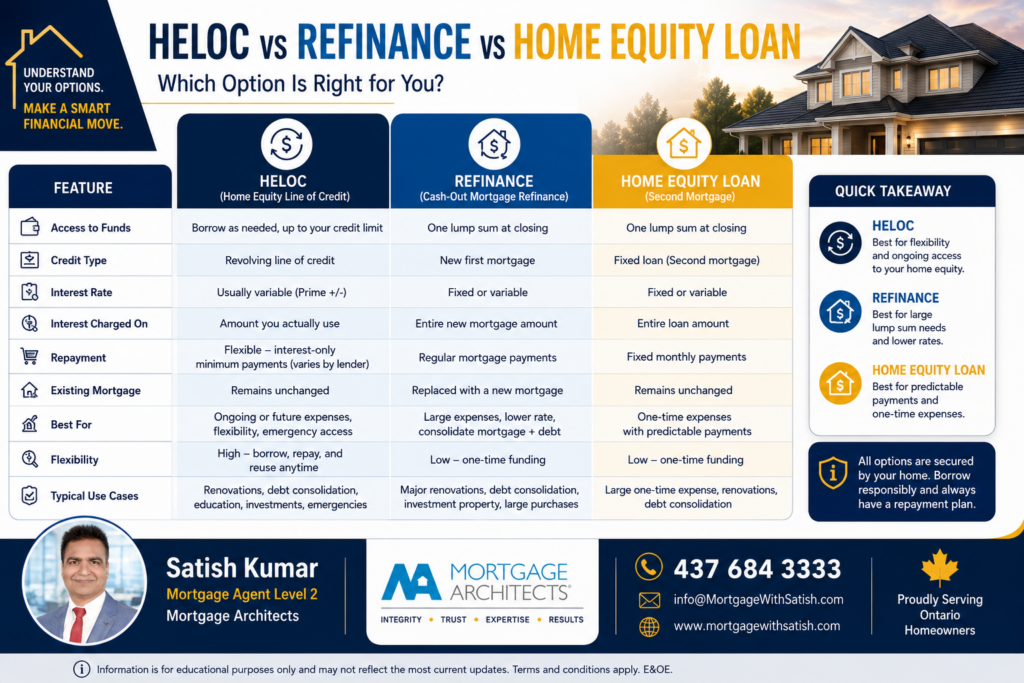
Both a HELOC and mortgage refinancing allow homeowners to access home equity, but they work in different ways.
Comparison Table
| Feature | HELOC | Mortgage Refinance |
|---|---|---|
| Access to Funds | Borrow as needed | One lump sum |
| Existing Mortgage | Usually remains unchanged | Replaced with a new mortgage |
| Interest | On outstanding balance | On entire new mortgage amount |
| Repayment | Flexible | Regular mortgage payments |
| Best For | Ongoing expenses | Large planned expenses |
A HELOC May Be Better If You:
- Expect expenses over time
- Want emergency access to funds
- Prefer borrowing only what you need
- Need flexibility for ongoing projects
Mortgage Refinancing May Be Better If You:
- Need a large lump sum
- Want to consolidate significant debt
- Plan a major renovation
- Want to restructure your mortgage
HELOC vs Second Mortgage
Some homeowners also consider a second mortgage instead of a HELOC.
Comparison Table
| Feature | HELOC | Second Mortgage |
|---|---|---|
| Credit Type | Revolving | Fixed loan |
| Funds | Borrow as needed | Lump sum |
| Repayment | Flexible | Scheduled payments |
| Interest | Usually variable | May be fixed or variable |
| Best For | Ongoing borrowing | One-time financing |
HELOC vs Personal Loan
Another alternative is a personal loan.
Comparison Table
| Feature | HELOC | Personal Loan |
|---|---|---|
| Security | Secured by home | Usually unsecured |
| Borrowing | Revolving | Lump sum |
| Interest | On balance used | On full loan |
| Flexibility | High | Moderate |
| Credit Limit | May be higher | Depends on qualification |
Choosing the Right Option
Different financial goals call for different borrowing solutions.
| Financial Goal | Recommended Option |
|---|---|
| Ongoing renovations | HELOC |
| Emergency access to funds | HELOC |
| Major one-time renovation | Mortgage Refinance |
| Large debt consolidation | Mortgage Refinance |
| One-time financing | Second Mortgage |
| Smaller unsecured borrowing | Personal Loan |
Ontario Scenario
Michael and Sarah own a home in Oshawa and plan to renovate their kitchen, basement, and backyard over the next two years.
Instead of refinancing their mortgage for the full estimated renovation cost, they establish a HELOC and draw funds only as each phase begins. This approach allows them to pay interest only on the amount currently borrowed while maintaining flexibility if renovation costs change.
Satish’s Expert Insight
One of the most common questions I receive is whether a HELOC or refinancing is the better choice. The answer depends on your objective. If your expenses will occur gradually, a HELOC often provides greater flexibility. If you need a substantial amount all at once, refinancing may be more appropriate. Reviewing your complete financial picture helps determine the solution that best aligns with your long-term goals.
Key Takeaways
- A HELOC is ideal for flexible, ongoing borrowing.
- Mortgage refinancing is generally better for large lump-sum financing.
- Second mortgages and personal loans serve different borrowing needs.
- Choosing the right solution depends on your financial objectives, repayment strategy, and comfort with risk.

Common HELOC Mistakes
A Home Equity Line of Credit (HELOC) can be an excellent financial tool when used responsibly. However, because it provides convenient access to home equity, some homeowners unintentionally make decisions that increase long-term debt or reduce their financial flexibility.
Understanding these common mistakes can help you use a HELOC more effectively.
Mistake 1 – Treating a HELOC Like Extra Income
A HELOC is borrowed money—not additional income.
Using it for everyday spending, vacations, or lifestyle expenses without a repayment strategy can lead to unnecessary long-term debt.
Instead, use your HELOC for clearly defined financial objectives.
Mistake 2 – Borrowing More Than Necessary
One of the biggest advantages of a HELOC is flexibility.
However, easy access to available credit can tempt homeowners to borrow more than required.
Before each withdrawal, ask yourself:
- Is this expense necessary?
- Will it improve my financial position?
- Can I comfortably repay it?
Mistake 3 – Paying Only the Minimum
Many HELOCs require only minimum payments.
While this improves short-term cash flow, consistently paying only the minimum can significantly increase interest costs over time.
Whenever possible:
- Pay more than the required minimum.
- Reduce the principal balance.
- Restore available credit while lowering future borrowing costs.
Mistake 4 – Ignoring Interest Rate Changes
Most HELOCs have variable interest rates.
If market rates increase:
- Monthly interest costs may rise.
- Borrowing becomes more expensive.
- Household budgets may become strained.
Homeowners should plan for changing interest rates before borrowing.
Mistake 5 – Not Comparing Lenders
Every lender offers different:
- Interest rates
- Credit limits
- Fees
- Repayment flexibility
- Product features
Comparing several lenders helps you identify the HELOC that best supports your financial goals.
Mistake 6 – Borrowing Without a Repayment Plan
Every dollar borrowed should have a purpose.
Before using your HELOC, determine:
- How much you need.
- Why you need it.
- How long repayment will take.
- How it fits into your long-term financial plan.
Ontario Example
Linda owns a townhouse in Mississauga and opens a HELOC for planned home renovations.
Initially, she uses it only for construction expenses. Over time, however, she begins using the available credit for vacations and discretionary purchases. As the outstanding balance grows and interest rates rise, monthly costs become more difficult to manage.
A structured borrowing plan from the beginning could have helped her maintain greater financial flexibility.
Satish’s Expert Insight
The homeowners who benefit most from a HELOC treat it as a strategic financial resource rather than readily available spending money. Borrowing with a clear objective and repayment timeline helps preserve home equity while minimizing long-term borrowing costs.
Key Takeaways
- A HELOC should support financial goals—not everyday spending.
- Borrow only what you need.
- Prepare for interest rate changes.
- Develop a repayment strategy before accessing funds.

HELOC Myths vs Facts
Many misconceptions prevent homeowners from fully understanding how a Home Equity Line of Credit works.
Separating myths from facts helps you make better borrowing decisions.
| Myth | Fact |
|---|---|
| A HELOC is the same as refinancing. | Refinancing replaces your mortgage, while a HELOC is a separate revolving credit facility secured by your home’s equity. |
| You pay interest on the full credit limit. | Interest generally applies only to the outstanding borrowed balance. |
| A HELOC should only be used during financial emergencies. | Many homeowners use a HELOC for renovations, education, investment opportunities, and long-term financial planning. |
| Everyone with home equity automatically qualifies. | Qualification depends on income, credit history, debt obligations, home equity, and lender policies. |
| A HELOC is always the best borrowing option. | Depending on your goals, refinancing, a second mortgage, or another financing solution may be more appropriate. |
Key Takeaways
- A HELOC provides flexibility but is not suitable for every financial situation.
- Qualification depends on more than home equity alone.
- Understanding your options leads to better financial decisions.
Step-by-Step HELOC Application Guide
Applying for a HELOC is similar to applying for a mortgage because the lender evaluates both your financial profile and your property.
Step 1 – Determine Your Financial Goal
Clearly define why you want a HELOC.
Common objectives include:
- Home renovations
- Debt consolidation
- Education funding
- Investment opportunities
- Emergency financial planning
Step 2 – Estimate Your Home Equity
Calculate the difference between your home’s estimated market value and your remaining mortgage balance.
Understanding your available equity helps determine whether a HELOC may be appropriate.
Step 3 – Review Your Financial Situation
Gather information regarding:
- Employment
- Income
- Existing debts
- Credit profile
- Monthly expenses
Being organized can simplify the application process.
Step 4 – Compare HELOC Products
Review available options, including:
- Interest rates
- Credit limits
- Fees
- Repayment flexibility
- Borrowing features
Different lenders may offer different products.
Step 5 – Submit Your Application
Your lender may request:
- Income verification
- Employment information
- Property details
- Mortgage information
- Identification
- Credit authorization
Step 6 – Property Valuation
Many lenders require an updated property valuation to determine current market value and available home equity.
Step 7 – Approval and Account Setup
Once approved:
- Your HELOC account is established.
- A credit limit is assigned.
- Funds become available as needed.
- Interest is generally charged only on amounts borrowed.
Ontario Scenario
David and Melissa own a detached home in Burlington and want to complete several renovation projects over the next three years.
Rather than borrowing one large amount upfront, they establish a HELOC and withdraw funds only as each renovation begins. This approach allows them to manage cash flow while reducing interest costs on unused funds.
Satish’s Action Checklist
Before applying for a HELOC, make sure you can answer Yes to most of these questions:
✅ I understand why I want a HELOC.
✅ I know how much home equity I have.
✅ I understand how variable interest rates work.
✅ I have compared multiple lender options.
✅ I know how I will repay the borrowed funds.
✅ I understand the risks of borrowing against my home.
✅ I have a clear long-term financial strategy.
Key Takeaways
- Start with a clear financial objective.
- Review your finances before applying.
- Compare lender options—not just interest rates.
- Borrow responsibly and maintain a repayment plan.

What is a HELOC?
A Home Equity Line of Credit (HELOC) is a revolving line of credit secured by your home’s equity. It allows eligible homeowners to borrow funds as needed, repay the balance, and borrow again up to their approved credit limit.
How is a HELOC different from a mortgage refinance?
A HELOC provides ongoing access to a revolving credit facility while your existing mortgage generally remains unchanged. Mortgage refinancing replaces your current mortgage with a new one, often to obtain a lump sum or change mortgage terms.
How much can I borrow with a HELOC?
The amount depends on factors such as your home’s available equity, your income, credit profile, debt obligations, lender policies, and applicable Canadian lending regulations.
Do I pay interest on my full HELOC limit?
No. Interest is generally charged only on the amount you have actually borrowed, not on your total approved credit limit.
Can I repay my HELOC early?
Yes. Most HELOCs offer flexible repayment options, allowing you to repay principal at any time, subject to your lender’s terms and conditions.
Is a HELOC interest rate fixed or variable?
Many HELOCs have variable interest rates, meaning borrowing costs may increase or decrease over time depending on market conditions and lender pricing.
Can I use a HELOC for home renovations?
Yes. Renovations are one of the most common reasons homeowners establish a HELOC because they can access funds gradually as projects progress.
Can I use a HELOC to consolidate debt?
Many homeowners use a HELOC to consolidate higher-interest debt. Whether this strategy is appropriate depends on your financial situation and repayment plan.
Is a HELOC better than a personal loan?
It depends on your financial objectives. A HELOC offers revolving access to funds secured by your home, while a personal loan generally provides a fixed lump sum and is often unsecured.
Can self-employed borrowers qualify for a HELOC?
Yes. Self-employed applicants may qualify if they meet the lender’s income, documentation, credit, and underwriting requirements.
Can I use a HELOC to purchase an investment property?
Some homeowners use available home equity to help finance an investment property. Before doing so, it’s important to evaluate the risks, borrowing costs, and overall affordability.
What happens if interest rates increase?
If your HELOC has a variable interest rate, your borrowing costs may increase. Planning for potential rate changes can help protect your household budget.
Does opening a HELOC affect my credit score?
Applying for any new credit facility may have an impact on your credit profile. Managing your HELOC responsibly and making payments on time can help maintain a healthy credit history.
Is a HELOC suitable for emergencies?
Many homeowners establish a HELOC as a financial safety net for unexpected expenses because funds are available when needed.
Should I speak with a mortgage professional before applying?
Yes. A mortgage professional can help you compare available options, explain lender requirements, and determine whether a HELOC, mortgage refinance, or another financing solution best aligns with your financial goals.
Conclusion
A Home Equity Line of Credit can be one of the most versatile financial tools available to Ontario homeowners. Whether you’re renovating your home, consolidating debt, planning future investments, or preparing for unexpected expenses, a HELOC offers flexible access to your home’s equity while allowing you to borrow only what you need.
However, flexibility comes with responsibility. Because your home secures the credit facility, every borrowing decision should support a well-defined financial objective and include a realistic repayment strategy.
Before choosing a HELOC, compare available options, understand the costs, consider how changing interest rates may affect your budget, and ensure the solution aligns with your long-term financial goals.
When used wisely, a HELOC can provide valuable financial flexibility while helping you make the most of one of your greatest assets—your home.
What Should You Do Next?
If You’re a First-Time Homeowner
- Learn how home equity grows over time.
- Understand when a HELOC may become a suitable financing option.
- Build strong credit and maintain manageable debt levels.
If You’re Planning Home Renovations
- Estimate your renovation budget.
- Determine whether staged access to funds through a HELOC fits your project timeline.
- Compare borrowing options before making a decision.
If You’re Looking to Consolidate Debt
- Review all outstanding debts and interest rates.
- Evaluate whether using home equity supports your long-term financial plan.
- Avoid accumulating new unsecured debt after consolidation.
If You’re an Investor
- Assess potential returns alongside borrowing costs.
- Consider cash flow, market conditions, and investment risks before using home equity for investment purposes.
If You’re Self-Employed
- Organize income documentation and financial records.
- Review lender requirements carefully.
- Seek advice on financing solutions suited to your business and personal income structure.
Satish’s Action Plan
Before applying for a HELOC, follow this checklist:
☑ Define your financial goal.
☑ Estimate your available home equity.
☑ Review your household budget.
☑ Check your credit profile.
☑ Compare multiple lenders and products.
☑ Understand how variable interest rates work.
☑ Develop a repayment strategy.
☑ Borrow only what you genuinely need.
☑ Review your financing options with a qualified mortgage professional.
Call to Action
Every homeowner’s financial situation is unique. Choosing the right borrowing solution requires careful consideration of your goals, current mortgage, available equity, income, and future plans.
If you’re considering a Home Equity Line of Credit, a professional mortgage review can help you understand your available options and determine whether a HELOC, mortgage refinance, or another financing solution best supports your objectives.
Satish Kumar
Mortgage Agent Level 2
Mortgage Architects
📞 437-684-3333
📧 info@mortgagewithsatish.com
🌐 www.mortgagewithsatish.com