Is a reverse mortgage the right financial tool for you as a homeowner in Ontario? Whether you’re in Durham Region, Peel, or the GTA, understanding the reverse mortgage Canada pros and cons is essential before making a decision. For many older Ontarians, a reverse mortgage offers a way to access home equity without selling or making regular payments. But there are key trade-offs—and it’s vital to know them, especially with changing rules and lender requirements in Ontario.
Key takeaways
- A reverse mortgage lets Ontario homeowners 55+ access equity with no required monthly mortgage payments, but the debt grows over time.
- Borrowing is usually capped at up to 55% of a home’s appraised value; payout can be lump sum, planned payments, or a mix.
- No regular mortgage payments are needed, but fees, higher rates, and accruing interest mean less equity remains later.
- The loan is repaid when you sell, permanently move out, or die—potentially through a property sale.
- Independent legal advice and a clear understanding of total borrowing costs are essential before signing.
How does a reverse mortgage work in Canada?
A Canadian reverse mortgage allows eligible homeowners to borrow against the equity they’ve built up in their home. The most common product in Ontario, offered by several lenders, has a few defining features:
- Eligibility: You must own your home and are usually required to be at least 55 years old, though individual lenders can set additional conditions. The amount you can borrow is based on things like your age, property value, and location. Learn more about eligibility.
- Payout: Funds can be received as a lump sum, regular advances, or a combination—depending on the lender and product. This creates flexibility based on your financial needs. How payouts work.
- No regular payments: You do not have to make monthly mortgage payments. Interest and fees are added to your balance, meaning the amount you owe increases over time and is typically repaid only when your home is sold, when you move out, or after the last borrower dies. When repayment is required.
- Rates and fees: Reverse mortgage interest rates are usually higher than on conventional mortgages or home equity lines of credit (HELOCs). You may also be charged appraisal, legal, setup, and closing fees. HomeEquity Bank, for example, lists a typical CHIP closing fee of $1,795, but this can vary. Details on typical fees.
- Repayment triggers: The loan must be repaid if you sell your house, move out permanently, default, or the last borrower passes away. If the loan isn’t repaid, the lender may require the sale of the home to recover the balance. Repayment triggers and risks.
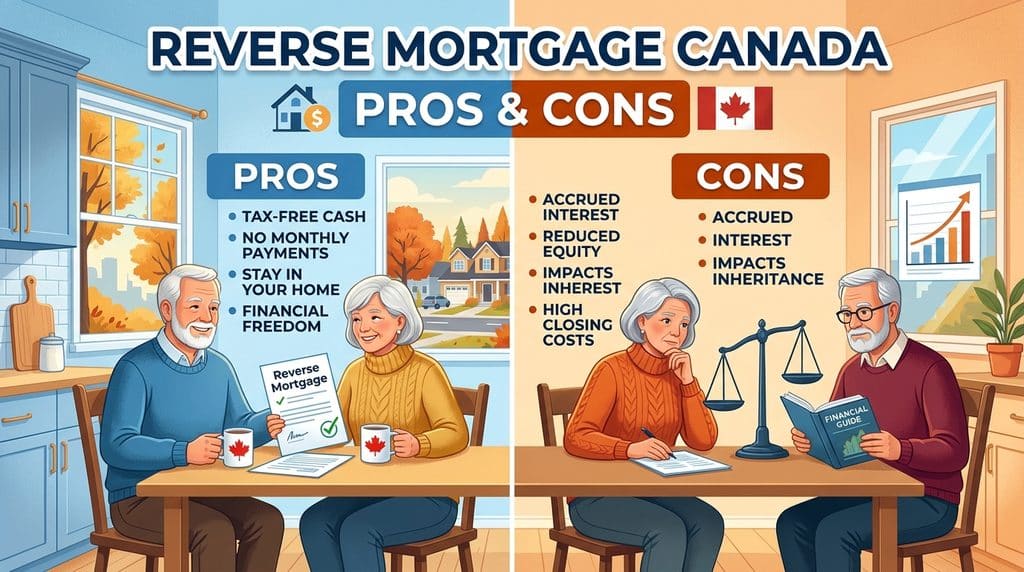
Reverse mortgage Canada pros and cons
Every financial product has trade-offs. Here’s how the advantages and disadvantages of a reverse mortgage stack up for Ontario homeowners:
Potential advantages
- Access home equity without selling: Tap into your home’s value and get cash while still living in your property, provided you continue to meet the lender’s terms. More on accessing equity.
- No required monthly mortgage payments: Compared to a traditional mortgage or HELOC, a reverse mortgage doesn’t demand regular payments, which may benefit those on a fixed income. Compare with HELOCs and conventional mortgages.
- Flexible payout options: Some products let you choose how and when you receive the money, which can help with budgeting for things like home repairs, healthcare, or supplementing retirement income. How funds are paid out.
- Non-taxable funds: The Canada Revenue Agency does not generally treat reverse mortgage proceeds as taxable income, and for most people, this won’t affect Old Age Security or Guaranteed Income Supplement benefits. Still, you should confirm with a consultant or review any unique situations. Tax and benefits impacts.
Potential disadvantages and risks
- Debt increases, equity shrinks: Because interest and fees are rolled into the loan, the amount you owe grows—meaning you or your heirs may have less equity left over when the property is eventually sold. Understand diminishing equity.
- Higher borrowing costs: Reverse mortgage rates and fees are usually higher than those for a standard mortgage or HELOC. Consider both interest and all associated costs. More about borrowing costs.
- Repayment may result in a forced sale: The outstanding loan must typically be repaid after a sale, move-out, or the passing of the last borrower. This often leads to selling the home to cover the debt. Read about repayment implications.
- Prepayment penalties: If you choose to repay the loan early—for example, if you sell or want to clear the debt before it’s due—you might face a prepayment fee. Find out about prepayment charges.
- Contractual obligations and risk of default: Failing to meet the loan’s requirements (like letting the home fall into disrepair, misusing proceeds, or making false statements) can result in default and even foreclosure. More on default risks in Ontario.
- Reduced inheritance: The more you borrow and the longer you carry the reverse mortgage, the less value remains for your heirs. Impacts on inheritance.
How do you qualify—and what’s the process?
Lenders have specific rules. In Canada, eligible borrowers are usually:
- At least 55 years old (all owners listed on title must meet the age requirement).
- Own their primary residence (some properties don’t qualify—ask your broker about condos, rural, or multiplex properties).
- The maximum loan is generally up to 55% of the home’s appraised value, with actual eligibility affected by your age, home value, condition, and location. Review qualifying criteria.
As part of the process, Ontario regulations require independent legal advice before you sign the reverse mortgage documents. Your legal counsel will explain the contract, the triggers that require repayment, what happens if a spouse passes, and your obligations for property maintenance and taxes. Why independent legal advice is vital.
Costs you should consider
Reverse mortgages come with several one-time and ongoing costs. According to HomeEquity Bank’s CHIP FAQ and the Financial Consumer Agency of Canada (FCAC):
- Interest rates are generally higher than for a regular mortgage or HELOC, and compound over time.
- Typical fees include an appraisal, legal advice, setup, and closing. CHIP’s typical closing fee is $1,795, but others may apply.
- Some contracts charge a prepayment penalty if you pay off your loan before it’s due. Ask your lender for details.
Always compare the total borrowing cost—not just the interest rate—covering fees, compounding interest, and what happens if you change your plans.
What this means for Ontario homebuyers
For most first-time buyers in Ontario, a reverse mortgage is not a way to purchase your first home. Instead, it’s potentially an option later in life if you have significant home equity and need funds without selling. If you’re a retiree, business owner, healthcare professional, or self-employed with limited income but lots of home equity, a reverse mortgage could help reduce financial stress—but it isn’t a one-size-fits-all solution.
The Ontario Financial Services Regulatory Authority (FSRA) emphasizes that borrowers should understand all product risks, assess total borrowing costs, and obtain independent legal advice. Make sure you’re comfortable with the idea of less equity for your estate and the potential requirement to sell your home when repayment is due. If you have family involved, talk through the impact on inheritance, too.
Before moving ahead, compare the reverse mortgage to other options (like downsizing or a HELOC), and consult with your mortgage broker to get an unbiased view of what fits your plans.
Frequently asked questions
How much can I borrow with a reverse mortgage in Ontario?
The amount is usually capped at up to 55% of your home’s appraised value. The actual maximum depends on your age, home value, and location. More details on limits.
Do I have to make monthly payments on a reverse mortgage?
No, regular monthly payments are not required. Interest accrues and is added to the loan balance, which is repaid when you sell, move out, or after death. Learn about repayment.
Will a reverse mortgage affect my government benefits?
Reverse mortgage proceeds are generally not considered taxable income and won’t affect Old Age Security or Guaranteed Income Supplement. Check if other programs may be impacted. See details.
Can I pay off a reverse mortgage early?
Early repayment is possible, but you may be charged a penalty or prepayment fee. Read your contract and ask your lender what applies. More on prepayment.
If you’re exploring your options or have questions about how a reverse mortgage might work for you—or if it’s the right fit—book a free discovery call with Satish Kumar, Licensed Mortgage Agent with Mortgage Architects, using this link: Book your free call here.
Disclaimer: This content is for general information only and is not personal mortgage or financial advice. Please speak with a licensed professional to discuss your own situation.
Credit Score for a Mortgage in Canada: Avoid Costly Mistakes Improve Your Approval Chances