
Executive Summary
Mortgage refinancing allows homeowners to replace their existing mortgage with a new one that better aligns with their financial goals. Whether you’re looking to lower your monthly payments, access home equity, consolidate high-interest debt, finance renovations, or adjust your mortgage term, refinancing can be a powerful financial tool when used strategically.
This comprehensive guide explains how mortgage refinancing works in Ontario and across Canada, who qualifies, the costs involved, the benefits and potential drawbacks, and how to determine whether refinancing is the right choice for your situation. You’ll also learn how refinancing compares with mortgage renewal and a Home Equity Line of Credit (HELOC), common mistakes to avoid, and practical strategies to maximize long-term savings.
Quick Answer
Mortgage refinancing replaces your current mortgage with a new one. It may allow you to lower your interest rate, reduce monthly payments, consolidate debt, finance home improvements, or access your home’s equity. While refinancing can provide significant financial benefits, it may also involve penalties, legal fees, appraisal costs, and qualification requirements that should be carefully considered.
Mortgage refinancing is the process of replacing your existing mortgage with a new one, often to obtain a lower interest rate, change your mortgage term, consolidate debt, or access home equity. In Canada, refinancing generally requires sufficient home equity, meeting lender qualification criteria, and understanding the associated costs before proceeding.
Key Takeaways
- Mortgage refinancing can help reduce borrowing costs and improve financial flexibility.
- Homeowners commonly refinance to consolidate debt, finance renovations, or access equity.
- Refinancing is different from mortgage renewal and should be evaluated based on your long-term financial goals.
- Understanding costs, penalties, and qualification requirements is essential before refinancing.
Table of Contents

Introduction
For many Ontario homeowners, a mortgage is more than just a loan—it’s one of the most significant financial commitments they’ll ever make. As your financial situation changes over time, the mortgage that once suited your needs may no longer be the best fit.
Perhaps interest rates have changed, you’ve built substantial equity in your home, or you’re looking to simplify your finances by consolidating high-interest debt. You may also want to renovate your property, invest in another home, or adjust your monthly payments to better align with your current budget.
Mortgage refinancing offers an opportunity to restructure your mortgage to support these changing financial goals. However, refinancing isn’t automatically the right decision for everyone. Understanding how it works, what it costs, and when it makes sense is essential before making any changes.
This guide provides Ontario homeowners with a clear, practical explanation of mortgage refinancing so you can make informed decisions with confidence.
What Is Mortgage Refinancing?
Mortgage refinancing is the process of replacing your existing mortgage with a new mortgage agreement. Instead of continuing with your current mortgage terms, you obtain a new mortgage that may better suit your financial needs.
Depending on your goals, refinancing can help you:
- Lower your interest rate
- Reduce monthly mortgage payments
- Access equity built up in your home
- Consolidate higher-interest debts
- Finance major home renovations
- Change your mortgage term or amortization
- Switch from a variable-rate mortgage to a fixed-rate mortgage (or vice versa)
Unlike a mortgage renewal, refinancing generally involves creating an entirely new mortgage agreement and may require requalification under the lender’s current lending criteria.
Ontario Example
Consider a homeowner in Ajax who purchased a home several years ago. Since then, the property’s value has increased, and mortgage payments have reduced the outstanding balance. With additional home equity available, refinancing could allow the homeowner to consolidate high-interest credit card balances into the mortgage, potentially simplifying monthly payments and reducing overall borrowing costs.
Satish’s Expert Insight
In my experience working with Ontario homeowners, refinancing is most effective when it’s tied to a clear financial objective—not simply because rates have changed. Whether your goal is reducing debt, improving cash flow, or funding a major life event, the decision should be based on the long-term financial impact rather than short-term market conditions.
Why Homeowners Refinance Their Mortgage
Every homeowner has different financial priorities, but the most common reasons for refinancing include:
1. Lower Monthly Payments
A lower interest rate, longer amortization period, or revised mortgage structure may reduce monthly payment obligations.
2. Debt Consolidation
High-interest debts such as credit cards, personal loans, or lines of credit can often be consolidated into a mortgage, which may carry a lower borrowing cost.
3. Home Renovations
Many homeowners refinance to access equity for renovations that improve comfort, functionality, or property value.
4. Access Home Equity
Refinancing may provide access to accumulated home equity for major expenses such as education, investment opportunities, or unexpected financial needs.
5. Change Mortgage Type
Homeowners may refinance to switch between fixed and variable interest rates or to modify the mortgage term based on changing financial goals.
6. Improve Cash Flow
Restructuring your mortgage can provide greater monthly flexibility, allowing you to better manage household expenses and long-term financial planning.
Key Takeaways
- Mortgage refinancing provides financial flexibility for changing life circumstances.
- Homeowners refinance for many reasons beyond securing a lower interest rate.
- Every refinancing decision should align with long-term financial goals.
- Understanding both the benefits and costs helps determine whether refinancing is the right strategy.
How Mortgage Refinancing Works
Mortgage refinancing replaces your current mortgage with a new mortgage agreement that better aligns with your present financial goals. Instead of continuing under your existing mortgage terms, you apply for a new mortgage, which may involve changing lenders or refinancing with your current lender.
Unlike a simple mortgage renewal, refinancing usually requires a full mortgage application and qualification process.
The amount you can refinance depends on factors such as:
- Your home’s current market value
- Your remaining mortgage balance
- Your available home equity
- Your income and employment
- Your credit profile
- Your debt obligations
- Individual lender policies
Generally, Canadian lenders allow homeowners to refinance up to 80% of their home’s appraised value, subject to qualification requirements.
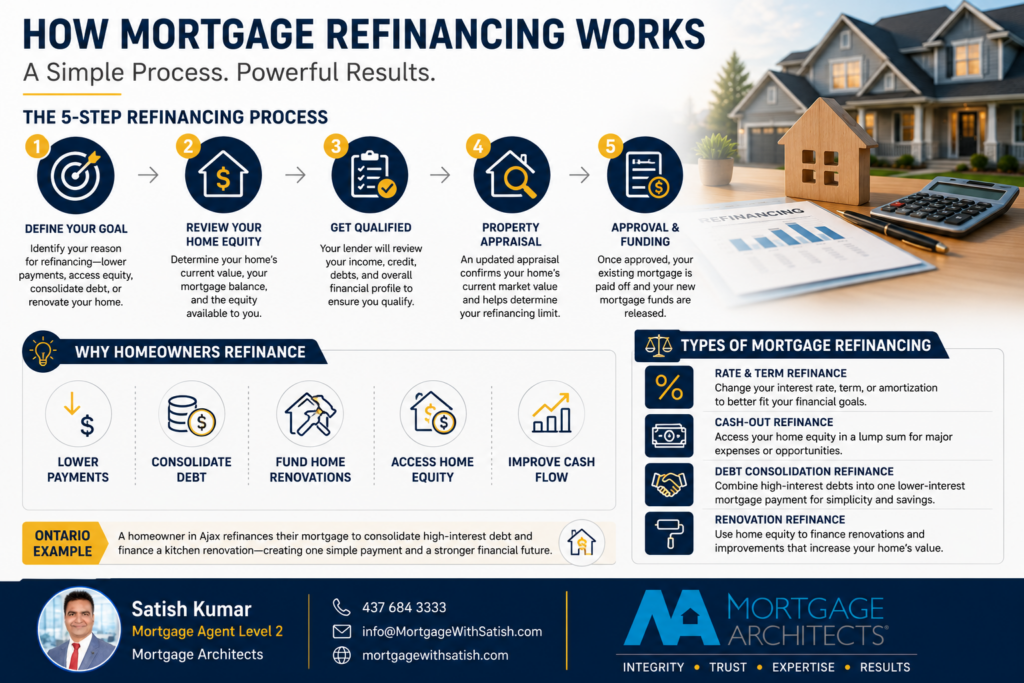
The Mortgage Refinancing Process
Step 1 – Define Your Financial Goal
Before refinancing, determine exactly why you want to refinance.
Common objectives include:
- Lower monthly payments
- Reduce borrowing costs
- Consolidate debt
- Access home equity
- Finance renovations
- Purchase an investment property
- Improve monthly cash flow
The clearer your objective, the easier it becomes to determine whether refinancing is appropriate.
Step 2 – Review Your Home Equity
Home equity equals:
Current Market Value − Outstanding Mortgage Balance
The more equity you’ve built, the more refinancing options may be available.
Example:
| Home Value | Mortgage Balance | Available Equity |
|---|---|---|
| $900,000 | $500,000 | $400,000 |
Although you may have significant equity, lenders generally limit refinancing based on their maximum loan-to-value (LTV) policies.
Step 3 – Complete Mortgage Qualification
Just like obtaining your original mortgage, refinancing usually requires lenders to review:
- Employment status
- Income verification
- Credit history
- Existing debts
- Property information
- Mortgage payment history
The lender assesses whether you continue to meet its lending guidelines.
Step 4 – Property Valuation
Most lenders require an updated appraisal to determine your home’s current market value.
A higher property value may increase available equity, while a lower valuation may reduce refinancing options.
Step 5 – Approval and Funding
Once approved:
- Legal documents are prepared.
- Existing mortgage funds are repaid.
- New mortgage funds are advanced.
- Additional equity (if applicable) is released.
- Your new mortgage payments begin under the updated agreement.
Ontario Example
Sarah purchased her home in Whitby several years ago for $650,000.
Her property is now worth $920,000, while her remaining mortgage balance is $420,000.
She refinances to:
- Pay off higher-interest consumer debt.
- Finance a kitchen renovation.
- Maintain an emergency savings fund.
Instead of managing several high-interest debts, she now has one structured mortgage payment that better fits her financial plan.
Satish’s Expert Insight
One of the biggest misconceptions I hear is that refinancing is only worthwhile when interest rates fall. In reality, many homeowners refinance because their financial priorities have changed—not just because of rate movements. A well-planned refinance should support your overall financial strategy, whether that’s improving cash flow, funding renovations, or simplifying debt.
Key Takeaways
- Refinancing replaces your existing mortgage with a new mortgage.
- Qualification is usually required.
- Updated property valuation is commonly part of the process.
- Refinancing should support a specific financial objective.
Who Can Qualify for Mortgage Refinancing?
Every lender has its own underwriting policies, but most evaluate several common factors when considering a refinancing application.
1. Home Equity
The amount of equity you’ve built plays a significant role in determining your refinancing options.
Generally, greater equity provides:
- More borrowing flexibility
- Better lender options
- Lower lending risk
2. Stable Income
Lenders typically look for reliable income from sources such as:
- Full-time employment
- Part-time employment
- Self-employment
- Pension income
- Investment income (where applicable)
Income helps demonstrate your ability to comfortably manage mortgage payments.
3. Credit History
A stronger credit profile may improve:
- Mortgage approval chances
- Available mortgage products
- Interest rate options
Borrowers with lower credit scores may still qualify, although available products and pricing may differ.
4. Debt Service Ratios
Lenders review your existing financial obligations, including:
- Mortgage payments
- Property taxes
- Heating costs
- Credit cards
- Vehicle loans
- Personal loans
- Lines of credit
Lower debt obligations generally improve affordability.
5. Property Condition
The property itself is also evaluated.
Lenders may consider:
- Market value
- Property type
- Location
- Overall condition
Types of Mortgage Refinancing
Not every refinance serves the same purpose. Understanding the different refinancing options helps homeowners choose the solution that best fits their financial needs.
Rate-and-Term Refinance
This option changes the terms of your mortgage without significantly increasing the mortgage balance.
Homeowners commonly refinance to:
- Lower their interest rate
- Change mortgage term
- Switch between fixed and variable rates
- Improve monthly budgeting
Cash-Out Refinance
A cash-out refinance allows homeowners to borrow against available home equity.
Funds are commonly used for:
- Home renovations
- Debt consolidation
- Investment opportunities
- Education expenses
- Emergency financial needs
Debt Consolidation Refinance
Many Ontario homeowners use refinancing to combine higher-interest debts into one mortgage payment.
This may simplify finances by replacing multiple monthly payments with a single mortgage payment.
Common debts include:
- Credit cards
- Personal loans
- Lines of credit
- Auto loans
Renovation Refinance
Some homeowners refinance specifically to finance renovations such as:
- Kitchen upgrades
- Basement finishing
- Energy-efficient improvements
- Accessibility modifications
- Home additions
Strategic renovations may improve both comfort and long-term property value.
Comparison Table – Types of Mortgage Refinancing
| Refinance Type | Primary Purpose | Best For |
|---|---|---|
| Rate & Term | Lower payments or modify mortgage | Long-term savings |
| Cash-Out | Access home equity | Major expenses |
| Debt Consolidation | Combine multiple debts | Simplifying finances |
| Renovation Refinance | Finance home improvements | Increasing home value |
Comparison Table – Mortgage Renewal vs Mortgage Refinancing
| Feature | Mortgage Renewal | Mortgage Refinancing |
|---|---|---|
| New Mortgage Application | Usually No | Usually Yes |
| Home Equity Access | No | Yes (subject to qualification) |
| Change Mortgage Amount | No | Yes |
| Qualification Required | Limited or Not Required | Usually Required |
| Legal Documentation | Minimal | More Extensive |
| Purpose | Continue Existing Mortgage | Restructure Mortgage |
Satish’s Expert Insight
Every refinancing option comes with trade-offs. A cash-out refinance may provide valuable flexibility today, but it also increases your mortgage balance and could extend the time needed to become mortgage-free. Before refinancing, consider not only what you gain now but also how the decision fits into your long-term financial goals.
Key Takeaways
- Qualification depends on your income, equity, credit profile, debt obligations, and property.
- Different refinancing options serve different financial objectives.
- Mortgage refinancing is more comprehensive than a standard renewal.
- Choosing the right refinancing strategy begins with understanding your financial priorities.
What Does Mortgage Refinancing Cost?
While refinancing can provide significant financial benefits, it’s important to understand the costs involved before making a decision. The savings from refinancing should generally outweigh the total cost of replacing your existing mortgage.
The actual costs vary depending on your lender, mortgage type, and whether you refinance before your current mortgage term ends.
Mortgage Prepayment Penalty
For many homeowners, the largest refinancing expense is the mortgage prepayment penalty.
This penalty compensates your lender for ending your current mortgage agreement before the end of its term.
The amount depends on several factors, including:
- Fixed or variable interest rate
- Remaining mortgage term
- Current lender’s penalty calculation
- Outstanding mortgage balance
Every lender uses its own calculation method, so it’s important to request an exact payout statement before proceeding.
Property Appraisal
Most lenders require an updated appraisal to determine your home’s current market value.
An appraisal helps establish:
- Current property value
- Available home equity
- Maximum refinancing amount
- Loan-to-value ratio
Legal Fees
Because refinancing creates a new mortgage registration, legal work is generally required.
Legal professionals typically assist with:
- Mortgage registration
- Title verification
- Document preparation
- Mortgage discharge
- Fund transfers
Discharge Fee
If you’re replacing an existing mortgage, your current lender may charge a mortgage discharge fee to remove the original mortgage registration.
Administrative Fees
Depending on the lender, additional costs may include:
- Registration fees
- Title search fees
- Processing fees
- Mortgage assignment fees
Not every refinance includes all of these costs, but homeowners should understand the complete financial picture before proceeding.
Ontario Example
David owns a home in Pickering and wants to refinance to consolidate debt.
Before proceeding, he compares:
- Mortgage penalty
- Legal costs
- Appraisal fee
- Interest savings over the next five years
Although refinancing requires upfront costs, the long-term savings from lower borrowing costs and debt consolidation outweigh the initial expenses.
Key Takeaways
- Refinancing is not free.
- Mortgage penalties are often the largest expense.
- Always compare total costs against expected long-term savings.
- Request a complete cost breakdown before refinancing.

Mortgage Refinancing vs Mortgage Renewal
Many homeowners confuse refinancing with mortgage renewal, but they serve different purposes.
A mortgage renewal simply extends your mortgage at the end of its current term, while refinancing restructures the mortgage itself.
Comparison Table
| Feature | Mortgage Renewal | Mortgage Refinancing |
|---|---|---|
| New Mortgage Amount | No | Yes |
| Access Home Equity | No | Yes |
| Full Qualification | Often Not Required | Usually Required |
| Change Amortization | Limited | Yes |
| Consolidate Debt | No | Yes |
| Finance Renovations | No | Yes |
| Replace Mortgage | No | Yes |
When Renewal Makes Sense
Mortgage renewal may be appropriate if:
- You’re satisfied with your mortgage.
- You don’t need additional funds.
- Your financial situation hasn’t changed.
- You simply want to continue with a new term.
When Refinancing Makes Sense
Refinancing may be more suitable if you want to:
- Access home equity
- Lower borrowing costs
- Consolidate debt
- Renovate your home
- Improve cash flow
- Change your mortgage structure
Mortgage Refinancing vs HELOC
Another common question homeowners ask is whether they should refinance or obtain a Home Equity Line of Credit (HELOC).
Both use your home’s equity but serve different purposes.
Comparison Table
| Feature | Mortgage Refinance | HELOC |
|---|---|---|
| Access to Funds | Lump Sum | Borrow as Needed |
| Interest Charges | On Full Mortgage Balance | Only on Amount Used |
| Payment Structure | Regular Mortgage Payments | Flexible Payments |
| Best For | Large Planned Expenses | Ongoing Access to Funds |
| Interest Rate | Generally Lower | Usually Higher than Mortgage |
| Flexibility | Lower | Higher |
Refinancing May Be Better For
- Major debt consolidation
- Large renovations
- Purchasing another property
- Lower monthly borrowing costs
HELOC May Be Better For
- Ongoing renovation projects
- Emergency funds
- Short-term borrowing needs
- Flexible access to home equity
Satish’s Expert Insight
Many homeowners automatically assume they need a refinance when they really need flexibility. In some situations, a HELOC may be more appropriate because you only borrow what you need when you need it. Choosing between the two depends on your financial goals, repayment strategy, and future borrowing plans.
Advantages of Mortgage Refinancing
When refinancing aligns with your financial objectives, it can provide meaningful long-term benefits.
Lower Interest Costs
A more competitive mortgage rate may reduce the total interest paid over the life of your mortgage.
Lower Monthly Payments
Refinancing can improve monthly cash flow by restructuring your mortgage.
Debt Consolidation
Combining multiple higher-interest debts into one mortgage payment may simplify your finances.
Access Home Equity
Home equity can be used to finance:
- Renovations
- Education
- Investments
- Major purchases
- Emergency expenses
Improved Financial Planning
A new mortgage structure may better match your current lifestyle and long-term goals.
Potential Disadvantages
Refinancing is not always the best solution.
Consider these potential drawbacks.
Mortgage Penalties
Breaking your current mortgage early may result in significant penalties.
Increased Mortgage Balance
Borrowing additional funds means owing more on your mortgage.
Longer Time to Become Mortgage-Free
Extending your amortization can reduce monthly payments but increase the total interest paid over time.
Qualification Requirements
Not everyone qualifies for refinancing.
Changes in income, employment, debt, or credit may affect approval.
Closing Costs
Legal fees, appraisal costs, and administrative expenses should all be considered when evaluating refinancing.
Pros and Cons Comparison
| Advantages | Considerations |
|---|---|
| Lower payments | Mortgage penalties |
| Debt consolidation | Legal costs |
| Access equity | Appraisal fees |
| Finance renovations | Higher mortgage balance |
| Better cash flow | Longer amortization |
| Flexible mortgage options | Qualification required |
Satish’s Expert Insight
In my experience, the most successful refinancing decisions are driven by a clear financial strategy rather than a desire to simply access equity. Before refinancing, ask yourself how the new mortgage will improve your financial position five or ten years from now. If the answer is clear and the benefits outweigh the costs, refinancing can be a valuable tool.
Key Takeaways
- Refinancing offers significant opportunities but also comes with costs.
- Compare refinancing with renewal and HELOC before making a decision.
- Calculate total long-term savings—not just monthly payment reductions.
- A refinancing decision should support your broader financial plan.

Common Mortgage Refinancing Mistakes
Refinancing can be an excellent financial strategy, but only when approached carefully. Many homeowners focus solely on obtaining a lower interest rate while overlooking other important factors that affect the overall cost and long-term value of refinancing.
Understanding these common mistakes can help you make more informed decisions and avoid unnecessary expenses.
Mistake 1 – Focusing Only on the Interest Rate
A lower interest rate is attractive, but it should not be the only factor influencing your decision.
Consider the complete picture, including:
- Mortgage penalties
- Legal fees
- Appraisal costs
- Closing costs
- Total interest paid over the life of the mortgage
- Mortgage features and flexibility
Sometimes a slightly higher rate with more flexible repayment options may provide greater long-term value.
Mistake 2 – Borrowing More Than Necessary
Accessing home equity can be beneficial, but borrowing additional funds without a clear financial purpose may increase long-term debt.
Before increasing your mortgage balance, ask yourself:
- Is this borrowing necessary?
- Will it improve my financial position?
- Can I comfortably afford the higher mortgage balance?
Mistake 3 – Ignoring Mortgage Penalties
Many homeowners are surprised by the cost of breaking an existing mortgage before the term ends.
Always request a mortgage payout statement that clearly outlines:
- Remaining balance
- Prepayment penalty
- Discharge fee
- Total payout amount
Understanding these costs helps determine whether refinancing is financially worthwhile.
Mistake 4 – Extending the Amortization Without a Plan
Reducing monthly payments by extending the amortization period may improve cash flow today, but it can also increase the total interest paid over the life of the mortgage.
A longer amortization should support a clear financial objective rather than simply reducing monthly payments.
Mistake 5 – Not Comparing Multiple Lenders
Every lender has different:
- Interest rates
- Mortgage features
- Prepayment privileges
- Penalty calculations
- Qualification guidelines
Comparing multiple options can help identify the mortgage solution that best fits your needs.
Mistake 6 – Refinancing Too Frequently
Repeated refinancing may lead to:
- Additional legal fees
- Repeated appraisal costs
- Higher mortgage balances
- Increased interest costs over time
Refinancing should be part of a long-term financial strategy, not a short-term reaction to changing market conditions.
Satish’s Expert Insight
One of the most common situations I encounter is homeowners focusing entirely on reducing their monthly payment. While lower payments may improve cash flow, they don’t always result in lower overall borrowing costs. I encourage clients to evaluate how refinancing will affect their financial position over the next five to ten years rather than focusing only on immediate savings.
Key Takeaways
- Look beyond interest rates when evaluating refinancing.
- Understand all costs before making a decision.
- Borrow only what you genuinely need.
- Compare multiple mortgage options before committing.

Mortgage Refinancing Myths vs Facts
There are many misconceptions about mortgage refinancing. Separating fact from fiction can help homeowners make more confident decisions.
| Myth | Fact |
|---|---|
| Refinancing is only worthwhile when rates fall significantly. | Refinancing can also help with debt consolidation, renovations, improved cash flow, and accessing home equity. |
| Refinancing always lowers your costs. | Refinancing may involve penalties and closing costs that should be carefully evaluated. |
| Only homeowners with excellent credit can refinance. | Qualification depends on several factors, including equity, income, debt levels, and lender policies. |
| Refinancing and mortgage renewal are the same. | Mortgage renewal continues an existing mortgage term, while refinancing creates a new mortgage agreement. |
| Refinancing is only for financial emergencies. | Many homeowners refinance proactively to improve long-term financial planning or achieve specific goals. |
Key Takeaways
- Refinancing is about achieving financial goals, not just securing a lower rate.
- Costs and benefits should always be evaluated together.
- Understanding the differences between refinancing and renewal helps avoid confusion.
Step-by-Step Mortgage Refinancing Checklist
If you’re considering refinancing, the following checklist can help you prepare.
Step 1 – Identify Your Financial Goal
Clearly define why you want to refinance.
Possible objectives include:
- Lower monthly payments
- Consolidate debt
- Access home equity
- Finance renovations
- Invest in another property
- Improve cash flow
Step 2 – Review Your Current Mortgage
Gather key information, including:
- Current interest rate
- Remaining mortgage balance
- Remaining term
- Amortization period
- Mortgage features
- Prepayment privileges
Step 3 – Estimate Your Home Equity
Calculate your available equity by comparing your home’s estimated market value with your outstanding mortgage balance.
Step 4 – Review Your Financial Situation
Prepare documentation related to:
- Income
- Employment
- Existing debts
- Monthly expenses
- Credit history
Being organized can make the application process smoother.
Step 5 – Compare Mortgage Options
Review available mortgage products, considering:
- Interest rates
- Mortgage features
- Prepayment options
- Flexibility
- Total borrowing costs
Step 6 – Calculate Total Refinancing Costs
Consider:
- Mortgage penalties
- Legal fees
- Appraisal costs
- Administrative fees
- Potential long-term savings
Step 7 – Complete Your Mortgage Application
Submit the required documentation and work with your mortgage professional to complete the refinancing process.
Ontario Scenario
Michael and Jennifer own a detached home in Oshawa. They have accumulated significant home equity over several years and are carrying high-interest credit card debt while planning a basement renovation.
After reviewing their finances, they decide to refinance their mortgage to:
- Consolidate consumer debt.
- Finance the renovation.
- Simplify their monthly payments.
Although refinancing involves upfront costs, their new mortgage structure better aligns with their long-term financial goals.
Satish’s Action Checklist
Before refinancing, make sure you can answer Yes to most of these questions:
✅ I understand why I want to refinance.
✅ I know my current mortgage balance.
✅ I have reviewed potential mortgage penalties.
✅ I understand all refinancing costs.
✅ I have compared multiple mortgage options.
✅ I know how refinancing will affect my monthly payments.
✅ I understand how refinancing impacts my long-term financial goals.
Key Takeaways
- A successful refinance begins with a clear financial objective.
- Careful planning helps avoid unnecessary costs.
- Comparing mortgage options can improve long-term outcomes.
- Understanding both short-term and long-term impacts leads to better financial decisions.

What is mortgage refinancing?
Mortgage refinancing replaces your existing mortgage with a new mortgage agreement. Homeowners commonly refinance to lower borrowing costs, access home equity, consolidate debt, finance renovations, or change mortgage terms.
How is refinancing different from mortgage renewal?
Mortgage renewal extends your existing mortgage at the end of its term, while refinancing creates a new mortgage agreement that may change the mortgage amount, interest rate, amortization, or lender.
How much equity do I need to refinance my mortgage?
The amount of equity required depends on lender policies and your financial situation. Generally, Canadian lenders allow homeowners to refinance up to 80% of their home’s appraised value, subject to qualification requirements.
Can I refinance before my mortgage term ends?
Yes. Many homeowners refinance before maturity, although doing so may result in a mortgage prepayment penalty. It’s important to compare the cost of the penalty with the long-term financial benefits of refinancing.
Can refinancing reduce my monthly mortgage payments?
Yes. Refinancing may reduce monthly payments by securing a different interest rate, extending the amortization period, or restructuring the mortgage. However, extending amortization may increase total interest paid over time.
Can I use refinancing to consolidate debt?
Yes. Many homeowners refinance to combine higher-interest debts—such as credit cards, personal loans, or lines of credit—into their mortgage, simplifying payments and potentially reducing overall borrowing costs.
Can I refinance to renovate my home?
Yes. Mortgage refinancing can provide access to home equity that may be used to finance renovations, home improvements, or accessibility upgrades.
Does refinancing require a home appraisal?
In many cases, yes. Lenders commonly require an updated appraisal to determine the property’s current market value and available equity.
Will I need to qualify again?
Usually, yes. Refinancing often requires lenders to review your income, employment, credit profile, debt obligations, and property information before approving a new mortgage.
What costs should I expect when refinancing?
Possible costs include:
– Mortgage prepayment penalties
– Legal fees
– Property appraisal fees
– Mortgage discharge fees
– Administrative costs
Understanding these expenses helps determine whether refinancing is financially beneficial.
Can I switch lenders when refinancing?
Yes. Refinancing provides an opportunity to move your mortgage to another lender if a different mortgage product better supports your financial goals.
Is refinancing better than a HELOC?
It depends on your objectives. Refinancing may be suitable for large, planned expenses or debt consolidation, while a Home Equity Line of Credit (HELOC) offers flexible access to funds as needed.
Does refinancing affect my credit score?
A refinancing application may involve a credit inquiry. While this can have a temporary impact, responsible borrowing and timely mortgage payments remain the most important factors influencing long-term credit health.
When is the best time to refinance?
The best time depends on your financial circumstances rather than market conditions alone. Homeowners often refinance when they have built equity, need to consolidate debt, finance renovations, or improve cash flow.
Should I speak with a mortgage professional before refinancing?
Yes. Every homeowner’s financial situation is unique. A mortgage professional can explain available options, compare lenders, estimate costs, and help determine whether refinancing aligns with your long-term financial goals.
Conclusion
Mortgage refinancing is one of the most versatile financial tools available to Canadian homeowners. When used strategically, it can improve cash flow, consolidate higher-interest debt, unlock home equity, finance renovations, and better align your mortgage with your current financial goals.
However, refinancing is not simply about obtaining a lower interest rate. It requires careful consideration of qualification requirements, mortgage penalties, legal costs, and the long-term impact on your financial future.
By understanding how refinancing works and comparing it with alternatives such as mortgage renewal or a Home Equity Line of Credit, homeowners can make informed decisions that support both their immediate needs and long-term financial success.
The right refinancing strategy is one that balances flexibility, affordability, and long-term financial planning.
What Should You Do Next?
If You’re a First-Time Homeowner
- Review your mortgage terms regularly.
- Build home equity through consistent payments.
- Learn how refinancing may support future financial goals.
If You’re Considering Debt Consolidation
- List all outstanding debts.
- Compare interest rates and monthly payments.
- Evaluate whether refinancing could simplify your finances.
If You’re Planning Home Renovations
- Estimate renovation costs.
- Determine how much equity is available.
- Compare refinancing with other financing options.
If You’re an Investor
- Review your property’s equity position.
- Consider refinancing to support future investment opportunities while maintaining a sustainable borrowing strategy.
If You’re Self-Employed
- Organize your income documentation.
- Understand lender qualification requirements.
- Explore mortgage solutions tailored to self-employed borrowers.
Satish’s Action Plan
Before refinancing, follow this practical checklist:
☐ Clearly define your financial objective.
☐ Estimate your available home equity.
☐ Review your current mortgage terms.
☐ Understand any prepayment penalties.
☐ Compare refinancing with mortgage renewal and HELOC options.
☐ Calculate all refinancing costs.
☐ Gather your financial documentation.
☐ Compare mortgage products from multiple lenders.
☐ Evaluate the long-term financial impact.
☐ Seek professional mortgage advice before making a final decision.
Professional Call to Action
Every homeowner’s financial situation is different, and there is no one-size-fits-all refinancing solution.
If you’re considering refinancing your mortgage in Ontario, a personalized mortgage review can help you understand your available options, compare lenders, estimate potential costs, and determine whether refinancing aligns with your financial goals.
The goal isn’t simply to refinance—it’s to make an informed decision that supports your long-term financial success.