
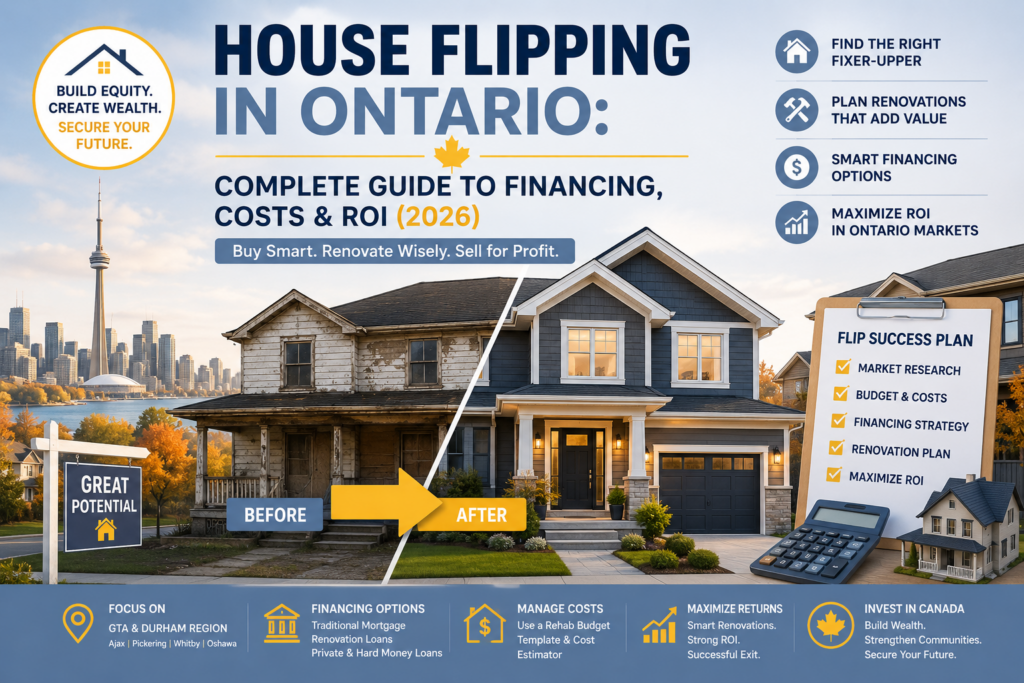
House flipping has become one of Canada’s most popular real estate investment strategies. With strong demand for updated homes across Ontario, especially in the Greater Toronto Area (GTA) and Durham Region, many investors are looking for opportunities to buy, renovate, and sell homes for a profit.
While television shows make house flipping look easy, successful investors know it requires careful planning, accurate budgeting, smart financing, and a solid understanding of the local housing market.
Whether you’re buying your first fixer-upper property or expanding your investment portfolio, this guide explains everything you need to know about house flipping in Ontario.
What Is House Flipping?
House flipping is the process of purchasing a property below market value, renovating or improving it, and selling it for a higher price within a relatively short period.
Most successful flips involve:
- Buying undervalued homes
- Completing cost-effective renovations
- Increasing the property’s market value
- Selling before carrying costs become too high
The goal is simple:
Buy low. Renovate wisely. Sell for profit.
Why Ontario Is an Excellent Market for House Flipping
Ontario continues to attract investors because of its growing population, strong employment opportunities, and consistent housing demand.
Some of the best opportunities can be found in:
- Toronto
- Mississauga
- Brampton
- Markham
- Vaughan
- Ajax
- Pickering
- Whitby
- Oshawa
- Clarington
Durham Region has become particularly attractive because buyers continue searching for more affordable alternatives to Toronto while enjoying convenient GO Transit access and expanding infrastructure.
Neighbourhood revitalization and increasing demand create opportunities for experienced investors who can identify homes with renovation potential.
How to Find Profitable Fixer-Upper Properties
Finding the right property is often the most important step in a successful flip.
Look for:
- Cosmetic renovation opportunities
- Older kitchens and bathrooms
- Outdated flooring
- Poor curb appeal
- Estate sales
- Bank-owned properties
- Distressed real estate
- Motivated sellers
Avoid properties with major structural issues unless you have extensive renovation experience and a reliable contractor team.
Understanding Distressed Real Estate
Distressed real estate refers to properties experiencing financial or physical challenges, including:
- Power of Sale homes
- Estate properties
- Vacant homes
- Homes needing extensive maintenance
- Inherited properties
- Deferred maintenance properties
These homes often provide opportunities to purchase below market value.
However, buyers should always complete:
- Home inspections
- Title searches
- Contractor estimates
- Environmental reviews when necessary
How Much Money Do You Need to Flip a House?
Many new investors underestimate the total investment required.
Besides the purchase price, consider:
Purchase Costs
- Down payment
- Land Transfer Tax
- Legal fees
- Appraisal
- Inspection
Renovation Costs
- Roofing
- Flooring
- Kitchens
- Bathrooms
- Windows
- Electrical
- Plumbing
- Painting
- Landscaping
Holding Costs
- Mortgage payments
- Property taxes
- Insurance
- Utilities
- Interest expenses
Selling Costs
- REALTOR® commissions
- Legal fees
- Staging
- Marketing
Every dollar spent affects your final profit.
House Flipping Financing Options in Canada
Choosing the right financing is one of the biggest decisions for any investor.
Traditional Mortgage
Ideal for:
- Strong credit
- Stable income
- Longer renovation timelines
Advantages include lower interest rates but stricter qualification requirements.
Renovation Loans
Many lenders offer renovation financing that combines purchase and improvement costs into one mortgage.
These loans are ideal when:
- Renovations are planned immediately
- Improvements increase market value
- You qualify under standard lending guidelines
Private Lenders
Private lenders provide faster approvals when:
- Time-sensitive purchases arise
- Credit challenges exist
- Traditional financing is unavailable
Although interest rates are generally higher, speed can make the difference between winning and losing a competitive property.
Hard Money Loans
Some experienced investors use hard money loans for short-term projects.
Benefits include:
- Fast funding
- Flexible qualification
- Asset-based lending
However, these loans usually carry significantly higher interest rates and fees. They work best when renovations and resale timelines are short.
Should You Use the BRRRR Method Instead?
Some investors choose the BRRRR method, which stands for:
- Buy
- Renovate
- Rent
- Refinance
- Repeat
Instead of selling immediately, investors refinance after renovations and use the recovered equity to purchase another property.
This strategy can help build long-term wealth while generating rental income.
Choosing between house flipping and the BRRRR method depends on:
- Cash flow goals
- Market conditions
- Financing options
- Risk tolerance
Renovations That Deliver the Best Home Renovation ROI
Not every renovation increases resale value.
The highest-return improvements often include:
Kitchen Updates
Modern cabinets, countertops, lighting, and appliances consistently attract buyers.
Bathroom Renovations
Updated bathrooms often deliver excellent returns.
Flooring
Replacing old carpet with luxury vinyl or hardwood-style flooring can dramatically improve buyer appeal.
Fresh Paint
Neutral colours make homes appear brighter and larger.
Curb Appeal
Landscaping, exterior lighting, front doors, and driveways create stronger first impressions.
Energy Efficiency
Modern windows, insulation, and high-efficiency HVAC systems appeal to today’s buyers while lowering operating costs.
Create a Realistic Rehab Budget Template
Successful investors rarely guess renovation costs.
A basic rehab budget template should include:
| Category | Estimated Budget |
|---|---|
| Kitchen | $25,000 |
| Bathrooms | $18,000 |
| Flooring | $12,000 |
| Electrical | $8,000 |
| Plumbing | $7,000 |
| Paint | $6,000 |
| Exterior | $10,000 |
| Landscaping | $5,000 |
| Contingency (10–15%) | Variable |
Always include a contingency fund for unexpected repairs.
Use a House Flipping Cost Estimator Before Buying
One of the biggest mistakes investors make is focusing only on renovation costs.
A complete house flipping cost estimator should include:
- Purchase price
- Closing costs
- Renovations
- Financing costs
- Property taxes
- Insurance
- Utilities
- Realtor fees
- Legal fees
- Contingency reserve
Knowing your true investment helps prevent unpleasant surprises later.
Common House Flipping Mistakes
Many first-time investors lose money because they:
- Overpay for the property
- Underestimate renovation costs
- Ignore permit requirements
- Choose poor contractors
- Over-improve the home
- Forget holding costs
- Misjudge neighbourhood demand
- Skip professional inspections
Careful planning significantly reduces these risks.
Tax Considerations in Canada
Profits from house flipping may be fully taxable depending on your circumstances.
The Canada Revenue Agency (CRA) considers several factors when determining whether profits are treated as business income or capital gains.
Investors should always consult qualified accounting and tax professionals before purchasing investment properties.
Why Mortgage Pre-Approval Matters
A mortgage pre-approval strengthens your position when making offers.
Benefits include:
- Knowing your purchasing power
- Faster offers
- Greater negotiating confidence
- Reduced financing uncertainty
In competitive GTA markets, pre-approved buyers often move much faster than those arranging financing after an offer is accepted.
Is House Flipping Right for First-Time Investors?
House flipping can be rewarding, but it is not risk-free.
It may be suitable if you:
- Have available capital
- Understand renovation costs
- Can manage contractors
- Have financing arranged
- Understand local housing markets
- Can handle unexpected expenses
If you’re new to investing, working with experienced mortgage professionals, real estate agents, lawyers, contractors, and accountants can significantly improve your chances of success.
House Flipping Opportunities in Durham Region
Durham Region continues attracting investors because of:
- Relative affordability
- Population growth
- Infrastructure investment
- Transit expansion
- Strong buyer demand
Cities including Ajax, Pickering, Whitby, and Oshawa continue offering opportunities for carefully selected renovation projects.
Neighbourhood research remains essential because property values can vary significantly within the same municipality.
Choosing the Right Mortgage Strategy
Every investment property is different.
The ideal financing solution depends on:
- Purchase price
- Renovation budget
- Exit strategy
- Credit profile
- Income verification
- Property type
- Investment experience
Working with an experienced Ontario mortgage broker gives you access to multiple lenders, helping you compare financing options instead of relying on a single institution.
Is house flipping legal in Ontario?
Yes. Investors can legally buy, renovate, and sell homes, provided they comply with municipal bylaws, building permits, tax rules, and financing requirements.
How much profit should I expect?
Profit varies depending on purchase price, renovation quality, financing costs, and market conditions. Every project should be evaluated individually.
Can self-employed investors qualify?
Yes. Many lenders offer mortgage solutions for self-employed borrowers, although documentation requirements vary.
Are renovation loans available in Canada?
Yes. Several Canadian lenders provide mortgage products that include renovation financing for eligible properties.
Should I flip or rent?
Flipping may generate quicker profits, while renting can provide long-term cash flow and equity growth. The right choice depends on your financial goals.
Final Thoughts
House flipping can be an effective way to build wealth when supported by careful research, realistic budgeting, and the right financing strategy. Ontario—particularly the GTA and Durham Region—continues to offer opportunities for investors who understand local market conditions and focus on properties with genuine value-add potential.
Before making an offer, take the time to estimate renovation costs, review financing options, and develop a clear exit strategy. A well-planned project is far more likely to deliver a positive return than one driven by emotion or unrealistic expectations.
If you’re considering purchasing a fixer-upper, exploring renovation loans, refinancing an existing property, or comparing house flipping financing options, speaking with an experienced Ontario mortgage professional can help you identify the most suitable lending solution for your investment goals.
Written by Satish Kumar, Mortgage Agent Level 2 (Lic. M21004863) with Mortgage Architects (Brokerage FSRA #12728); this content is for informational purposes only and does not constitute formal financial advice.