
Commercial Mortgages: Your Guide to Smarter Business Financing in Ontario
Whether you’re buying your first commercial property, expanding your business, or building a real estate investment portfolio, choosing the right commercial mortgages can make a significant difference to your long-term success.
Commercial financing is very different from residential mortgages. Lenders look beyond your personal income and carefully review your property’s value, business performance, cash flow, and future potential.
If you’re investing in Ontario—especially throughout the Greater Toronto Area (GTA), Durham Region, Ajax, Pickering, Whitby, and Oshawa—understanding how commercial mortgages work can help you secure better terms and avoid costly mistakes.
This guide explains everything you need to know.
What Is a Commercial Mortgage?
A commercial mortgage is a loan used to purchase, refinance, construct, or renovate income-producing or business-related properties.
Unlike residential mortgages, commercial financing focuses heavily on the property’s ability to generate income.
Commercial properties include:
- Office buildings
- Retail plazas
- Industrial buildings
- Warehouses
- Apartment buildings (5+ units)
- Medical and dental clinics
- Restaurants
- Hotels
- Mixed-use properties
- Self-storage facilities
Many Ontario business owners also use commercial mortgages to purchase the buildings where they operate their businesses instead of leasing.
Who Needs Commercial Mortgages?
Commercial financing is ideal for:
- Business owners
- Commercial real estate investors
- Self-employed professionals
- Medical practitioners
- Dentists
- Franchise owners
- Manufacturers
- Retail businesses
- Developers
- Multi-family property investors
Whether you’re buying your first commercial building or expanding an existing portfolio, the right financing strategy can improve cash flow and accelerate long-term wealth.
How Commercial Mortgages Work in Canada
Commercial lenders evaluate several important factors before approving financing.
These include:
- Property location
- Property type
- Rental income
- Business financial statements
- Debt Service Coverage Ratio (DSCR)
- Net Operating Income (NOI)
- Down payment
- Credit history
- Industry experience
- Property appraisal
Most lenders finance between 65% and 85% of the property’s value depending on the asset, borrower profile, and lender guidelines.
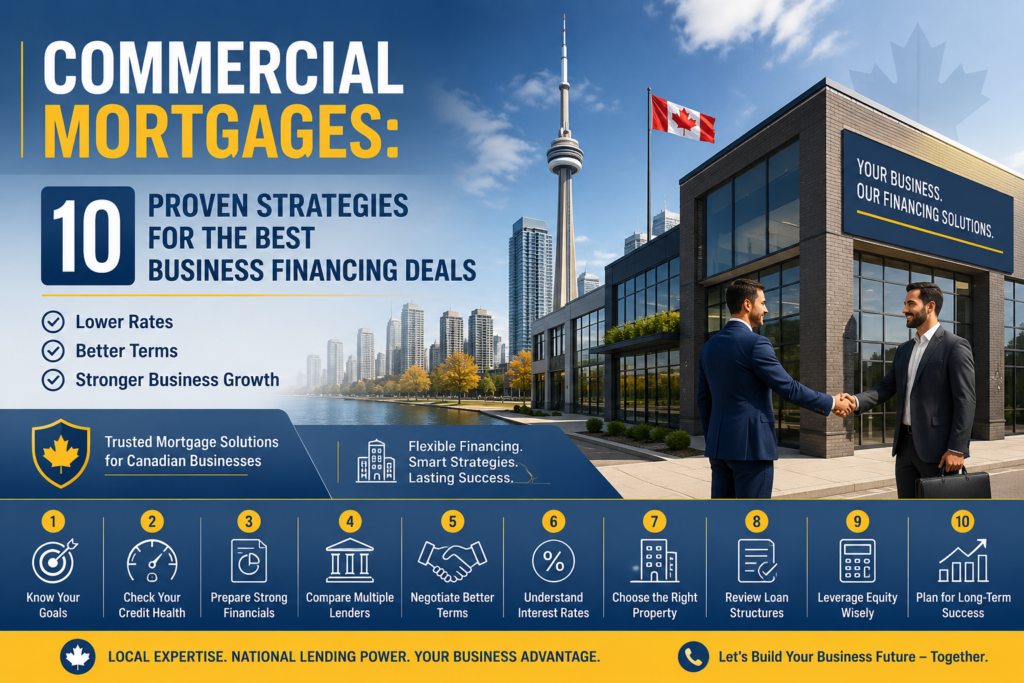
10 Proven Strategies for Better Commercial Mortgage Financing
1. Improve Your Business Financials
Lenders prefer borrowers with:
- Strong annual revenue
- Stable profits
- Healthy cash flow
- Low business debt
Organized financial statements increase lender confidence and improve approval odds.
2. Increase Your Down Payment
A larger down payment often leads to:
- Lower interest rates
- Better lender options
- Smaller monthly payments
- Higher approval chances
Commercial buyers commonly invest between 20% and 35% as a down payment.
3. Choose the Right Property
Not every commercial property receives the same financing.
Lenders generally favour:
- Medical buildings
- Multi-unit apartments
- Industrial properties
- Professional offices
- Established retail plazas
Special-purpose properties may require larger down payments.
4. Maintain Strong Credit
Although commercial lending emphasizes business performance, your personal and corporate credit history still matters.
Good credit can help you:
- Qualify faster
- Negotiate lower rates
- Access additional lenders
5. Understand Your Debt Service Coverage Ratio (DSCR)
One of the most important lending metrics is the Debt Service Coverage Ratio (DSCR).
It measures whether the property’s income can comfortably cover mortgage payments.
A stronger DSCR often results in:
- Better financing terms
- Higher loan amounts
- Reduced lending risk
6. Compare Multiple Lenders
Different lenders have different lending policies.
Options include:
- Major Canadian banks
- Credit unions
- Monoline lenders
- Alternative lenders
- Private lenders
An experienced mortgage broker can compare dozens of lenders to find the most competitive solution.
7. Consider Value-Add Opportunities
Commercial investors often increase property value through improvements.
Examples include:
- Renovations
- Modernization
- Tenant upgrades
- Improved energy efficiency
- Better space utilization
These improvements may significantly increase rental income and overall property value.
8. Use Renovation Financing Strategically
Many investors purchase older commercial buildings that require upgrades.
Similar to residential renovation loans, commercial improvement financing can help fund:
- Building repairs
- Accessibility upgrades
- Interior renovations
- Energy-efficient improvements
Proper planning can significantly improve your home renovation ROI principles when applied to commercial assets by increasing tenant appeal and rental income.
9. Prepare Detailed Financial Projections
Commercial lenders appreciate borrowers who understand their investment.
Prepare:
- Cash flow forecasts
- Expense budgets
- Rental income estimates
- Vacancy assumptions
- Future appreciation plans
Professional planning demonstrates experience and reduces perceived risk.
10. Work with an Experienced Commercial Mortgage Broker
Commercial financing is complex.
A knowledgeable mortgage broker can:
- Structure your financing
- Compare lender programs
- Negotiate competitive rates
- Recommend suitable loan terms
- Help resolve challenging applications
Professional advice often saves both time and money.
Commercial Mortgage Options Available in Ontario
Depending on your project, financing may include:
Conventional Commercial Mortgages
Ideal for stable businesses with strong financials.
CMHC Multi-Unit Financing
Suitable for qualifying apartment buildings and rental housing.
Construction Financing
Designed for new commercial developments.
Bridge Financing
Helps purchase property before long-term financing is finalized.
Private Commercial Mortgages
Useful when traditional lenders decline an application.
Refinancing
Allows property owners to:
- Consolidate debt
- Access equity
- Fund expansion
- Renovate commercial properties
Commercial Mortgages for Real Estate Investors
Many investors begin with residential rental properties before expanding into commercial real estate.
Some also invest in:
- Fixer-upper properties
- Distressed real estate
- Multi-family conversions
Investment strategies such as the BRRRR method (Buy, Rehab, Rent, Refinance, Repeat) demonstrate how improving a property’s value can create additional borrowing power. While the BRRRR strategy is most commonly used with residential rentals, experienced investors sometimes apply similar value-add principles when acquiring smaller commercial properties.
Investors purchasing properties that need significant repairs may also explore financing solutions similar to house flipping financing, renovation loans, or short-term hard money loans, depending on the project’s scope and lender requirements.
Careful planning using a house flipping cost estimator or rehab budget template can help estimate renovation expenses, improve financing discussions, and strengthen your overall real estate investment strategy.
Common Mistakes to Avoid
Many borrowers unknowingly reduce their financing options by making avoidable mistakes.
These include:
- Applying to only one lender
- Underestimating renovation costs
- Poor financial documentation
- Weak cash flow projections
- Buying the wrong property
- Ignoring closing costs
- Waiting until financing becomes urgent
Proper preparation can prevent delays and increase approval success.
Why Commercial Real Estate Remains Attractive in the GTA
Ontario continues to attract businesses and investors due to:
- Population growth
- Expanding infrastructure
- Strong employment markets
- Growing industrial demand
- Increasing rental demand
- Business expansion opportunities
Communities such as Ajax, Pickering, Whitby, Oshawa, Markham, Vaughan, Mississauga, Brampton and Toronto continue to offer excellent opportunities for commercial property owners and investors.
How much down payment is required for a commercial mortgage?
Most lenders require between 20% and 35%, depending on the property type, borrower qualifications, and lender policies.
Can self-employed borrowers qualify?
Yes. Strong business financial statements, cash flow, and industry experience can significantly improve approval chances.
Can I refinance a commercial property?
Absolutely. Refinancing may help lower borrowing costs, access equity, renovate the property, or fund business expansion.
Are commercial mortgage rates higher than residential rates?
Generally, yes. Commercial mortgage rates are influenced by property type, loan size, business risk, and market conditions.
How long is the approval process?
Straightforward applications may receive approval within a few weeks, while more complex transactions can take longer due to appraisals, environmental reviews, and business underwriting.
Final Thoughts
Commercial real estate can be one of the most rewarding long-term investments when financed correctly. Whether you’re purchasing your first office, expanding into industrial space, refinancing an apartment building, or growing a commercial investment portfolio, understanding how commercial mortgages work will help you make informed financial decisions.
Working with an experienced mortgage professional who understands Ontario’s commercial lending landscape can simplify the process, uncover more financing options, and help you secure competitive terms tailored to your goals.
If you’re buying, refinancing, or investing in commercial property anywhere in Ontario—including Toronto, Ajax, Pickering, Whitby, Oshawa, and the Durham Region—professional mortgage advice can make all the difference.
Need Commercial Mortgage Financing in Ontario?
Whether you’re purchasing your first commercial property, refinancing an existing building, or expanding your investment portfolio, I can help you compare financing options from a wide network of Canadian lenders.
Let’s discuss your project and build a financing strategy that supports your business growth and long-term investment success.